
AP: Chavez Wasted His Money on Healthcare When He Could Have Built Gigantic Skyscrapers
Makes Chavez's schools and health clinics look pretty sad, doesn't it? (Photo: Joi Ito)
 By By
One of the more bizarre takes on Venezuelan President Hugo Chavez's death comes fromAssociated Press business reporter Pamela Sampson (3/5/13):
 Chavez invested Venezuela's oil wealth into social programs including state-run food markets, cash benefits for poor families, free health clinics and education programs. But those gains were meager compared with the spectacular construction projects that oil riches spurred in glittering Middle Eastern cities, including the world's tallest building in Dubai and plans for branches of the Louvre and Guggenheim museums in Abu Dhabi. Chavez invested Venezuela's oil wealth into social programs including state-run food markets, cash benefits for poor families, free health clinics and education programs. But those gains were meager compared with the spectacular construction projects that oil riches spurred in glittering Middle Eastern cities, including the world's tallest building in Dubai and plans for branches of the Louvre and Guggenheim museums in Abu Dhabi.
That's right: Chavez squandered his nation's oil money on healthcare, education and nutrition when he could have been building the world's tallest building or his own branch of the Louvre. What kind of monster has priorities like that?
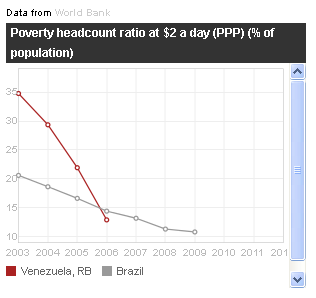
Souce: NACLA's Keane Bhatt
In case you're curious about what kind of results this kooky agenda had, here's a chart (NACLA,10/8/12) based on World Bank poverty stats–showing the proportion of Venezuelans living on less than $2 a day falling from 35 percent to 13 percent over three years. (For comparison purposes, there's a similar stat for Brazil, which made substantial but less dramatic progress against poverty over the same time period.)
Of course, during this time, the number of Venezuelans living in the world's tallest building went from 0 percent to 0 percent, while the number of copies of the Mona Lisa remained flat, at none. So you have to say that Chavez's presidency was overall pretty disappointing–at least by AP's standards.
Saudi threatens to ban WhatsApp, Viber and Skype TUESDAY, 26 MARCH 2013 TUESDAY, 26 MARCH 2013  Internet messenger applications such as Skype, Viber and WhatsApp, used by many migrant workers including Sri Lankans, face being banned in Saudi Arabia if operators fail to allow authorities in the kingdom to censor them, industry sources said. Internet messenger applications such as Skype, Viber and WhatsApp, used by many migrant workers including Sri Lankans, face being banned in Saudi Arabia if operators fail to allow authorities in the kingdom to censor them, industry sources said.Local telecommunication providers have been told to ask the operators of the services to furnish means of control, an official at the kingdom's Communications and Information Technology Commission said, requesting anonymity. Another source at telecom operator Saudi Telecommunications Co. (STC) said the commission gave service providers one week ending on Saturday to respond, warning it would "take measures to ban them" if they failed to comply. An industry source said telecom operators were behind the move, accusing the STC, along with Mobily and Zain, of asking the commission to impose censorship due to the "damage" caused by the free-of-charge applications. In neighbouring UAE, most Skype applications and Viber are blocked but WhatsApp messenger remains accessible. The two countries in 2010 threatened to ban BlackBerry instant messaging and demanded installing local servers to censor the service. The services remain uninterrupted but it was not clear how far the RIM Canadian maker did comply. (Source: Bangkok Post) |
Peace for the World

First democratic leader of Justice the Godfather of the Sri Lankan Tamil Struggle: Honourable Samuel James Veluppillai Chelvanayakam
A Brief Colonial History Of Ceylon(SriLanka)
Tuesday, March 26, 2013
