

The abandoned harvests of 1948: Palestinian farmers remember the Nakba
In 1948, as Palestinians faced what would be known as the 'catastrophe', farmers endured destruction, loss, exile and death
Khadija al-Azza, pctured here in 2019, was forced to flee the village of Tell al-Safi in 1948. The 88-year-old Palestinian has lived for decades in al-Amaari refugee camp in the occupied West Bank (MEE/Skip Schiel)
in al-Amaari refugee camp, occupied West Bank- 14 May 2020
 Life wasn’t easy for Palestinian farmers under the British Mandate. But in 1948, their lives were turned upside down.
For over three decades, between 1917 and 1948, Britain ruled over
Palestine. While the McMahon-Hussein correspondence during World War I
formally promised Arab independence across the region, including for
Palestine, the British government vowed in the Balfour Declaration of
1917 to establish a national home for the Jewish people in Palestine.
Throughout the Mandate, the British faced resistance from both
Palestinians and Zionist militias - as the latter rejected Mandate
policies seeking to slow down the influx of Jewish immigrants, and
progressively became more aggressive in seeking to create their own
state.
On 15 May 1948, Britain withdrew its forces from Palestine, and Zionist
leadership declared the establishment of a state of Israel, ramping up
the ongoing process of the ethnic cleansing of Palestinians.
Palestinians were taken by surprise by the British decision. After 30
years of brutal British repression, they found themselves without
unified leadership, unorganised, and largely unarmed against Zionist
paramilitary groups seeking to establish control.
The subsequent killing of some 15,000 Palestinians, the destruction of
at least 530 villages and towns, and the forcible displacement of around
750,000 Palestinians from their homes would pave the way for Israel to
claim large swathes of land as its own.
While Israelis commemorate Independence Day on 15 May, for Palestinians the events of 1948 and beyond are known as the Nakba - or "catastrophe".
Survivors who spoke to Middle East Eye recalled their memories of escape
from massacres and destruction and the difficult transition to uprooted
lives as refugees.
Abandoned harvests
For the three-quarters of Palestinians at the time living in rural areas in particular, the Nakba upended life as they knew it.
The British retreat and subsequent ethnic cleansing of Palestinians
coincided with the harvest season, the loss of which for farmers would
have been a calamity in itself.
Khadija al-Azza, 88, recalled the moment when Zionist militias attacked her village, Tell al-Safi.
"It was mid-summer, and the farmers had already piled the wheat on the
threshing floor when Jewish armed gangs attacked the village, killing
many farmers,” she said. “Terrified villagers fled and left the heaps of
wheat unthreshed. We thought that we would return to thresh it.”

Saeed Dandan, 87, shares similar memories of the moment when his village, Tiret Dandan, was occupied.
“It was the third day of Ramadan when Jewish militiamen raided our
village,” he said. “The villagers were about to harvest their corn but
were forced to flee. We left our sheep behind and never retrieved them.”
Many displaced farmers tried to sneak back into their villages to
salvage whatever crops, livestock or goods they could from their
abandoned homes. But to do so was to run the risk of getting shot by
Zionist militias. Some farmers succeeded. Others found their villages
destroyed. Others still were shot dead.
Zakia Hamad, 91, was among those who fled the village of Saris, west of Jerusalem, for nearby Beit Susin.
"The villagers infiltrated into Saris at night in order to harvest their
crops,” she said. “They would reap them at night and go back to Beit
Susin to sleep during the day.
“They winnowed and pounded the grains with their hands inside their homes because if the Jews saw them, they would shoot.”
Mustafa Abu Awad, 83, was a child when his village of Sabbarin near Haifa was attacked by militias on 12 May 1948.
"After 10 days, I tried to return with my older brother and arrived at
the nearby village of Umm al-Shouf,” he recalled. “We found our village
surrounded by (Zionist) gangs and saw 13 of my fellow villagers dead. We
couldn’t enter the village so we turned back around. We thought that it
was a matter of days before Arab armies would reclaim our village and
we could return home.”
An uneven fight
Left to their own devices, Palestinians set up local defence committees
in every village, equipped only with old guns carried by untrained
farmers. Farmers sold their harvests and women parted with their
jewellery in order to buy weapons to protect themselves.
But for the most part, their efforts were no match for the Zionist
militias seeking to push them out. News of the Deir Yassin massacre -
during which more than 100 villagers were killed on 9 April - spread
quickly among Palestinians, sowing fear and playing a decisive role in
convincing many people to flee before they met the same fate.

"Villagers heard of the massacre in the nearby village of Deir Yassin,
and feared murder and the rape of women,” recalls Shaker Odeh, 87, from
the village of al-Maliha. “My father asked my sisters and my mother to
leave the village and since I was a child, I followed them to Beit Jala.
That same night, my father joined us after al-Maliha was occupied by
Zionists."
Odeh recounted the capture of Maliha thusly: "When the Zionists attacked
Maliha, there were few (Palestinian) fighters, armed only with old
Egyptian rifles. Each fighter only had five bullets, some of which were
not suitable for use, in addition to being extremely expensive (half a
Palestine pound). They tried to defend the village, but they couldn’t
stand their ground."
The decision to leave their homes was extremely difficult, one that
families did not take unless they felt no other options remained.
But many Palestinians thought the situation would be temporary, only the
matter of a few days. As a result, most fled to places close to their
villages, carrying few belongings and supplies.
Shukria Othman, 86, said her father was shot dead near the family home during the attack on the village of Lifta.
“My eldest brother decided that we should leave immediately, like most
of the other villagers,” she said. “But one of the farmers, Abu Rayya,
didn’t leave as he wanted to stay on his farm where he had planted okra
and beans. Then the (Zionist) gangs came and slaughtered him.
“We left in a hurry, taking only two mattresses and two blankets,” she
recounts with sorrow. “We left behind jars of olive oil and our
chickens. All our belongings and supplies were left behind as we
believed that we would return in a few days”.
The road of exile
Like many others, Azza’s journey into exile after the attack on Tell
al-Safi on 9 July 1948 was extremely difficult and involved repeated
displacement.
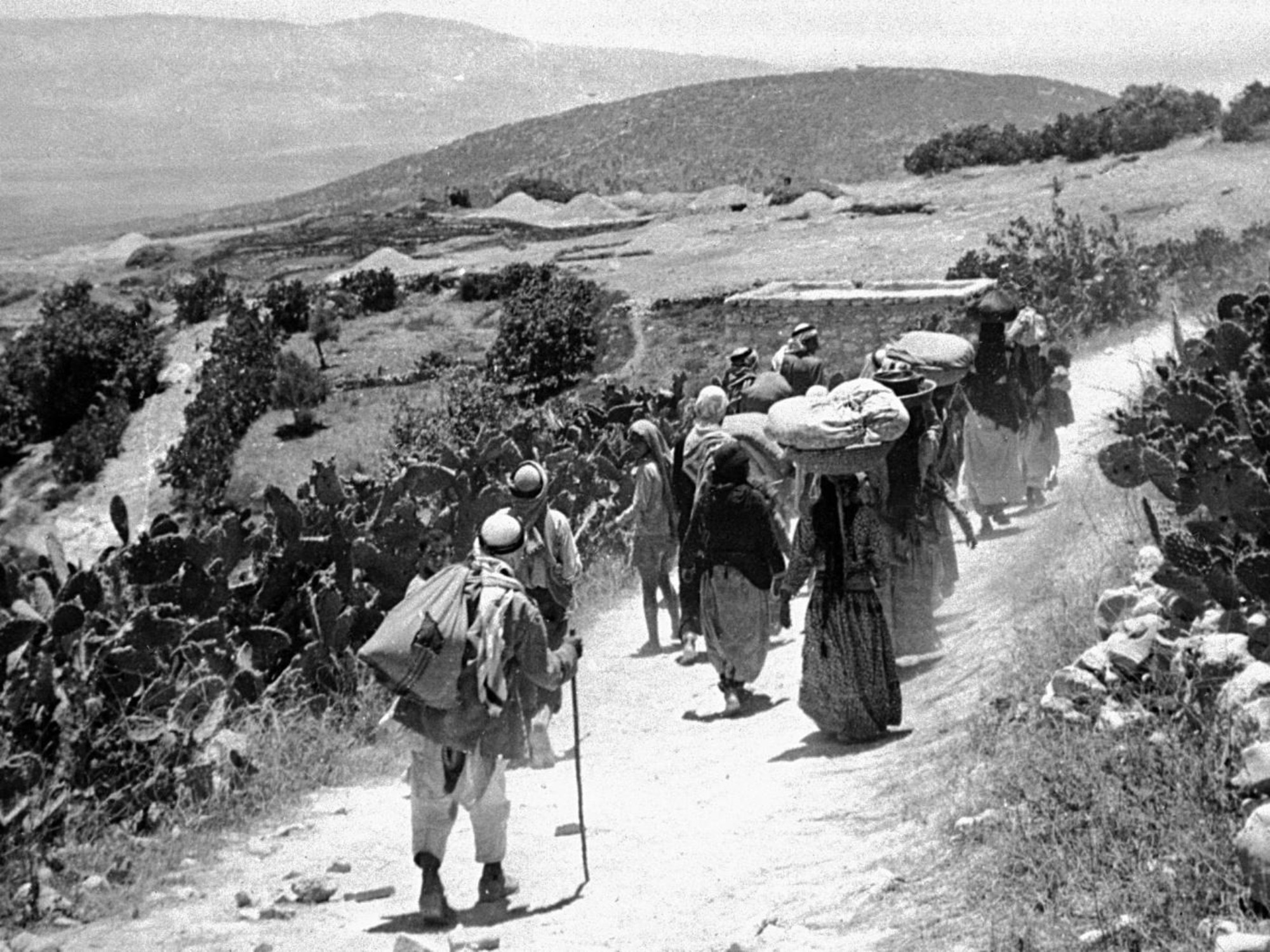
“We left on foot, carrying nothing with us. After walking one day and
one night, we got to the village of Ajjur, where farmers kindly received
us in their homes,” she said. “We spent three days there, then the
Zionist gangs attacked Ajjur and we fled to the east.
“We walked for two days without water until we reached Beit Jibrin.”
They remained in Beit Jibrin for a few months until that village was also attacked by Zionist militias in October 1948.
There, Palestinians and their Arab allies fought back for many days.
"The Zionist militias bombarded the town with artillery and warplanes,
forcing people to flee towards caves in the hills. They entered the town
from the west and we fled from the east. We walked for five days and
five nights until we arrived in Hebron," Azza added.
Maryam Abu Latifa, 91, recalls a similarly harrowing escape from the village of Saraa, west
of Jerusalem, in July 1948. Villagers tried to defend their homes, but
couldn’t; so they escaped in the middle of the night towards nearby
hills.
“I locked the door of my home and left, but then I remembered I had left
behind my six-month-old baby Yassin,” she said. “So I returned to the
house to get him and ran towards the hills in the dark.”
The residents of Saraa sheltered under trees for days, hoping to come
back home. But after two weeks, Israeli paramilitary groups arrived with
bulldozers and razed the village under their eyes, Abu Latifa said. The
villagers lost all hope of return and left on foot for Beit Nattif - a
village that would also end up being turned into rubble a few months
later.
Yearning for return
After fleeing from one village to another, displaced farmers found
themselves in refugee camps, where their agricultural knowledge and
experience were no longer useful.
In order to make a living, most had to take on new lines of work.
“After the Nakba, some refugee farmers in the Qalandiya camp worked as
construction labourers in nearby areas,” Hamad said. “Others worked as
guards at the Qalandiya airport, others as tourist guides.”

As Palestinian refugees have been born, lived, and died for over 70
years in camps made of concrete, they have slowly lost much of the
agricultural knowledge that had previously been passed down from
generation to generation.
The Nakba resulted not only in the physical displacement of the farmers,
but also in the loss of parts of their identity, of their ties to the
land.
As 2020 marks 72 years since the beginning of the Nakba, survivors still yearn to return home and cultivate their fields.
Azza, who now lives in the al-Amaari refugee camp near Ramallah in the
occupied West Bank, still bemoans the heap of wheat that was left
unthreshed.
“I wish the time will come when I will be able to return and die in my hometown,” she said.
