

PODCAST: Deciding the fate of Palestinians — without Palestinians
The callousness of Trump’s 'Deal of the Century' mirrors the racism targeting Palestinians in Israeli politics, says human rights lawyer Diana Buttu.
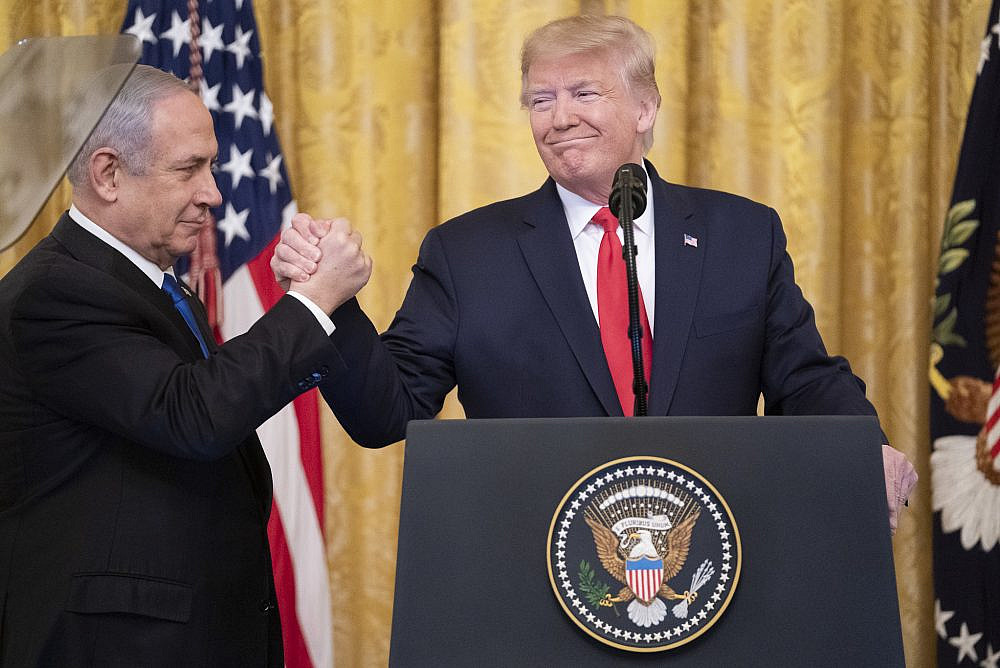 U.S. President Donald Trump delivers remarks with Israeli Prime Minister Benjamin Netanyahu Tuesday, Jan. 28, 2020, in the East Room of the White House to unveil details of the Trump administration’s Middle East plan. (Shealah Craighead/White House)
 Listen here: iTunes/Apple Podcasts | Google Play | Spotify
 ByAmjad Iraqi-March 6, 2020
A month after U.S. President Donald Trump unveiled his Middle East plan, Israelis went to the polls for a third time in a year. While Israeli Prime Minister Benjamin Netanyahu was quick to declare victory, not much has shifted the deadlock from the previous two rounds, and no party is able to form a government yet.
For Diana Buttu, Palestinian human rights lawyer, analyst, and former advisor to the Palestine Liberation Organization, the contents of the “Trump-Netanyahu plan,” as she calls it, are cause for alarm.
The arrogance that characterizes the deal, which deliberately excludes Palestinians from the conversation, reflects an Israeli “fantasy” that “somehow Palestinians are going to agree to their own subjugation,” says Buttu. That exclusion is compounded by the Palestinian Authority’s failure to effectively respond to the plan, she explains.
Palestinian President Mahmoud Abbas is “focused on the plan as a means of just continuing the process of doing nothing,” which has “tremendous consequences” for Palestinians, adds Buttu.

For Buttu, this was one of the reasons Palestinians in Israel voted in even greater numbers this time around. That fact that Netanyahu’s rival, Benny Gantz of the Blue and White party, supports the Trump deal and echoes many of Likud’s policies shows “just how far to the right Israeli society is.”
Despite — or perhaps because of — mounting racist attacks, the Palestinian-led Joint List won a record 15 seats, making it the third-largest party once again. But now, its members must decide how to use this political capital.
For some, explains Buttu, this is an opportunity to get rid of Netanyahu — a promise the Joint List has campaigned on. Others believe the List should not “go down the path of being the ‘kingmakers’ in Israeli politics,” which is still centered on the oppression of Palestinians.
