

Economic stimulus: Challenge for governments
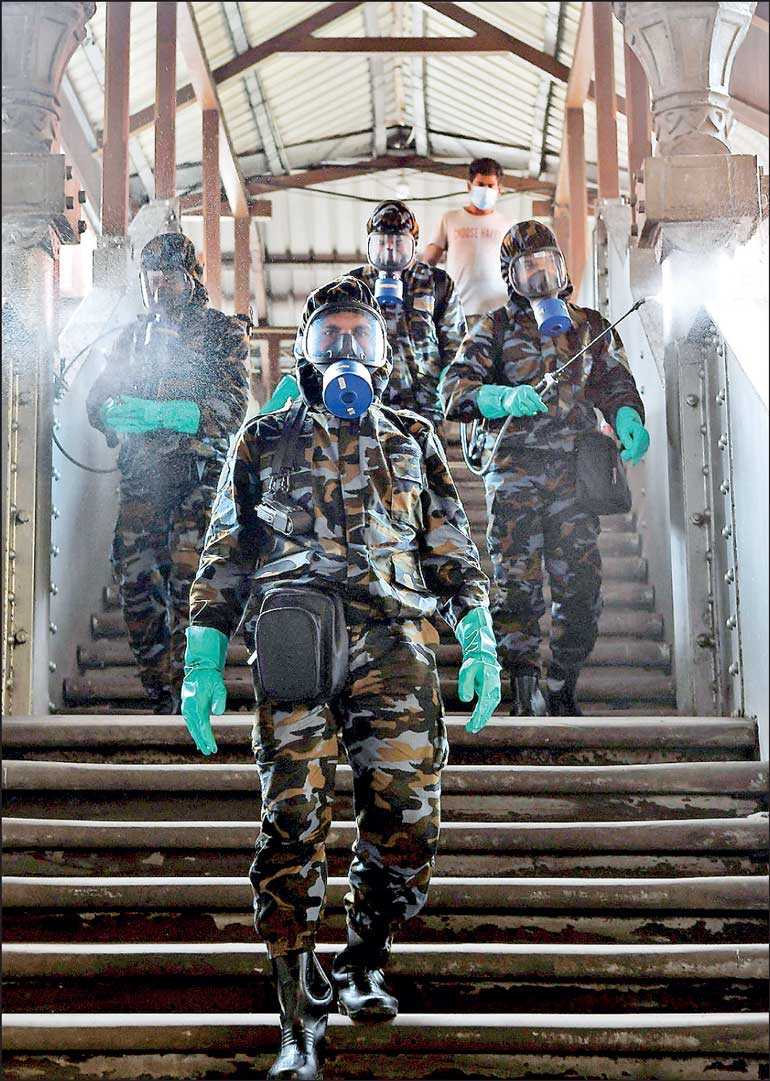
The stock market crash was caused by the coronavirus
– Pic by Shehan Gunasekara
 Friday, 20 March 2020
The news of emptied toilet paper shelves at supermarkets that extended to essentials shows the panic in many families to stock up to survive the next three to six months. Furthermore stock markets have suffered their worst day since the 2008 financial crisis, as shares plunge worldwide amid fears of a global downturn.
According to the World Health Organization the number of reported cases of the coronavirus disease has crossed 220,000 globally, several measures taken by countries to slow down the spread of the virus — such as closing borders and keeping people at home — have in many ways hit the real economy, with experts now warning of a recession. So, countries globally are facing an unprecedented crisis of a gigantic proportion.
Many governments have launched stimulus packages to cushion the outbreak’s economic hit to businesses and households. The stimuli unfortunately don’t directly address the immense task of dealing with the virus itself, which continues to spread through the population at every level.

As the number of cases rises, medical systems could easily become overwhelmed and perform below expectations. The travel and leisure industries are already facing a huge slump in demand. An economic essential now is to prevent a collapse of the financial system, as businesses and individuals will get pushed to delay their loan payments.
Central banks round the world will need to take significant steps to stabilise the Treasury-bond market and the market for short-term inter-bank loans. In part, this may involve providing government guarantees for loans that stricken businesses have already taken out, or else issuing them new ones. Many smaller firms may also need help.
In the US for example there is a move from the Trump Administration to provide low- or no-interest loans for companies of all sizes that have been negatively affected by coronavirus-related supply chain disruptions, and to avoid layoffs and work time reductions. The Australian Government for example is giving small and medium sized enterprises up to Australian $ 25,000 to help them cover their payrolls. New Zealand is looking at $ 12.1 billion while Prime Minister Boris Johnson announced his Government’s £ 330 billion package to support businesses.
 Options for governments
 The real challenge for most governments now is that while they do more and more to flatten the infection curve, they are steepening the recession curve. The public want the right health related measures, to save lives and ensure vital aid necessary to guarantee the health services related capacity to deal with the threats posed by COVID-19.The worry load right now on a full scale economic all out is not yet fully understood for many reasons and it will however increase exponentially once the pandemic shows signs of being controlled and the infected numbers start to drop like in China.
In many markets the economic stimulus packages are expected to cover paid sick leave; maintenance of income to cover the cost of housing, electricity, food and other essential items. This is seen as a strategy to sustain jobs and the economy, protect wages, the welfare of workers, and small businesses.
There are many good lessons to adopt from the financial crisis of 2008 for governments. For example, income support for poor families to ride over the crisis is far more effective because it also helps small businesses in many ways.
The other challenge for governments would be that even if they provide nil borrowing costs it will not motivate factory owners to re-start operations in factories that cannot source raw materials from their suppliers, or whose workers are ill, quarantined or simply afraid of contracting the virus in their workplace or as they travel using public transport to their workplaces.
Therefore the challenge is manifold; while we still have a lot to learn as to how this pandemic is developing, yet for now it is far more important to do whatever it takes to force down the infection curve while minimising the impact on the economy in the short term with targeted stimulus.
