

Coronavirus live news: Spain set to extend state of emergency after 394 new deaths
First two cases in Gaza; Saudi Arabia cases pass 500; Italy shuts all Australia shuts pubs and cinemas but schools stay open; Italy warns of worst crisis since WWII; India launches curfew- UK coronavirus: follow latest updates live
- US coronavirus latest updates
- Germany’s low coronavirus mortality puzzles experts
- Meet the experts who are now household names
- See all our coronavirus coverage
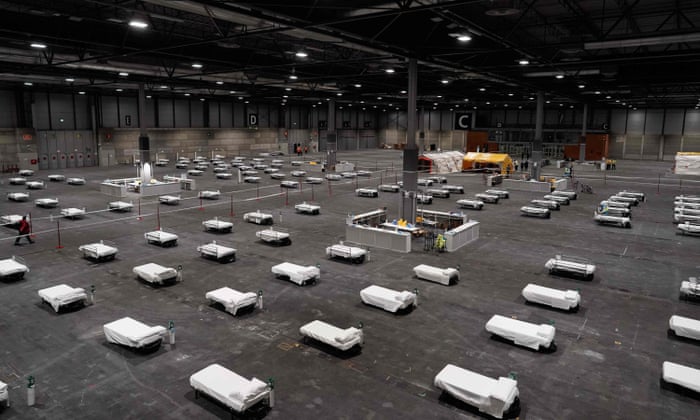 A temporary hospital set up at a convention centre in Madrid. Photograph: COMUNIDAD DE MADRID/AFP via Getty Images
Hannah Mays (now) and Haroon Siddique and Helen Davidson (earlier)

Spain’s prime minister has called for the European Union to roll out its own “Marshall Plan,” describing a program of public investment capable of countering the deep economic blow of the crisis.
The country has emerged as one of the hardest hit in Europe, with the death toll soaring to 1,720. The country has 28,572 confirmed cases – a number that is expected to rise in the coming days as expanded testing is rolled out.
Officials have warned that the worst is yet to come. “We’re in a critical moment, the days ahead will be hard,” the prime minister, Pedro Sánchez, said in a televised address on Saturday. “We have to ready ourselves psychologically and emotionally.”
Around 12% – or 3,475 of the confirmed cases – are doctors, nurses and others on the frontlines of the coronavirus battle, the head of Spain’s health emergency centre, Fernando Simón said Sunday. Earlier this week, Spain lost its first healthcare worker to the virus: A 52-year-old nurse from the Basque Country.
As the government scrambles to contain the virus, a near-total lockdown has been imposed with residents ordered to stay in their homes save for essential trips. Sánchez said on Sunday that he would seek to extend the emergency measures until 11 April.
He also announced additional measures, including a 30-day restriction on travellers arriving from non-EU countries, save for those on essential travel. As well, regional governments will be given the power to take control of private care homes amid concerns that the unchecked spread of the virus in care facilities could be linked to the deaths of at least 100 people.
While the country struggles to contain the virus, many worry about the economic impact it will have on a country where the unemployment rate already ranks among the highest in the industrialised world.
Praising the EU’s response to the crisis so far, Sánchez called for an EU-wide plan aimed at reinvigorating the economies of member states. “We need to articulate a grand Marshall Plan of reconstruction,” he said.
“Europe is at war against the coronavirus. And we have to respond with all of our weapons, with all our tools.”
The country has emerged as one of the hardest hit in Europe, with the death toll soaring to 1,720. The country has 28,572 confirmed cases – a number that is expected to rise in the coming days as expanded testing is rolled out.
Officials have warned that the worst is yet to come. “We’re in a critical moment, the days ahead will be hard,” the prime minister, Pedro Sánchez, said in a televised address on Saturday. “We have to ready ourselves psychologically and emotionally.”
Around 12% – or 3,475 of the confirmed cases – are doctors, nurses and others on the frontlines of the coronavirus battle, the head of Spain’s health emergency centre, Fernando Simón said Sunday. Earlier this week, Spain lost its first healthcare worker to the virus: A 52-year-old nurse from the Basque Country.
As the government scrambles to contain the virus, a near-total lockdown has been imposed with residents ordered to stay in their homes save for essential trips. Sánchez said on Sunday that he would seek to extend the emergency measures until 11 April.
He also announced additional measures, including a 30-day restriction on travellers arriving from non-EU countries, save for those on essential travel. As well, regional governments will be given the power to take control of private care homes amid concerns that the unchecked spread of the virus in care facilities could be linked to the deaths of at least 100 people.
While the country struggles to contain the virus, many worry about the economic impact it will have on a country where the unemployment rate already ranks among the highest in the industrialised world.
Praising the EU’s response to the crisis so far, Sánchez called for an EU-wide plan aimed at reinvigorating the economies of member states. “We need to articulate a grand Marshall Plan of reconstruction,” he said.
“Europe is at war against the coronavirus. And we have to respond with all of our weapons, with all our tools.”
Angela Merkel in quarantine

Greece’s prime minister has announced that as of 6 AM tomorrow a curfew will come into effect nationwide. In a televised address - his third in less than a week - Kyriakos Mitsotakis said the measure will prohibit “the circulation and movement of citizens” deemed to be “purposeless” - the strictest restriction, yet, in the fight to contain the novel coronavirus spreading further.
“It is perhaps the last step that an organised democratic state [can take],” he said. “ A step which must be taken in time, so that it is not taken in vain, because time isn’t counted, any more, in days but in hours,” he told the nation adding that in Italy, every two minutes, a life was now being lost to Covid-19.
Exceptions to the rule would be made for citizens going to and from work; for the provision of food and medicine; for visits to a doctor and for those who needed care; for those exercising individually, or with one other person, and for people walking dogs. Those travelling to their permanent place of residence would also be exempt from the measure.
But once enforced anyone out on the streets would have to have their passports or identity cards with them at all times, the centre right leader said insisting that the full force of the law would be imposed on those who violated the restriction. Fines of 150 euro will be given in the case of infractions.
Although Greece has managed to contain the spread of Covid-19 infections, numbers are going up and privately officials say they expect a big leap in the coming days. On Sunday, health authorities announced that in the past 24 hours there had been 94 new cases of people testing positive for the virus with a total of 624 confirmed coronavirus cases countrywide. To date, 15 people have died from the disease (with the exception of three, all men). Altogether 124 have been hospitalised with 34 requiring intensive care - double the figure over that released yesterday. Most of those who have contracted the virus are in Athens. The average age of those hospitalised is 64.
Greece was among the first EU member states to announce draconian measures to stem the virus, starting with the closure of schools on March 10, followed by the shutting of nightclubs, gyms, cinemas and theatres two days later and cafes, restaurants, bars and shopping malls on March 18. All retail shops were ordered closed on March 18. In his address, Mitsotakis thanked the vast majority of Greeks for upholding the restrictions, chastising the “frivolous few [who] undermine the safety of most.”
Greeks could be seen in droves converging on beaches on Saturday to enjoy the warm weather. A mass exodus of residents from Athens and other urban centres to villages in the countryside has also alarmed authorities who fear transmission rates spreading to remote areas nationwide.
“It is perhaps the last step that an organised democratic state [can take],” he said. “ A step which must be taken in time, so that it is not taken in vain, because time isn’t counted, any more, in days but in hours,” he told the nation adding that in Italy, every two minutes, a life was now being lost to Covid-19.
Exceptions to the rule would be made for citizens going to and from work; for the provision of food and medicine; for visits to a doctor and for those who needed care; for those exercising individually, or with one other person, and for people walking dogs. Those travelling to their permanent place of residence would also be exempt from the measure.
But once enforced anyone out on the streets would have to have their passports or identity cards with them at all times, the centre right leader said insisting that the full force of the law would be imposed on those who violated the restriction. Fines of 150 euro will be given in the case of infractions.
Although Greece has managed to contain the spread of Covid-19 infections, numbers are going up and privately officials say they expect a big leap in the coming days. On Sunday, health authorities announced that in the past 24 hours there had been 94 new cases of people testing positive for the virus with a total of 624 confirmed coronavirus cases countrywide. To date, 15 people have died from the disease (with the exception of three, all men). Altogether 124 have been hospitalised with 34 requiring intensive care - double the figure over that released yesterday. Most of those who have contracted the virus are in Athens. The average age of those hospitalised is 64.
Greece was among the first EU member states to announce draconian measures to stem the virus, starting with the closure of schools on March 10, followed by the shutting of nightclubs, gyms, cinemas and theatres two days later and cafes, restaurants, bars and shopping malls on March 18. All retail shops were ordered closed on March 18. In his address, Mitsotakis thanked the vast majority of Greeks for upholding the restrictions, chastising the “frivolous few [who] undermine the safety of most.”
Greeks could be seen in droves converging on beaches on Saturday to enjoy the warm weather. A mass exodus of residents from Athens and other urban centres to villages in the countryside has also alarmed authorities who fear transmission rates spreading to remote areas nationwide.
Colombia’s prisons were rocked by riots and protests overnight, with inmates demanding better protection against the spread of Covid-19 in the South American country’s jails.
Shootouts were heard outside some prisons as videos circulated on social media showing fires and unrest.
One video appears to show armed riot police outside La Modelo prison in Bogotá, the capital, as shots and explosions can be heard inside.
Another video appeared to show a fire raging inside the same prison.
“The authorities must urgently hand over an official report on the protests and riots that occurred last night in the country’s jails,” José Miguel Vivanco, Americas director at Human Rights
Watch, tweeted on Sunday morning. “Many of the detainees demanded conditions to prevent the spread of the coronavirus. They denounce several dead and wounded.”
Prison authorities have not yet reported how many casualties resulted from the disturbances.
Bogotá’s mayor, Claudia López, joined the chorus calling for a report on Sunday morning, tweeting that if authorities don’t “face up and explain [what happened] to families of prisoners, there will be another right, but of distressed families.”
The riots broke out on the same night that Colombia confirmed its first death as a result of Covid-19. On Sunday morning, confirmed cases stood at 231, with two people dying from the disease.
A nationwide quarantine - expanding on those currently in place in cities across the country, including Bogotá - will come into effect at midnight on Tuesday.
Shootouts were heard outside some prisons as videos circulated on social media showing fires and unrest.
One video appears to show armed riot police outside La Modelo prison in Bogotá, the capital, as shots and explosions can be heard inside.
Another video appeared to show a fire raging inside the same prison.
Colombia’s overcrowded prisons have long been hotbeds for organised crime, with violent power struggles between inmates and guards flaring up on occasion. Earlier this month, the government banned visitors to prisons in a bid to isolate inmates from the coronavirus.#NoticiaW II A esta hora se registra un motín en la cárcel modelo de Bogotá >> https://t.co/AMNglsACd7 pic.twitter.com/tZmWfCAAhZ— W Radio Colombia (@WRadioColombia) March 22, 2020
“The authorities must urgently hand over an official report on the protests and riots that occurred last night in the country’s jails,” José Miguel Vivanco, Americas director at Human Rights
Watch, tweeted on Sunday morning. “Many of the detainees demanded conditions to prevent the spread of the coronavirus. They denounce several dead and wounded.”
Prison authorities have not yet reported how many casualties resulted from the disturbances.
Bogotá’s mayor, Claudia López, joined the chorus calling for a report on Sunday morning, tweeting that if authorities don’t “face up and explain [what happened] to families of prisoners, there will be another right, but of distressed families.”
The riots broke out on the same night that Colombia confirmed its first death as a result of Covid-19. On Sunday morning, confirmed cases stood at 231, with two people dying from the disease.
A nationwide quarantine - expanding on those currently in place in cities across the country, including Bogotá - will come into effect at midnight on Tuesday.
