

What the therapist heard: ‘What would you do if your client behaved like a dog?’
After 20 years in practice, a therapist reflects on the conversations he’s had, surprising lessons learned, and the power of silence to soothe the soul
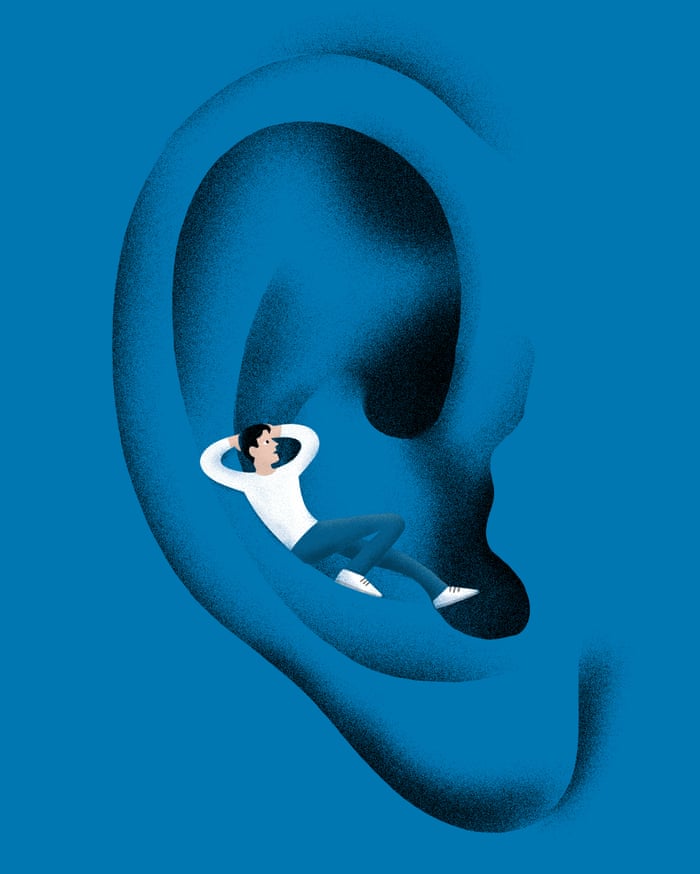
‘I soon learned to say less – much less.’ Illustration: Lo Cole/The Guardian
 Jonathan Izard-
I’m closing my private psychotherapy practice after 20 years. How many conversations have I had with clients over that time? Thousands, and each one different. Sometimes delightful, exciting and energising; often frustrating, disappointing and exhausting. There is no template: the dialogue is minted fresh every time the door opens. So what have I learned?
Getting started: learning to say less
I began my training the week after conducting my father’s funeral. We hadn’t been particularly close, although I suspect we loved each other deeply without being able to express it. I felt in exactly the right place to have discussions about life, death, love, loss and everything that matters deeply but isn’t always easy to express. In healthy, worthwhile therapy we give ourselves permission to go to the risky, shadow side of our lives, client and therapist both.When I began, I’m sure I used to spray words about unnecessarily. I remember wittering on at my first session with Pedro – a real live client! – about my training and background, taking up far too much time. Pedro waited politely but had no need for my waffle. He trusted me to listen to his concerns; trusted me more than I trusted myself.
But I soon learned to say less – much less. Silence is a rare commodity in most of our lives and for a client to sit without the necessity to speak can be a luxury. There can still be meaningful psychological connection. The longest time I spent with a client when neither of us spoke was 18 minutes. It was, he said later, “such a refuge”.
Honesty is the best policy
“Tell the truth” has to be my mantra. Maybe not the whole truth, the whole time. There’s often an internal monologue (Is it too cold in here? She said Brian – is that her husband or her son? How many minutes are there left? Is it better to pick up on that reference now, or shelve it and come back to it later?) but mostly the concentration is total and the process all-consuming. In that space, it can be surprisingly straightforward to tell the immediate, unfiltered truth. To say, “I don’t understand” or, “I’m shocked” or, “Isn’t that different from what you said last week?” Or even: “I’m not sure I entirely believe you.”Which is very different from accusing someone of lying or, worse, being a liar (one is a comment on a single statement, the other a judgment of their character). I might add: “I wonder why that is. What are your thoughts?” or, “Perhaps there’s something else you’re not telling me,” which opens up an inquiry rather than shutting it down. Such a comment can be accepted or easily batted away by the client. It can feel risky, but without risk there will probably not be progress.
