

'The martyr at the barricades': The life and death of one Sudanese protester
Abbas Farah was among scores killed by security forces in Khartoum one month ago. Using footage of the day, MEE tells the story of the young man's final moments

Abbas Farah was one of more than 100 estimated killed as Sudanese forces cracked down on protesters
 Kaamil Ahmed- 3 July 2019
With blood seeping through his yellow shirt, Abbas Farah stumbled with heavy, halting steps towards a barricade. Then he collapsed.
In the first hours of the deadly attack by Sudan’s forces on a peaceful sit-in last month, the image of Farah, somehow still standing after being shot in the stomach, was one of the first and most powerful to emerge of the resistance Sudanese protesters were putting up against the heavily armed military council ruling over them.
Farah later died from his injuries, becoming one of more than 100 killed on 3 June. Through videos and images that have trickled onto social media in the month since then, despite an internet blackout, and by interviewing those who knew him, it is now possible to tell the story of the final hours of Farah's life and how the sit-in he was defending was bloodily dispersed.
'A revolution of ideas'
A 28-year-old engineering graduate, it did not take long for Farah to buy into the uprising that started with economic protests in December 2018, but quickly morphed into opposition to Sudanese President Omar al-Bashir's 30-year rule, the only leader of the country he had ever known.
He spoke to friends and posted philosophically on Facebook about it, describing it as a “revolution of ideas” that had to work “for all Sudanese,” including those marginalised under Bashir’s rule.
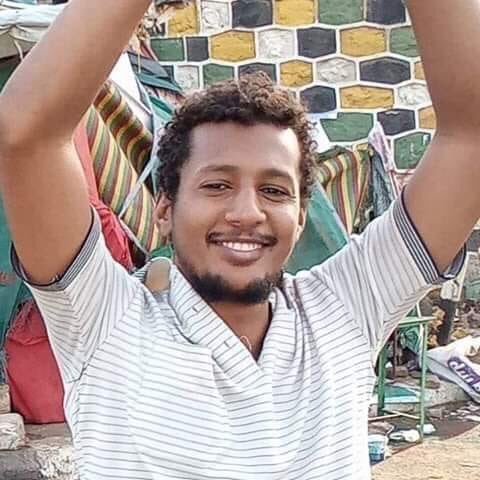
He was also out on the streets himself, long before protesters escalated their campaign with a sit-in on 6 April that took only days to bring down Bashir.
A former neighbour of his told Middle East Eye that one day in March they were filming from their rooftop while protesters were being chased by Sudan’s notorious National Intelligence and Security Service (NISS) when they saw Farah running from the security officers.
They described Farah as someone who was always happy and welcoming to others around him.
"I moved to the neighbourhood we shared in 2007. He was the first person from the block to ask me to join them for a football match and introduced me to everyone and always made sure I was comfortable as a new kid in the block," they said.
When the sit-in started, Farah became a devoted attendee, first protesting against Bashir and then against the military council that replaced him.
“The blood of the martyrs and the establishment of rights is more important than the treasures of the earth,” he wrote on Facebook.
The dispersal
For almost two months, the sit-in at the heart of Khartoum had become almost celebratory. Though it had come under attack from military forces and militias on several occasions, its jubilant atmosphere encouraged families to happily join the protest with their children.
But the sit-in was abruptly and violently dispersed early on the morning of 3 June when Sudanese forces stormed into the camp, firing live ammunition and burning tents, and raping women according to activists' accounts.
The attack was widely blamed on the Rapid Support Forces (RSF) militia force controlled by Mohamed Hamdan Dagolo, the deputy head of the transitional military council known as Hemeti. Footage of the crackdown showed men in RSF uniforms and vehicles taking part, as well as some wearing the uniforms of other branches of the Sudanese security forces.
On social media, a live stream capturing the firing on protesters turned to Farah, stumbling painfully in the opposite direction of the other protesters, who were running to confront the militia fighters firing at them.
