

The Most Dangerous Moment

By Jayantha Somasundaram –APRIL 18, 2019
Jayantha Somasundaram
 “British Prime Minister Winston Churchill considered the most dangerous moment of the Second World War, and the one which caused him the greatest alarm, was when news was received that the Japanese Fleet was heading for Ceylon.” –The Most Dangerous Moment by Michael Tomlinson (1976) William Kimber, London.
This September it will be eighty years since the commencement of the Second World War. For Sri Lanka, with the theatre of war being initially Europe and North Africa, like the Great War before it, this too was a distant war. However with alarming speed, commencing with the Japanese attack on Pearl Harbour in December 1941, the defeat of British forces in Malaya in January 1942 and the fall of Singapore in February, World War II entered the Indian Ocean, and its epicentre British Ceylon.
For Britain the fall of Singapore was the turning point in Asia. The Military Chiefs of Staff in London feared that British interests in the Indian Ocean, traditionally a British lake, were now threatened. Once Singapore surrendered, Ceylon another Island Fortress became Britain’s next line of defence in the east. Hence the Royal Navy’s East Indies Station was relocated to Colombo, with headquarters now at shore base HMS Lanka.
If the Japanese gained control of Ceylon, they would be within striking distance of British oil fields in the Persian Gulf and make vulnerable British lines of sea communication with India and Australia. It was therefore necessary to rapidly build Ceylon’s defences. Initially the 16th Brigade of the British 70thInfantry Division in North Africa was deployed to Ceylon. Later the 21st East African Infantry Brigade Group, supported by two batteries of light howitzers, headed for the island. At Prime Minister Churchill’s request Canberra offered to reassign to Ceylon the 16th and 17th Infantry Brigades of the Australian 6th Division which were en route from Libya to defend Australia.
The Australian troops were under their own commander, Major General Allan Boase, General Officer Commanding, Australian Imperial Force Ceylon, and were stationed in the island’s south west at Horana, because according to the records of the Australian War Memorial, this part of Ceylon “was considered to be the sector in which the Japanese would be most likely to land.” Anticipating an imminent invasion the Australians rapidly established a Jungle Warfare Training School to train their soldiers for combat in the tropics. They had hitherto only been exposed to action in the desserts of North Africa.
The island now had the equivalent of two army divisions, largely comprising British, Ceylonese and Australian soldiers. Ashley Jackson, Professor of Imperial and Military History at King’s College London, in his 2009 paper War on the Home Front in Ceylon, writes “Ceylon was transformed from a (military) backwater into a key Allied military base.”
Meanwhile with British Rangoon falling to the Japanese on 8th March 1942 General Archibald Wavell, Britain’s Commander-in-Chief India, argued that the way was clear for the Imperial Japanese Army to invade Northeast India. He therefore asked that the 16th Brigade be redeployed for the defence of India. The Chiefs of Staff responded by saying that the defence of India depended on control of the Indian Ocean, and this could only be achieved by retaining the naval bases in Colombo and Trincomalee, and therefore by maintaining strong land forces in Ceylon to deter a Japanese invasion of the island.
The First Sea Lord, Admiral of the Fleet Sir Dudley Pound decided to immediately withdraw the battleship HMS Warspite and the aircraft carrier HMS Formidable which were under the command of Vice-Admiral Sir James Somerville from the Eastern Mediterranean and move them to Ceylon where Somerville would assume command of the Eastern Fleet. They were followed by four Revenge-class battleships and six destroyers. By end March the Eastern Fleet included one light and two fleet carriers, five battleships, seven cruisers, sixteen destroyers and seven submarines. The Eastern Fleet maintained seven shore bases including in India, the Maldives, Mauritius and Seychelles. On paper a formidable fleet, but all the Royal Navy carriers together only had as many aircraft as one Japanese carrier; and in any case the Japanese aircraft were superior. Professor Jackson in his 2006 work, The British Empire and the Second World War was unimpressed: “The Eastern Fleet was not only inferior, it was completely unprepared.”
An advance flotilla of the Japanese Imperial Navy entered the Indian Ocean and occupied the Andaman Islands on 23rd March, shielding their new positions in Malaya, Singapore and Sumatra. This was followed by the occupation of Mergui in Burma and Pukhet in Thailand, ports on the Andaman Sea. This naval force consisted of submarines that remained off the west coast of India and a carrier force under the command of Vice-Admiral Jisaburō Ozawa which included the light carrier Ryujo, five heavy cruisers, a light cruiser and four destroyers. They dropped anchor in the Bay of Bengal awaiting the arrival of the main fleet.
On 26th March Vice-Adm Chūichi Nagumo Commander-in-Chief of the First Air Fleet, the Japanese Imperial Navy’s main aircraft carrier force, sailed out of Kendari in Celebes (now Sulawesi in Indonesia) into the Bay of Bengal. Five Fleet Carriers the Akagi, the Hiryu, the Soryu, the Shokakuand the Zuikaka, along with four battleships the Haruna, the Hiei, the Kirisbima and the Kongo, accompanied by two heavy cruisers and ten destroyers headed for Ceylon. “In striking power” says naval historian H. P Willmott of the US Naval Institute in Empires in the Balance, “virtually the same as the force used against Pearl Harbour.”
Admiral Nagumo’s objective was to replicate the Pearl Harbour victory by catching an unprepared Eastern Fleet in Ceylon’s harbours so as to destroy Britain’s maritime capability in the Indian Ocean. He planned to attack the island on 5th April which was Easter Sunday, when he expected the British to be off their guard.
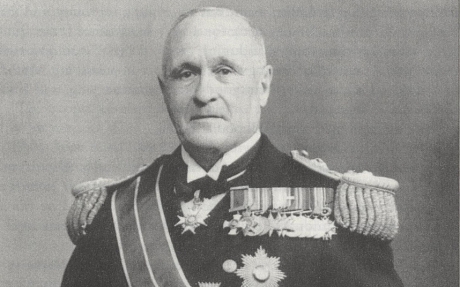
Geoffrey Layton
In London the newly appointed Chairman of the Chiefs of Staff Committee General Alan Brooke decided that in Ceylon the Allies should move from a defensive to an offensive strategy. This meant according to his biographer, Arthur Bryant that “the three arms of land, sea and air had to be brought to bear on the enemy as one force…For this there must be unified command.” This principle of single command was unique and unprecedented, and implemented for the first time in Ceylon with the appointment of a Commander-in-Chief for the island in the person of Admiral Sir Geoffrey Layton. He was given wide-ranging, almost dictatorial powers that subordinated the civilian authorities.
Another critical appointment with respect to the defence of Ceylon was that of Air Vice-Marshal John D’Albiac as Air Officer Commanding No. 222 Group. In addition, No 803 Naval Air Squadron, a Royal Navy Fleet Air Arm squadron, was re-equipped in March 1942 with Fairey Fulmar II aircraft and posted to HMS Formidable. But not only was Britain’s airpower in the Indian Ocean weak, they had no maritime capability that could halt the advance of the approaching Japanese carrier fleet.
On 28th March the Far East Combined Bureau (FECB), a British code breaking service in Ceylon which operated from HMS Devonshire, intercepted a Japanese signal which identified Colombo as Admiral Nagumo’s objective. Admiral Layton realized that the island’s defences were inadequate in the face of the Japanese threat. So he made improvements to radar facilities and air raid systems and revamped the local civil defence.
He also ordered the diversion to Ceylon of two squadrons of Hurricane fighters which had been destined for Java. And as described by Prof Jackson, “anti-aircraft guns, barrage balloons, and searchlights appeared around ports and towns, and defensive trenches were dug in case the invader should come; air-raid shelters, first-aid posts, and cleared fields of fire appeared in coastal settlements; harbours were expanded to take more warships, defended by artillery and anti-torpedo booms; flying-boat anchorages were established on inland lagoons; and airstrips and barracks sprouted across the country.”
The commercial sector was also drawn into the war effort. Walker Sons and Company which had produced machinery for the tea and rubber industries in peacetime began undertaking military contracts. During the War its 3,600 workers repaired or refitted almost five hundred warships including the aircraft carrier HMS Eagle. They also converted over sixty merchantmen and passenger liners into troopships, fitting a miniature crow’s nest on the main mast to control a kite which deterred dive bombers from making low attacks. Walkers also made dummy weapons to mislead the enemy, including dummy Hurricanes, Bofors anti-aircraft guns and radar towers.
Unknown to the Japanese, the Royal Navy had developed a secret base on Addu Atoll in the Maldive Islands. Once the JIN’s presence in the Indian Ocean was known, Admiral Somerville retreated to Addu Atoll in order to avoid the Japanese during the day; but he would attempt to track and engage them in the night when under cover of darkness the Eastern Fleet’s superiority in gun power would give him an advantage.
Admiral Somerville had divided his fleet into two components. Force A was led by the battleship HMS Warspite, while Force B comprised four vintage battleships. Based on FECB’s signals intelligence Admiral Somerville expected to intercept the Japanese on April 1st, but after three days of fruitless search, the Eastern Fleet returned to Addu Atoll to refuel.
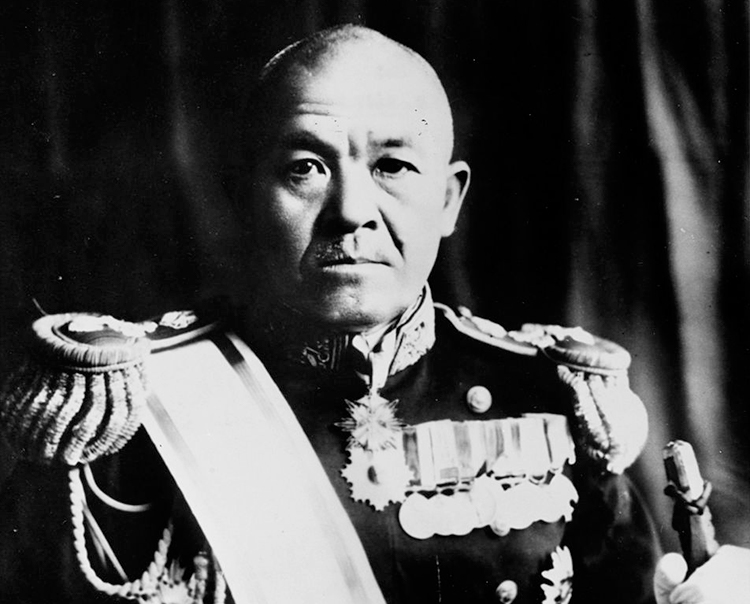
Vice Admiral Chūichi Nagumo
Squadron Leader Leonard Birchall of the Royal Canadian Air Force was attached to No 413 Squadronwhich had transferred to Ceylon on April 2nd. Two days later while flying out of Koggala on a reconnaissance mission in a Consolidated PBY Catalina seaplane, his crew sighted the approaching Japanese fleet. Before they were shot down by Mitsubishi “Zero” long-range fighter aircraft and taken prisoner, Birchall and his crew managed to radio a warning to Colombo.
