

Do Not Steal Our Birthright

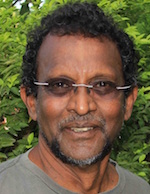
Dr Ranil Senanayake
 The totally incredulous decision announced by the Prime Minister and by Minister for Power and Energy that Sri Lanka should rely even more on more fossil fuels, specifically on more coal powered power plants, cannot go unanswered. The callous disregard of the health of the next generations, or even the violation of our fundamental right to breathe the quality of air that we grew up in seems to have no value for these ‘leaders’. The entire goal of ‘economic development’, to Sri Lanka politicians seem to be unable to see beyond, ‘borrow as much money as we can and boast about how much was borrowed,’ with no idea on how to pay back that loan. They create a massive dependency on power by selling cheap to industry and ‘development’ projects and then whinge that we need coal fired power plants never mind their impact on public health and cultural artefacts.
What words can be used to describe people who sell and destroy the birthright and culture of their own people for the gain of personal wealth or political power? To answer this question, it is critical to understand the scope of the words birthright and culture.
A Birthright is the privilege or possession that a person has or is believed to be entitled to as soon as he or she is born. The primary birthright of any human is the right to life. Once alive, the ability to continue living is a consequence of the environment that the person is born into. Thus the birthright of any individual will be to enjoy whatever health and wellbeing the environment that they have been born into can provide. While there is a great discrepancy in the nature of the environments that each of us are born into, the condition of that environment we are born into must represent our most fundamental birthright. Any degradation of that environment must transgress that right and must be seen as transgressing our fundamental human right.
Culture is the evolved human capacity to classify and represent experiences with symbols, to act imaginatively and creatively; and the distinct ways that people, who live differently, classified and represented their experiences, and acted creatively. Culture represents the arts and other manifestations of human intellectual achievement regarded collectively.
With these definitions in mind, we can examine the intent and the consequences of the decisions to create a nation dependent on coal fired power plants as their primary source of energy.
Irrespective of the debate on energy profligacy as an indicator of ‘development’, it will be of value to look at the human cost of the currently promoted cheap energy source ‘Coal’. Is this activity compromising our fundamental right, the right to life?
In a healthy population the right to life has been expressed well, a people enjoying a high quality of air, should not have their right to life compromised by the choice of our sources of energy. We are being bullied into a future that depends of the burning of coal for our power needs. Do we need to invest our capital in creating a slew of national problems?
But let us look at birthright and culture. In committing this nation to be coal dependent what might be the possible consequences to our birthright and culture?
The greatest of all gifts is the gift of health, said the Buddha. Does coal bring health to a nation? Two nations ensnared in having to burn coal for their power needs are China and India.
The South China Morning Post Wed Nov 5th 2014 reports that the pollution caused by coal burning killed an estimated 670,000 in China in 2012
In a study of the cost of coal burning for power plants a new study made during 2012 and officially backed by the China Academy of Environmental planning who agreed with research by Tsinghua and Peking Universities that suggested that the massive health problems that China today was a consequence of burning coal to drive the power plants they conclude that a sum 260 Yuan must be added to each tonne of Coal burnt to account for the health cost to the nation. Today China has cancelled all new coal fired power plants and is looking at replacing the existing output, through renewables. That is a government sensitive to the health and well-being of its people.
In addition to the well-known consequences of Lead and Mercury, Sulphuric compounds and Oxides of Nitrogen are produced by Coal burning power plants, all of which produce gasses that mix with the ambient air and degrade the human birthright to a healthy air quality.
For instance, burning coal releases large amounts of the neurotoxin mercury into the air. Globally, coal-fired power plants are the single largest emitter of mercury emissions, accounting for over 50 percent of the mercury pollution caused by humans.
Once released, mercury settles in streams, lakes and rivers and on the earth itself, where it infiltrates the groundwater. From there, it enters the food chain via algae and infects all life forms, from minnows to predator fish to birds and mammals, whose diets include fish, it goes up the food chain, the concentration of mercury intensifies.
Emissions from the coal-burning power plants release the mercury into the atmosphere, which can travel thousands of miles before coming back to the Earth or the ocean. Billions of tons of coal being burned in Asia (especially India and China) have sent all the resulting mercury over the Pacific Ocean. Here it gets into the ocean’s food chain. The microorganisms in the sea convert this metallic mercury, which is not terribly hazardous, into another form of mercury called methyl mercury, which is very hazardous.
