

Judiciary Played A Crucial Role In Halting Sirisena’s March To Constitutional Dictatorship

Veluppillai Thangavelu
 The high tech drama began on the night of October 26, at 8.30 pm. President Sirisena to everyone surprise appointed his arch-foe Mahinda Rajapaksa, MP as Prime Minister. On the following day, he fired off a letter to Prime Minister Wickremesinghe informing him that he has removed from his office of Prime Minister in virtue of powers vested in him in terms of Article 44 (2) of the constitution. President Sirisena did not know that Article 44(2) does not apply to a sitting Prime Minister. It applies to the appointment of a Prime Minister after the elections. However, President Sirisena claimed that he had been advised by “legal experts” that he does have powers under 44 (2) to dismiss a sitting Prime Minister.
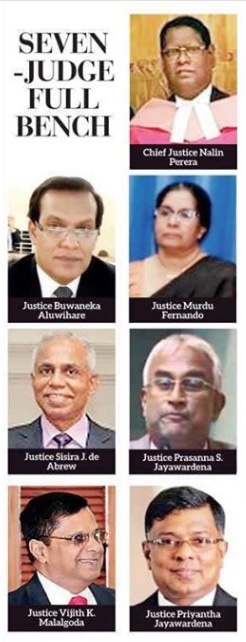
In between the appointment of Mahinda Rajapaksa on the 26th October and dismissal of Ranil Wickremesinghe on 27th October, there were two Prime Ministers! Not long after the country had no Prime Minister, Ministers or government until Ranil Wickremesinghe took his oaths following the judgment of a seven-member bench of the Supreme Court on December 13th.
Following the parliamentary elections held on August 17, 2015, the incumbent United National Party (UNP) led United National Front for Good Governance (UNFGG) won 106 seats, an increase of 46 since the 2010 election, but failed to secure a majority in Parliament. The main opposition United People’s Freedom Alliance (UPFA) won 95 seats, a decline of 49 seats. The Tamil National Alliance (TNA), the largest party representing Sri Lankan Tamils, won 16 seats, an increase of two compared to 2010. The remaining eight seats were won by Janatha Vimukthi Peramuna (6), Sri Lanka Muslim Congress (1) and Eelam People’s Democratic Party (1).
Prime Minister Ranil Wickremesinghe, leader of the UNFGG and UNP, was able to form a national government with the support of UPFA MPs loyal to President Maithripala Sirisena.
 One of the landmark pieces of legislation enacted by the national government was the 19th Amendment (19A) to the Constitution on 28 April 2015. It was passed by the 225-member Sri Lankan Parliament with 215 voting in favour, one against, one abstained and seven absent. The Amendment envisaged the stripping of many powers of the Executive Presidency, which had been in force since 1978. It is the most radical reform ever applied to the 1978 Constitution of Sri Lanka enacted by JR Jayawardhane in 1978. He became the first Executive President of Sri Lanka in 1978.
Differences between President Sirisena and Prime Minister began to surface after the formation of the national government. The long-simmering uneasy relationship between the President and Prime Minister over government policies became more acrimonious beginning from 2018. The President accused the Prime Minister of not investigating an alleged plot by Nalaka de Silva, the former DIG of the Terrorist Investigation Division (TID) to assassinate several VIPs, including him, Though the DIG Nalakka de Silva he was cleared initially of any wrongdoing was subsequently arrested by the CID on Thursday, October 26, one day before Rajapaksa was sworn in as Prime Minister.
The arrest was made during his interrogation by the CID which had questioned him on five separate days over the alleged plot.
A man named Namal Kumara in mid-September disclosed the alleged plot implicating Nalakka de Silva. Kumara has claimed that Silva had discussed the plot with him over phone targeting Sirisena and Rajapaksa.
After the swearing in of Rajapaksa by President Sirisena, the country plunged into a stormy and turbulent constitutional crisis day and night. Here is the timeline:
October 27 – President Sirisena prorogues Parliament until November 16. He issued a formal notice for Prime Minister Ranil Wickremesinghe to step down. Same day Prime Minister Wickremesinghe addresses the Nation refusing to step down. He said only Parliament can remove him.
October 29 – President Sirisena address the nation. He claimed “I noted that there were also differences of culture between Mr Wickremesinghe and me. I believe that all those differences in policy, culture, personality and conduct aggravated this political and economic crisis.
October 30 – Speaker Karu Jayasuriya made a ‘kind request’ to President Maithripala Sirisena to reconvene Parliament to “prevent the country from falling into a crisis” following requests made by the UNP, ITAK, JVP. SLMC MPs to safeguard the privileges and rights of the MPs and establish a majority in Parliament.
November 02 – 119 MPs from several parties met and passed a resolution calling for an immediate convention of Parliament claiming that the removal of the Prime Minister and the appointment of another was unconstitutional.
November 08 – President Sirisena met with Tamil National Alliance (TNA) delegation. He told the TNA parliamentary group that he would not reappoint UNP leader Ranil Wickremesinghe as the Prime Minister even if his party secured a majority in Parliament. He asked the TNA to abstain at voting time. The TNA told Sirisena it had taken a decision to vote against the appointment of Mahinda Rajapaksa as the Prime Minister.
November 09 – President Sirisena dissolved Parliament amid a political crisis following his attempt to replace Sri Lanka’s prime minister. The dissolution took effect from midnight on Friday. A general election was fixed for January 05, 2019.
November 12 – Twelve Fundamental Right petitions were submitted to the Supreme Court of Sri Lanka challenging the president’s decree sacking parliament and calling a snap election, by the UNP, TNA, JVP, SLMC and others demanding the restoration of status quo prevailing prior to 26 October. These were taken up for hearing on the same day by a three-member bench of the Supreme Court. Responding to the petitions, Attorney General Jayantha Jayasuriya made submissions stating that “the court had no jurisdiction to hear and determine the Fundamental Rights petitions against the dissolution of Parliament”. On the same day, 5 petitions by Prof G. L. Peiris, Minister Udaya Gammanpila, Minister Vasudeva Nanayakkara and two others supporting the dissolution of parliament were filed at the Supreme Court. However, in the evening the three Judge bench issued an interim order till 7th December staying the proclamation issued by President Sirisena to dissolve parliament and granted leave to precede with the Fundamental Rights petitions that challenged the President’s dissolving parliament.
