

The Quagmire Concerning Our Parliament

Rusiripala Tennakoon
 The recent decision by the President to appoint a Prime Minister following a changing of the composition of the Cabinet of Ministers and the simultaneous prorogation of the Parliament has caused a mayhem leading to a tense political situation. Several parties in addition to the parliamentarians representing different segments of the society seem to be seriously involved in this embroil. Latest is the exacerbation of the confusion consequential to the Speakers announcement that he was accepting the Status –quo- of the Parliament prior to the appointment of Mahinda Rajapakse as the new Prime Minister.
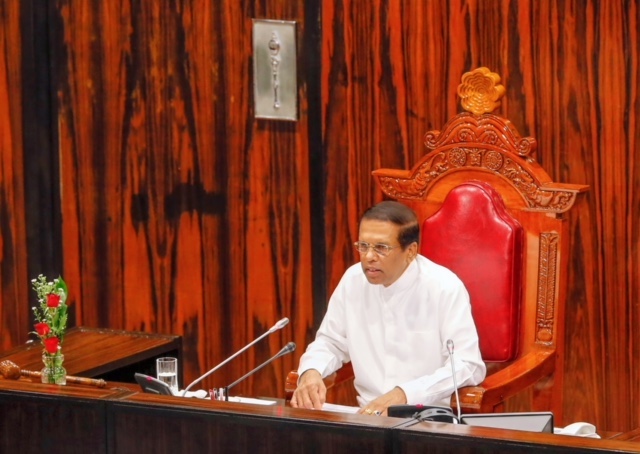
A statement released by the Speaker on 5th November, (as reported in the Press), contravening a previous statement made by the HIM stating that he would recognize Mahinda Rajapaksa as Prime Minister, as his name was gazetted by President, Maithrhipala Sirisena appointing him as the Prime Minister, came as a complete surprise to the country due to its volte-face 180 degrees turnaround from his previous position. When we examine both these statements in the context of the provisions under the constitution of the country they appear to be worthless. Because the constitution provides a prerogative power of appointing a Prime Minister sans any powers of recognition by any one below him. To be more precise, the article 42, in our constitution (after 19th Amendment) sub titled, “Prime Minister and the Cabinet of Ministers” in sub section (4) reads as follows;
“The President shall appoint as Prime Minister the Member of Parliament, who in the President’s opinion is most likely to command the confidence of Parliament.”
There are no sub clauses or overriding provisions anywhere else in the Constitution regarding this power. Nor is it stated any-where that the Speaker has to recognize or approve this appointment. Therefore we are compelled to state with respect that his first position of accepting him as the PM and his second position of refusing to recognize are both redundant. It looks like something confined to an opinion unenforceable.
In so far as the opinion of the President regarding the likelihood of his appointee’s command to win the confidence of the Parliament, it is a matter for the parliament to prove that it is not so, if it is so! That will have to be done following the laid down Parliamentary procedures. It is not a matter to be preempted. Nor should it be left to be decided arbitrarily by any one at his discretion!
Our constitution is very clear regarding matters where consultation, advice and approvals are required in exercising powers delegated under the constitution. The constitution also does not provide for any adoption of practices elsewhere to supplement and undermine clearly stated rights and powers. Therefore trying to challenge an act under the powers of the constitution is unconstitutional and may be even considered as illegal and punishable.
To the extent of eliminating any doubts or conjectures it is not harmful to make a statement clarifying a position. Eg: The Speaker making an announcement to the effect that the officials in the Parliament are making the necessary arrangements to facilitate the changes necessitated by the Gazette notification is quite in order. But to make a statement which in effect is an overriding of the Presidential powers as given in the constitution tantamount to a superseding of the constitutional powers.
The meaning of prorogation in accepted Parliamentary terms is clearly pronounced. Besides how it is to be done under the applicable laws, practices and procedures, there is no ambiguity with regard to its meaning and application under a universal definition;
