

National & Sub-National Planning Approaches In Sri Lanka (1948 – 2018)

Dr. Siri Gamage
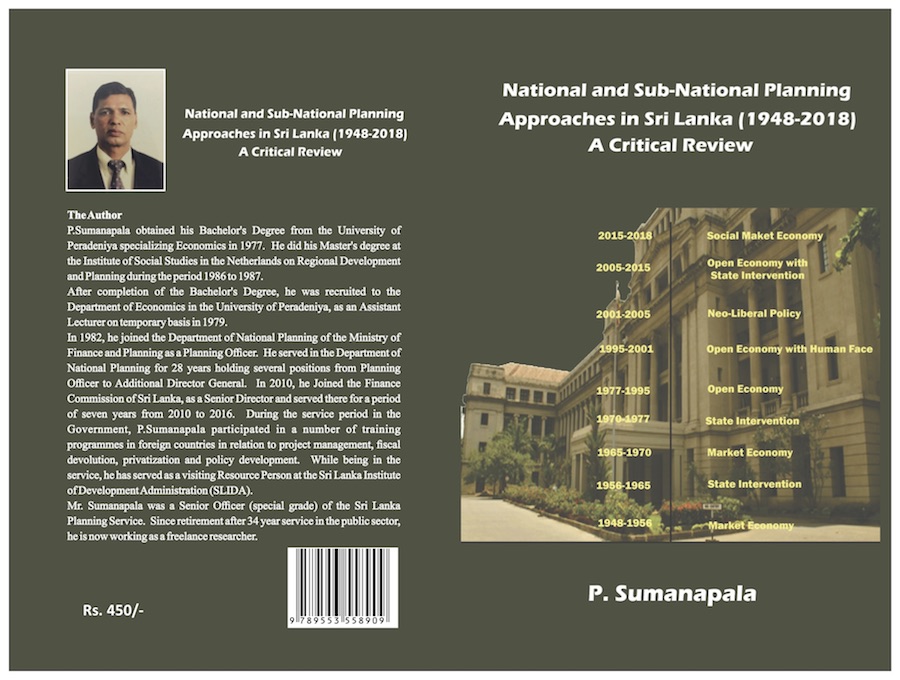
 National and Sub-National Planning Approaches in Sri Lanka (1948 – 2018): A Critical Review by P. Sumanapala. 2018 Quality Printers, Homagama
Development planning, implementation, monitoring and evaluation at national and regional levels assume high significance in contemporary society as they involve economic development, poverty alleviation, social engineering and preservation of quality of life at national and regional levels. Involvement in efficient economic development planning and implementation at various administrative units has been part of state responsibility at varying levels since independence. However, complexities have emerged in the field of planning with the expansion of neoliberal, free market economic ventures initiated and implemented by the private sector-local and foreign – making the process of planning quite challenging.
Coordination of planning and implementation activities including budgeting, provision and careful utilisation of resources among various levels of government plays a crucial part in the process. At this juncture, whether Sri Lanka is facing up to this challenge in terms of political, institutional (bureaucratic), and procedural dimensions is a reasonable question to raise. In this regard, gaining an understanding of how the development policy development and planning evolved since independence and acquiring a sense of the challenges facing planners as well as how to address them are necessary steps. This book provides the reader with a useful resource to achieve these objectives. The author who held important positions in the national planning department of the finance ministry and the finance commission responsible for provincial budgets has utilised his academic training as an economist to come up with this publication. He holds a Master’s degree in Regional Development and Planning from the Institute of Social Studies in The Hague, the Netherlands. The book details measures to arrest regional disparities, e.g. local government to be given more responsibilities, better coordination, industries in agriculture areas, focus on vulnerable groups (pp. 64-67). A series of recommendations to address other continuing issues are also included in the final two chapters. There are numerous insights that present day planners and students of development planning can gain by reading the book.
Successive governments since independence introduced a number of development plans and policy approaches/frameworks at the national level while a range of development initiatives has been instituted to develop regions and sub-regions. The latter followed policies and strategies adopted at macro level in order to address the regional disparities. In terms of the changes in planning approaches, ‘governments from 1948-1977 accorded a prominent place for economic planning. Governments that came after 1977 adopted a less interventionist liberalised economy approach. They provided policy directions to private investors considered as the engine of growth for viable projects and utility services (p.29). However, compared to other countries in the region such as Thailand, Singapore and Malaysia, Sri Lanka has not performed well in the economic frontier in terms of economic indicators. Aafter analysing socio-economic data, the author states that the objectives and targets set out have not been achieved satisfactorily due to domestic and international factors some of which are beyond the control of relevant authorities (P.81).
Since the introduction of Provincial Councils in 1987, national planners had to work with their counterparts at the provinces –both at the political and bureaucratic levels. However, the duplication of development plans by the line ministries and Provincial Councils has emerged as a major issue. Concentration of industrial, commercial and service activities in and around the capital have not changed during the last seven decades either.
The book includes chapters that engage with national and regional planning approaches, provincial planning and challenges of development planning. It analyses the planning strategies adopted by governments during the seventy years since 1948 at national and regional levels.
Chapter 1 deals with definitional issues and the nature of policies and plans implemented in various periods. Reasons for poor performance are also outlined (pp. 30-31). For the 2015-18 period, planning indicators are given. The government vision is explained as ‘to graduate the economy to an upper-middle income status by 2020’(p.25). In order to achieve this vision, ‘the government adopts an economic strategy based on social market concept with the twin objectives of achieving higher growth and promoting social equity’ (p.25). Developing regional and rural economies through strong small and medium enterprises is part of the policy agenda.
Chapter 2 deals with national planning approaches including their theoretical backgrounds such as Classical and Neo classical, Core-periphery, Dependency, and Neo Marxist. The distinction between capitalist and socialist development concepts are elaborated while pointing out that in the 20thcentury the US and the Soviet Union adopted mixed economy model incorporating elements of both market economy and centralised planning by the state. The details on theory in the chapter remain very basic and descriptive. The author does not engage critically with the theoretical approaches mentioned or their suitability to the Sri Lankan context. However, the chapter provides the reasons for regional disparities and emphasises the need for balanced regional development across provinces (pp. 34, 39-41).
