

Crisis Of Parliamentary Democracy & Need For A Credible Reformist Movement

Dr. Siri Gamage
 There are numerous media reports about the failure of good governance or Yahapalanaya since the new government came into power in early 2015. There seems to be not only a growing disenchantment with the existing system of governance and associated political culture but also a lack of choices to use by the public next time around. How did we come to this untenable situation and what should be the way forward?
Before the Presidential system of governance was introduced in 1978 and it started to corrode the parliamentary system of governance that people were familiar with, the voters who were not happy with one party opted for the other party at general elections. This was referred to as Tattumaruwa. Nonetheless, there was a choice then. After the elections, one set of politicians took seats in the opposition and a new lot in the government benches. After the new system came into being, sometimes with a two thirds majority in the parliament, there was a trend for smaller parties to emerge. Some of them were splinter groups from the mainstream parties. Examples such as Sri Lanka Mahajana Pakshaya, the party led by Lalith Athulatmudali come to mind. This trend continued during the war years. Even the JVP was split and the party led by Wimal Weerawansa came into being. Today Gammanpila leads a party called Pivithuru Hela Urumaya distiniguishing itself from Hela Urumaya led by Patali Champika Ranawaka. Even in the case of Tamil and Muslim parties similar splinter groups and parties have emerged. Even the Ceylon Workers Congress led by Thondaman is no spared. This trend can be defined as a process of FRGMENTATION in the political party system in Sri Lanka. However, parallel to this process there is another process. It can be defined as FUSION.
BY fusion I mean the forming of coalitions before the general and Presidential elections where smaller parties come together with a mainstream party such as the UNP or the SLFP. Such coalitions issue election manifestos. Speakers on stages and in the TV discussions repeat the promises listed in such documents. However, once a government is formed at the initial stages, some minor parties join the government even if they did not support the particular coalition before the election. In return their leaders get ministerial appointments. Such change of support for a different coalition can go against the principles, values and promises these leaders make before the elections. Nonetheless, they rationalise such moves on the ground of pragmatism.
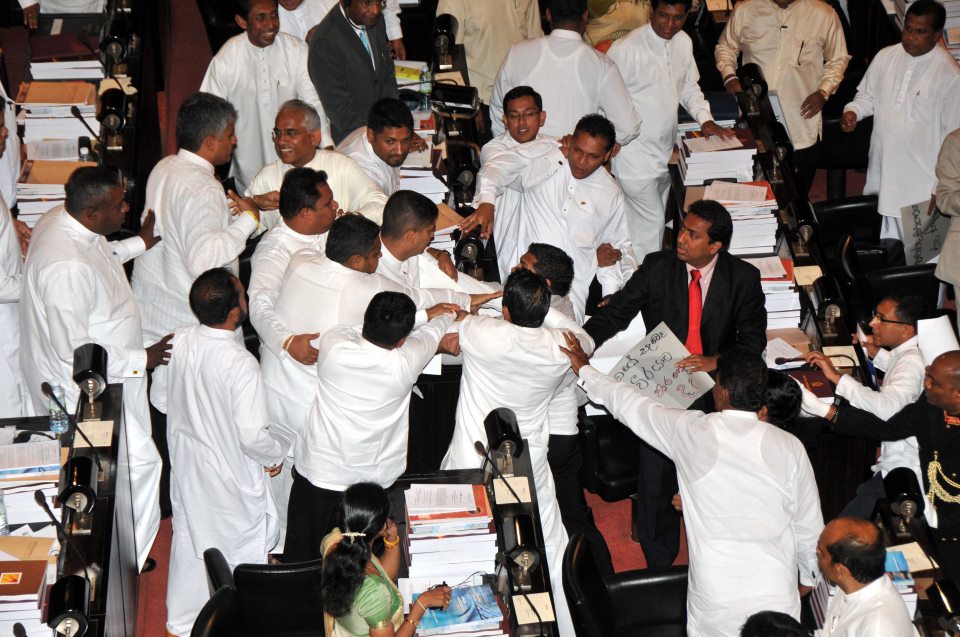
During the war years, those belonging to UNP and other parties joined the Rajapaksa government. After the 2015 elections, a national government was formed by the UNP and SLFP together with smaller parties. JVP remains outside this arrangement. What this changing practice of coalition formation or fusion has done is to reduce the choices voters have ag election times. They are no longer able to assume that their vote for the UNP, SLFP or indeed a minor party will mean the same after the elections in a political culture where members are able to cross over so easily or even those who lose elections can come to parliament on the National List. Voters are not able to elect someone who is not tarnished by charges of corruption, neglect, broken promises and so on. No wonder the people today have lost faith in the parliamentary cum Presidential systems. This situation reflects a crisis in the parliamentary system of governance as we have known it. People are at a loss to understand what to do next?
The irony of the matter is that those people including civil society leaders with a fair understanding of this situation are not thinking beyond the box. They ae only looking for alternatives (which are hard to find) within the existing parliamentary system and a multitude of parties however much discredited they are? They seem to look for a different alignment of major and minor parties at future elections as the solution when it is clearly not. They are not merging their criticisms and alternative ideas and possibilities with other likeminded forces, groups, and individuals to forge a grand alliance so that their reformist movement or collective becomes a force to be reckoned with. Instead, they are using whatever the platforms available to advance isolated critique of the existing system by citing examples of failure and corruption etc. How can one find a solution to a problem that has emerged due to corruption, broken promises etc. from the same process that led to such practices?
The answer lies, as in other cases of success elsewhere in the world, from articulating the challenges people face in clear language, identifying a strategy including a political one, forging alliances with likeminded groups and individuals, media etc., and pushing forward as a collective reformist movement. If necessary, a ten-point plan can be developed in order to bring a shared understanding of the goals and mission of such a movement. My view is that such a movement has to emerge from the civil society organisations acutely concerned with corruption, mal governance, foreign debt, elitism, effects of partisan politics, extravagance of politicians, and the lack of resources and programs for rural and poor upliftment, and heavy emphasis placed on imports in place of developing national economy (production, manufacturing and marketing). If they can identify established politicians with a clean record, their support should be obtained as is the support of other leaders in the society such as religious leaders, academics, professionals, teachers, and journalists.
Such a course of action is not without its difficulties. However, rather than focusing on the difficulties, what we need to focus on is the collective strength that can emerge from the engagement with various layers of society to seek support. In this instance, I note the campaign being conducted by Mr. Nagananda Kodituwakku. His main aim seems to be reforms in the legal sector. However, winning Presidential or general elections cannot be a reality unless he forges alliances with other civic organisations and leaders including trade unions that are interested in a reform agenda for the country. As politics has become a tradition or a cult among the masses who can be convinced to vote this or that way after intoxicating them with jargon full humour, humiliation, personal attacks etc, and showing only those in the opposition side are weak or cannot be relied, breaking into the mindset of the suffering masses to support an alternative vision is not an easy task for the newcomers. An effective communication strategy is a must to address this challenge.
