

UNHRC Cannot Rely On Sri Lanka To Prosecute Its Armed Forces
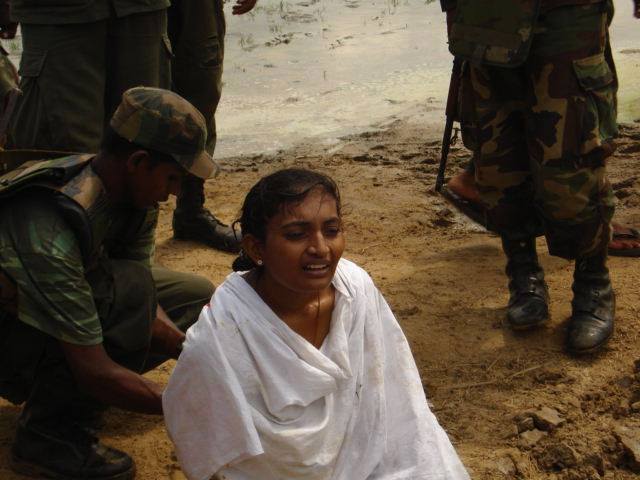
Isaipriya alive

Usha S Sri-Skanda-Rajah
 – As the search for justice for victims of the Tamil genocide continues.
– While the application of ‘universal jurisdiction’ by individual states to prosecute war criminals must be pursued rigorously, the way forward for member states of the UN Human Rights Council is to lobby the UN Security Council for an ICC referral or for the establishment of an international special criminal tribunal for Sri Lanka.
UNHRC’s Prolonged Reliance on Sri Lanka to Prosecute Its Army Cannot be Sustained:
The 37th session of the UN Human Rights Council ended with no firm action taken against Sri Lanka, despite its continued failure to establish a hybrid court – member states missing the opportunity yet again to apply the necessary pressure required on Sri Lanka including imposing strict benchmarks and time lines for implementing transitional justice commitments it signed up to in October 2015, among other, the establishment of a special domestic court with “foreign participation”.
An honest look at the proceedings, in Geneva, relating to Sri Lanka, is telling – it’s manifestly obvious the UNHRC’s prolonged reliance on the Sri Lankan government to prosecute members of its armed forces and senior political leaders – those responsible for committing mass atrocities, cannot be sustained any longer.
Everyone knows such prosecutions, founded on international law, won’t materialize in Sri Lanka, not now, not later, certainly not by the March 2019 deadline – even with further extensions thereafter (which is most objectionable and should be vehemently opposed) definitely not through a domestic judicial mechanism with “foreign participation”, as set out in resolutions 30/1 and 34/L1 – and indisputably not as a means for litigating the charge of genocide.
A Hybrid Mechanism is Definitely Not in Sri Lanka’s Agenda:
Sri Lanka’s silence on the issue of a hybrid court at the UNHRC this session was deafening. Its new Foreign Minister Tilak Marapana’s subtle reference to it, in his statement to the Council when he said, “Sri Lanka’s judiciary and law enforcement mechanisms are fully capable..of advancing justice,” speaks volumes on how it intends to carry on in the future. A hybrid mechanism is definitely not in its agenda at all:
And I quote:
“Sri Lanka’s judiciary and law enforcement mechanisms are fully capable and committed to the process of advancing justice to all concerned. It has a long history of integrity and professionalism and since 2015, steps have been taken to further strengthen its independence. And may I add, Mr. President that all reconciliation mechanisms will be implemented in accordance with our constitution.”
End quote.
And therein lay the truth. No one needs any further declaration of Sri Lanka’s complete rejection of a hybrid court than that expressed by its Foreign Minister.
UNHRC Must Act to End Impunity – Must Step Up to The Plate
If member states search their conscience they would and should know it and any amount of waiting is not going to bring the desired result. The onus is now on member states to turn to the more realistic and credible option, by stepping up to the plate, and working more robustly and constructively towards finding a viable international accountability mechanism to achieve UNHRC’s aim, as an authentic body, that strives to ending impunity for serious human rights violations and taking to task recalcitrant states, in this case, Sri Lanka.
Referral to ICC Most Realistic Option – UNHRC Must Act Lobby Security Council:
That realistic and credible option is for the UNHRC member states to start lobbying the UN Security Council to refer Sri Lanka to the International Criminal Court (ICC) or establish a Special Criminal Tribunal, similar to the International Criminal Tribunal for the former Yugoslavia (CTY).
View of Renowned Legal Experts (MAP):
