

The Insatiable Craving For Ministerial Office
Prof. Asoka N.I. Ekanayaka
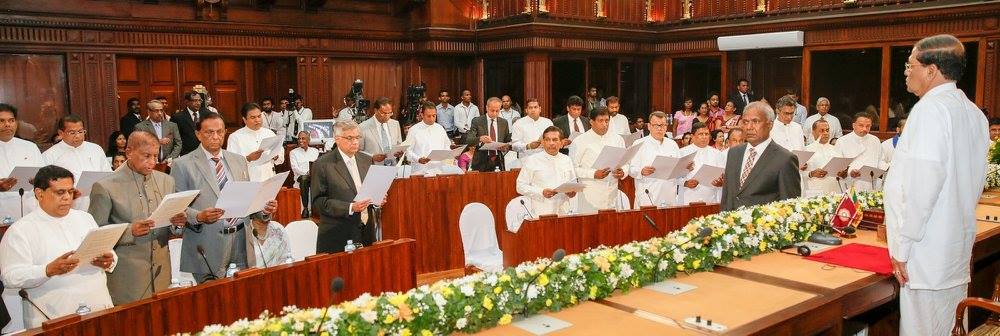
 Of all the lunatic contradictions, absurdities, and incongruities that mark politics and public life in Sri Lanka the most outrageous in recent times must surely be the shameless way in which the rebels who actively opposed the Prime Minister in the recent abortive no-confidence motion, continue to cling to their cabinet portfolios like leeches. Likening their tenacious hold on public office to the parasitic depredations of a blood sucking species of segmented worm is indeed apt. For the perks privileges and manifold luxuries of cabinet office which they are reluctant to let go of are all funded by the beleaguered tax paying masses of this country.
Truly in Sri Lanka truth is stranger than fiction. One does not know whether to laugh or to cry at the absurdity of it all. The issue is not whether one was for or against the no confidence motion or even one’s personal feelings about the PM. The point is that given the most rudimentary understanding of the ‘ done thing’ in a democratic tradition if they had even an ounce of shame, all the government MPs who joined hands with the enemies of the government in an abortive bid to oust their own Prime Minister – should have had the honour to resign their government portfolios well before they even cast their vote in parliament. And that is not all.
Even the cowardly ministers without backbones who sat on the fence, absented themselves and so abstained from voting, should have had the courtesy to tender their resignation as a matter of common decency, enabling the PM to use his discretion in terms of section 42(2) of the constitution and advice the President that some if not all of them might be reappointed. But that is a far cry from how things are done in Sri Lanka nowadays where to voluntarily renounce power and give up any public office high or low on a matter of high principle is virtually unknown.
By contrast one recalls how in 1951 when SWRD Bandaranaike resigned from the cabinet and crossed the floor confessing “I have conquered myself” – he quoted Milton “Human ambition is the last infirmity of mortal man”. True when in 1956 he gathered round him a motley rabble from amongst desperate Buddhist monks, teachers and native physicians and rode to power on an inflammatory slogan of “Sinhala only in 24 hours” at one stroke, shattering the trust between races and laying the foundation for decades of ethnic conflict – SWRD proved that he himself was not immune to Milton’s “last infirmity of mortal man”. Nevertheless the fact remains that far back in 1951 he was driven by his principles to voluntarily resign from the post of Minister of Health and Local Government.
A better example was Dudley Senanayake a gentleman politician of the highest integrity who in October 1953 resigned as Prime Minister citing poor health, although it is widely believed that the real reason for stepping down was his anguish over the deaths of several demonstrators during the previous Marxist hartal. And in more recent times one recalls the case of the late Gamini Jayasuriya who resigned as Minister of Agricultural development, Research and Food and left the government over his principled opposition to the Indo-Lanka Accord.
Such men seem like extra-terrestrials from some other planet compared to the monstrous greed of today’s Ministers who tenaciously cling to their ministerial posts even after attempting to oust their own Prime Minister and failing to do so.
Of course one expects that where such shameless hangers on fail to do their duty by resigning, they would be removed forthwith by those who exercise supreme constitutional authority over them. Consequently just as dispiriting as the stubborn refusal of these rebels to resign is the President’s seemingly stubborn reluctance to remove them. In any other reputable constitutional democracy in the world the mulish indifference of a head of state to what ought to have been an obvious and natural response, would have been interpreted either as the naivety of one whose intellect and education was on par with that of a “rural official” or worse the crass insensitivity of one who has the hide of a rhinoceros – as reflecting the distinction between folly and knavery.
As the nation waits with bated breath for a new cabinet purified of dissident ministerial maggots who might corrode good governance from within, one can be philosophical about the Sri Lankan political culture where ministers are so enslaved by high office. If as the saying goes people get the government they deserve then it stands to reason that the morality, values, and standards of politicians must mirror those of the masses who voted for them. There is some comfort in pragmatically falling back on this reality.
