

Europe tells Netanyahu it rejects Trump's Jerusalem move
Israeli PM had asked EU member states to recognise city as capital of Israel, and to back US peace initiative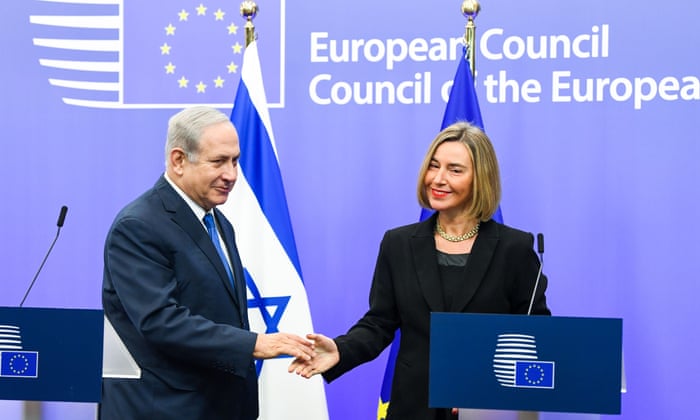
Peter Beaumontin Jerusalem-Monday 11 December 2017 14.02 GMT
 European foreign ministers have strongly rejected calls by Israel’s prime minister, Benjamin Netanyahu, for them to follow Donald Trump’s example and recognise Jerusalem as Israel’s capital.
Opposition from across the European spectrum came as Netanyahu made the first official trip to the EU by a sitting Israeli premier in 22 years.
Even the Czech Republic, one of Israel’s closest allies, said the US president’s decision was bad for peace efforts. France said Jerusalem’s status could be agreed only in a final deal between Israelis and Palestinians.
Netanyahu called on European governments to back a much-mooted US peace initiative despite the fact that Trump has yet to reveal any details about it.
France’s foreign minister, Jean-Yves Le Drian, made clear that the EU would not write a blank
cheque for an unseen Trump peace plan and urged Washington to disclose what was being drawn up by Jason Greenblatt, Trump’s Middle East envoy, and Jared Kushner, Trump’s son-in-law and senior adviser.
“We’ve been waiting already for several months for the American initiative, and if one is not forthcoming then the European Union will have to take the initiative,” Le Drian said.
The latest diplomatic moves came as Hezbollah’s general secretary, Hassan Nasrallah, said the group would renew its focus on the Palestinian cause after what he called “victories” elsewhere in the region – not least in Syria, where Hezbollah has been supporting the Assad regime.
Nasrallah also called on Hezbollah’s allies to put in place a united strategy “in the field” to confront Israel, as tens of thousands of people turned out for a rally in Beirut called by Nasrallah.
Netanyahu, arriving for a meeting of EU foreign ministers in Brussels, said Trump’s move made peace in the Middle East possible “because recognising reality is the substance of peace, the foundation of peace”.
He said all or most European countries would move their embassies to Jerusalem and recognise it as Israel’s capital, though there is no evidence that any European country is preparing to do so.
Sweden’s top diplomat, Margot Wallstrom, said after the meeting: “I have a hard time seeing that any other country would do that and I don’t think any other EU country will do it.”
The EU foreign policy chief, Federica Mogherini, reiterated the bloc’s commitment to a two-state solution, telling Netanyahu it would continue to recognise the international consensus on Jerusalem.
The EU would increase its peace efforts and hold talks with the Palestinian president, Mahmoud Abbas, next month, she said.
Palestinian officials have called on Europe to take a greater role in the moribund peace process after Trump’s move, which sparked protests across the Middle East and accusations that the US had abdicated its role as an honest mediator.
Abbas travelled to Istanbul and Cairo to meet Egypt’s president, Abdel Fatah al-Sisi, and his Turkish counterpart, Recep Tayyip Erdoğan, to rally support ahead of an emergency summit of the Organisation of Islamic Cooperation in Turkey this week.
Palestinians are calling on the 57-member OIC, which will convene on Wednesday, to make its own recognition of Jerusalem as the Palestinian capital.
Following his own meeting with Sisi on Monday, Russia’s president, Vladimir Putin, said any steps that pre-empted a possible agreement between Israel and the Palestinians were counter-productive and destabilising.
Arab states condemned Trump’s Jerusalem decision last week and vowed to press international bodies to take action against it, though without announcing any concrete measures.
There has been widespread condemnation in Germany of anti-Israel protests over the weekend that included chants of “Death to Israel” and incidents in which protesters set light to Israeli flags and ignited yellow Stars of David.

Opposition from across the European spectrum came as Netanyahu made the first official trip to the EU by a sitting Israeli premier in 22 years.
Even the Czech Republic, one of Israel’s closest allies, said the US president’s decision was bad for peace efforts. France said Jerusalem’s status could be agreed only in a final deal between Israelis and Palestinians.
Netanyahu called on European governments to back a much-mooted US peace initiative despite the fact that Trump has yet to reveal any details about it.
France’s foreign minister, Jean-Yves Le Drian, made clear that the EU would not write a blank
cheque for an unseen Trump peace plan and urged Washington to disclose what was being drawn up by Jason Greenblatt, Trump’s Middle East envoy, and Jared Kushner, Trump’s son-in-law and senior adviser.
“We’ve been waiting already for several months for the American initiative, and if one is not forthcoming then the European Union will have to take the initiative,” Le Drian said.
The latest diplomatic moves came as Hezbollah’s general secretary, Hassan Nasrallah, said the group would renew its focus on the Palestinian cause after what he called “victories” elsewhere in the region – not least in Syria, where Hezbollah has been supporting the Assad regime.
Nasrallah also called on Hezbollah’s allies to put in place a united strategy “in the field” to confront Israel, as tens of thousands of people turned out for a rally in Beirut called by Nasrallah.
Netanyahu, arriving for a meeting of EU foreign ministers in Brussels, said Trump’s move made peace in the Middle East possible “because recognising reality is the substance of peace, the foundation of peace”.
He said all or most European countries would move their embassies to Jerusalem and recognise it as Israel’s capital, though there is no evidence that any European country is preparing to do so.
Sweden’s top diplomat, Margot Wallstrom, said after the meeting: “I have a hard time seeing that any other country would do that and I don’t think any other EU country will do it.”
The EU foreign policy chief, Federica Mogherini, reiterated the bloc’s commitment to a two-state solution, telling Netanyahu it would continue to recognise the international consensus on Jerusalem.
The EU would increase its peace efforts and hold talks with the Palestinian president, Mahmoud Abbas, next month, she said.
Palestinian officials have called on Europe to take a greater role in the moribund peace process after Trump’s move, which sparked protests across the Middle East and accusations that the US had abdicated its role as an honest mediator.
Abbas travelled to Istanbul and Cairo to meet Egypt’s president, Abdel Fatah al-Sisi, and his Turkish counterpart, Recep Tayyip Erdoğan, to rally support ahead of an emergency summit of the Organisation of Islamic Cooperation in Turkey this week.
Palestinians are calling on the 57-member OIC, which will convene on Wednesday, to make its own recognition of Jerusalem as the Palestinian capital.
Following his own meeting with Sisi on Monday, Russia’s president, Vladimir Putin, said any steps that pre-empted a possible agreement between Israel and the Palestinians were counter-productive and destabilising.
Arab states condemned Trump’s Jerusalem decision last week and vowed to press international bodies to take action against it, though without announcing any concrete measures.
There has been widespread condemnation in Germany of anti-Israel protests over the weekend that included chants of “Death to Israel” and incidents in which protesters set light to Israeli flags and ignited yellow Stars of David.
Protests took place in Berlin on Friday and Sunday, pro- and anti-Israeli protesters clashed on the sidelines of a demonstration in Munich and several hundred people protested in front of the US consulate in Düsseldorf.
Angela Merkel, the German chancellor, said on Monday: “We condemn all kinds of antisemitism and xenophobia, and no disagreements, not even over the status of Jerusalem, justify such actions.”
US diplomats have continued to try to contain the damage caused by Trump’s decision, which upended years of US diplomacy and the international legal consensus.
Asked in a telephone briefing with Gulf-based journalists about whether the president would change his mind, David Satterfield, the assistant secretary for the Bureau of Near Eastern Affairs, said no. He stressed, however, that the developments of the past week did not prejudge the issue of final borders.
“The president’s decision stands,” Satterfield said. “It is, as I said, what the president believes was the right step, at the right moment. The president also said that these measures in no way prejudice the outcome of final status negotiation between Israel and the Palestinians.”
Additional reporting by Kate Connolly in Berlin
US diplomats have continued to try to contain the damage caused by Trump’s decision, which upended years of US diplomacy and the international legal consensus.
Asked in a telephone briefing with Gulf-based journalists about whether the president would change his mind, David Satterfield, the assistant secretary for the Bureau of Near Eastern Affairs, said no. He stressed, however, that the developments of the past week did not prejudge the issue of final borders.
“The president’s decision stands,” Satterfield said. “It is, as I said, what the president believes was the right step, at the right moment. The president also said that these measures in no way prejudice the outcome of final status negotiation between Israel and the Palestinians.”
Additional reporting by Kate Connolly in Berlin
