

Reforms race: Is SL winning?
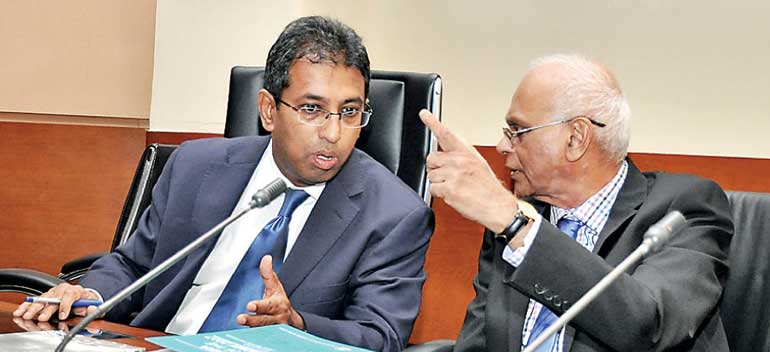 National Policies and Economic Affairs Deputy Minster Dr. Harsha de Silva (left) and former Central Bank Deputy Governor W.A. Wijewardena in an animated conversation on Tuesday at the launch of Institute of Policy Studies launch of State of the Economy 2017 Report
- Pix by Lasantha Kumara-Thursday, 12 October 2017

- Political and economic reforms: which is more important and is Govt. tackling both?
- Healthy debate at Institute of Policy Studies’ State of the Economy 2017 report launch
- IPS calls for quicker economic reforms to urgently address structural constraints to growth
- Says implementation rests on Govt. coalition partners realising economic reforms will eventually benefit ordinary voters
- Deputy Minister Harsha agrees economic reforms are a must but insists political reforms more important
- Argues 4% growth is creditable at times of prioritised political reforms as lasting reconciliation and peace are key for the economy
- Says Govt. can focus on 8% growth ignoring constitutional reforms but it is foolish
- Reminds people that protestors during previous regime were not slapped but shot
- Economist Wijewardene calls for simultaneous political and economic reforms to harmonise sound economics and political expedience
By Nisthar Cassim
The launch of the Institute of Policy Studies’ annual State of the Economy (SOE) report on Tuesday triggered a healthy debate on the problematic issue of whether Sri Lanka was suffering due to political reforms taking precedence over economic matters and which was more important.
The IPS 2017 SOE called for Sri Lanka to urgently address structural constraints through a process of reforms if the country was to raise its medium-term growth prospects.
It stressed that the implementation of reforms will depend on persuading government coalition partners that economic reform initiatives are designed with sufficient reference to the concerns of ordinary voters.
“If political indecision makes a reform effort less achievable, the evidence will begin to confirm that the probability of a sustained upswing for the Sri Lankan economy is dim. In view of the daunting medium-term debt financing challenges that Sri Lanka must prepare to meet, the country cannot afford to lose this opportunity to put its economic house in order,” the IPS said.
However, National Policies and Economic Affairs Deputy Minster Dr. Harsha de Silva, who was the Chief Guest at the launch of the report, noted that whilst economic reforms are important and being pursued, the need and urgency for political reforms was greater, especially in the context of the mandate given by the people at the 8 January 2015 Presidential Election followed by the General Elections in August of the same year.
“Yes, economic reforms are essential and must be done but political reforms giving people the rights they deserve in a democracy are perhaps equally or even more important,” argued Dr. de Silva. Extricating Sri Lanka as a sovereign nation with the global community is important for a Government, as a nation, he added.
“We must have the backbone as a Government to deal with what happened in the past. Nothing is important as much as ensuring winning the peace in the country. Perhaps we will grow at a slower pace, say 4%, but if that gives us the opportunity to ensure that once and for all we are able to bring in the political reforms that the whole world is asking us to do, including local society, then I think it (4% growth) is worth it,” emphasised the Deputy Minister.
He suggested that the Government could take steps for 8% growth next year by saying constitutional reforms were unnecessary but that would be foolish.
“When people talk of reforms, they get carried away that it’s only economic reforms. The economy cannot stand on its own. It is interconnected to democracy, peace and reconciliation,” he pointed out.
“When people ask me why we have been slow on reforms, I explain reforms are not only economic but also of other types such as political reforms and foreign policy reforms to extricate the country from the difficult position it was in. Some have forgotten that had Sri Lanka gone down the path of the previous regime, by today Sri Lanka would have been slapped with economic sanctions, and hauled to the International Criminal Court for crimes against humanity,” he said.
“As a democratic Government we had to deal with the urgent issues of that time, engage in political, foreign policy reforms, give greater freedom by amending the Constitution, re-established the independence of administrative structures. Some blamed the Government for corruption, but I must emphasise that corruption did exist before but was never exposed or there was no mechanism to prosecute people.”
Referring to anti-SAITM protests, he said that some people were against non-state education even if it met the minimum standards that are required. “In the past people didn’t protest and if they did, brute force was used against them. Today there are many protests. That is the consumption of democracy created by the current Government. Of course protestors during the previous regime were not slapped but got shot,” recalled the Deputy Minister.
Amidst these seemingly opposing views some sense of rationality was brought in by former Central Bank Deputy Governor and Daily FT’s weekly columnist W.A. Wijewardene, who provided a review of the IPS SOE 2017.
He said there was an urgent need for the Government to tackle both political and economic reforms simultaneously rather than only the former.
“Policy prescription (from the IPS report) is for the long term and the Government concentrating on the short-term election cycle should not ignore it. The Government should have a program to harmonise sound economics and political expedience,” said Wijewardene.
According to IPS, a primary constraint on growth was identified as the nation’s inadequate human resource pool of professional and technical skills and called for improvement in labour market efficiency by tackling two of the biggest limitations – its stringent employment protection laws and low female labour force participation rates. In his observations, Wijewardene too agreed that Sri Lanka’s thrust toward prosperity depends on how it could “de-skill and re-skill” its “irrational stock of labour”
2017 is a write-off economically!
Former Central Bank Governor W.A. Wijewardena on Tuesday claimed that 2017 was a write-off economically and that the country needed to speed up.“2017 is a write-off and what is lost in the current year has to be recovered with faster growth in the next eight to 30 years,” opined Wijewardena.
He said the Government needed to use all suggestions contained in the Institute of Policy Studies’ State of the Economy 2017 report as well as expeditiously implement several of the good policies declared in the 2025 Vision document to start achieving higher socioeconomic growth.
“The use of all the options is a must for speeding up the growth in the next eight-year period. More importantly, the country needs to lay the foundation for a solid investment base, augment domestic savings, consolidate the Budget and ease the debt problem,” Wijewardena said when he reviewed the IPS’ publication.
Drawing from a host of good recommendations in the IPS SOE 2017 Report, Wijewardena said that the Government must focus on promoting the export of both “goods and services” to generate higher income as the export of goods is constrained by structural problems and the loss of competitiveness.
“Structural problems arise from skills deficits, regulatory bottleneck, inefficient public services, failure to harness technology and competitiveness has been lost due to high wages, difficulty in doing business, high start-up costs and corruption at all levels,” declared Wijewardena.
“The long-term policy prescription by IPS for the Government and if interested, on sustained long-term growth the State, should not ignore the recommendations,” he added.
Wijewardena also cast some responsibility on IPS to propagate its useful recommendations among the public, politicians and others so as to win stakeholder support and hold the Government accountable for implementation.
