

Merkel backs Iran-style diplomatic solution for North Korea
Chancellor says Germany would lend its weight to any attempt to end nuclear programme through talks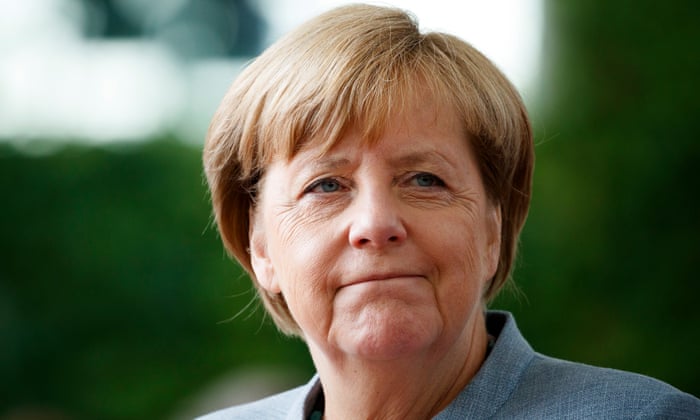
Angela Merkel: ‘I would say yes immediately if we were asked to join talks.’ Photograph: Carsten Koall/EPA
 Sunday 10 September 2017
 Germany would lend its weight to a diplomatic push to end North Korean nuclear weapons and missile development along the lines of a past deal with Iran, Angela Merkel has said.
The chancellor’s comments come days after the regime in Pyongyang claimed to have exploded a hydrogen bomb capable of being delivered on an intercontinental ballistic missile.
Pointing to the negotiations that led to Iran curtailing its nuclear programme as a possible model for tackling the crisis over North Korea’s nuclear and missile tests, Merkel said a diplomatic solution was the only viable way to resolve the crisis.
“I would say yes immediately if we were asked to join talks,” Merkel told the weekly newspaper Frankfurter Allgemeine Sonntagszeitung.
Her remarks came as the British defence secretary, Sir Michael Fallon, also stressed his desire for a diplomatic solution on Sunday. He said North Korea’s nuclear weapons programme must be halted before it developed a ballistic missile capable of hitting London.
Fallon said war must be avoided “at all costs” and stressed the desire for a diplomatic solution, given that the dangers of a “miscalculation” triggering a military response against North Korea were “extremely great”.
Meanwhile, Merkel said talks between Iran and six world powers, sealed with a 2015 deal for Tehran to roll back its nuclear programme and submit to inspections in exchange for some sanctions being rolled back, were “a long but important period of diplomacy” that had achieved a “good end”.
“I could imagine such a format for the settlement of the North Korea conflict. Europe and especially Germany ought to be ready to make a very active contribution,” Merkel said.
The chancellor said she had held telephone talks with the leaders of France, the United States, China, South Korea and Japan about the North Korea crisis over the past week, and she is expected to speak to the Russian president, Vladimir Putin, on Monday.
The United States is seeking a vote on a United Nations resolution which would impose the toughest ever sanctions on North Korea.
Fallon, speaking on BBC1’s The Andrew Marr Show, said: “What we have to avoid at all costs is this spilling over into any kind of military conflict.
“So we’re working flat out at the United Nations to get a better resolution there to enforce the existing sanctions, we’re looking at sanctions across the European Union, and of course we’re trying to persuade China to keep its neighbour in check.”
Asked if the situation was close to war in the Pacific, following threats against Guam, Fallon replied:
“I’m very concerned about the situation in the Pacific. The United States is fully entitled to defend its own territory, to defend its bases and look after its people. But this involves us. London is closer to North Korea and its missiles than Los Angeles.”
On whether North Korea has a ballistic missile capable of hitting London, Fallon replied: “Not yet, but they are clearly accelerating their missile programme.
“The range is getting longer and longer and we have to get this programme halted because the dangers now of miscalculation, of some accident triggering a response, are extremely great.
“So we’ve got to work at this problem and bring about a diplomatic solution that stops the development of North Korea’s nuclear programme and enforces the sanctions we have at the moment.”
Nato’s secretary general, Jens Stoltenberg, earlier refused to say whether an attack on the US territory of Guam would be covered by article 5, in which an attack on one member of the alliance is considered an attack on all.
He told the same programme: “I will not speculate about whether article 5 will be applied in such a situation. What I will say is we are now totally focused on how can we contribute to a peaceful solution of the conflict and press North Korea to stop its nuclear missile programmes.”
Washington has formally requested a vote on Monday on tough new sanctions for Pyongyang at the UN security council.
US diplomats have called for an oil embargo, an assets freeze against the North Korean leader, Kim Jong-un, a ban on textiles and an end to payments of North Korean guest workers in response to the nation’s sixth nuclear test last week.
But the measures could founder on opposition from the permanent security council members Russia and China.
