

University Accommodation Issues – Eastern University As Cross Roads
 The issues at the Eastern University raises many fundamental question in the administration of a University in Sri Lanka its policy and Autonomy of the Universities.
Hostel and Accommodation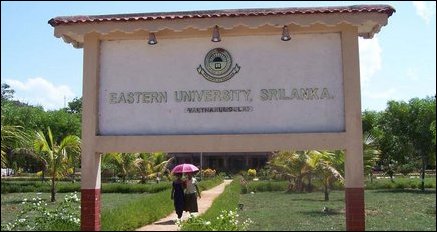
It is not far in history that the Universities had a policy of not giving hostels to students but promoting admission to the closest university to overcome such problem. It was recently that the Ministry had announced that they will give 100% accommodation to all students by 2018. These being political slogans have little reality on the ground. Nearly 30,000 students are enrolled each year to the university and on ball park figure 120,000 would be at the university system at any given moment of time assuming a 4 year course. This means on average a University should have at least 8000 students capacity at the Hostels of each university. At present none has it and none will have it for the next decade given the ground values. General principles have been to allow for first and final year accommodation at each university and additional allowed subject to the availability of space at the hostels. When students demand hostels beyond this and additional houses and accommodation are sought from private owners which range from 2000-10000 rupees per student. These have been given at some Universities including Eastern University. But large numbers find their own accommodation and pay the rent on their own sqeezing the budget of their parents. Why should only some be given the hostel outside paying for private accommodation while others pay for their own is an issue which may trigger a FR application. University would have no option but to pay all students accommodation allowance as a right if the policy is to provide ‘Accommodation to all’ which would mean on average “120,000×5000=600,000,000” six hundred million a month and 7.2 billion a year instead of accommodation. On the alternative if we only provide half then the value would be half of it, still considerable and to an university this would mean around 20 million per month. We understand Eastern University has a bill around 40 million for the existing private accommodations plus services for the a year. If the present crisis is resolved by additional accommodation it would warrant around another 50 million per year only catering to part of the students while others pay their own. Such being the reality in financial terms. The non availability of accommodation in large blocks is also an issue for the Universities to manage and smaller the house bigger the management needs trying to provide facilities.
On a different note, the reason for second year to live with the community also adds value to a multicultural society and the social harmony the country is trying to build. People should know the values of different cultures and their values specially as potential graduates who would eventually become leaders of the country. This practice is available in all universities not only in Sri Lanka but across the globe where Undergraduates live outside during their second years even working as their universities and not ‘free’. It is essential that under free education the values of education should not be traded for convenience. The inability of the students to live with the community may lead to looking at different alternatives other than provide hostel for all which is economically and administratively a nightmare for university administration;
- Outsource hostel accommodation where private accommodations are provided in the vicinity, as done in many countries
- Only send students who do not require accommodation to Universities; even currently some universities do not provide accommodation for the first and second years too.
- Revise the principles to allocate students closer to the university to avoid seeking accommodation
- Increase the university accommodation rates (present rates are close to zero and the clamour for the hostel accommodation is also related to the ‘free’ accommodation)
Accommodation adds other responsibilities to the University from canteens, water, sanitation to electricity failure, travel etc. It is unfortunate that an average Vice Chancellor spends around 60-80% of time on Hostel related issues. This leaves no room for the planning of the development of the Universities and many indiscipline also arises from hostel based issues than others in general. For example Ragging is one that is the maximum heard in the hostel related compounds than any other and eradication is not easy given the present context. This is one example.
Police and judiciary
When students violate the regulation to the point that the University administration is unable to handle e.g occupation of the Vice Chancellors office or senate or blockade of a place the University has only one option as a state institution report to the Police for assistance. The delay in action makes the university to paralyse as it has reached its maximum and cannot go beyond. In some cases the action had taken weeks for routine practice which needs to be considered. The University has no option than to close in such cases which needs to be avoided as it affects the entire student community pay for an offence of a few students. The issue becomes more complex when the first years write letters stating that they are against the zero ragging policy or state that they are operating on their own and with no interference from the seniors, options close for further actions. The usage of the anti-ragging act no 20 of 1998 may be the only useful tool and if used would lead to severe punishment by court. Though there is a feeling that this may ruin a student’s life some of the offences committed justify this as this would benefit a larger population of today and tomorrow in hundreds.
Judiciary too should be considerate and also fast in providing orders for these matter as dragging causes many further issues.
There needs to be defined framework designed for the Universities to follow when it goes beyond them and for the state to expedite the actions so that the University system is not damaged as it involved thousands of students struggling to begin their career ahead, the best minds of the country.
