

The Doomed King: A Requiem For Sri Vikrama Rajasinha
By S. Ratnajeevan H. Hoole –March 8, 2017

Prof. S. Ratnajeevan H. Hoole
Book Review: Gananath Obeyesekere’s The Doomed King: A Requiem for Sri Vikrama Rajasinha, Sailfish, Colombo, 2017. 409 pages. SL Rs. 1500, US$20, £16, €20.
 This fascinating book opens with the anonymous quotation: “In order to survive as a nation people have to truthfully invent falsehoods.”
This reminded me of my own article from April 2013 on “Heritage Histories.” We create false histories to define who we are in superior light – our caste, race, religion, language, schools etc. – and when these are questioned, it is soul wrenching. This is such a book. It is gratifying to have a Sinhalese Emeritus Princeton University Professor laying bare the Sinhalese myths built around the last king of Kandy.
The Doomed King
The Doomed King
 Lankan school texts unflinchingly claim that the Sinhalese came to Sri Lanka as settlers and the Tamils as invaders. Tamils cry foul, but cannot see that we do the same to our minorities – claiming that Muslims are low caste Tamils, that the Tamil Bible was translated by the Hindu Leader Navalar who taught Tamil at the age of 12 to the actual translator Peter Percival; and that C.W. Thamotharampillai who discovered some of the oldest Tamil books and whose infant baptism is a matter of record, was a born-Hindu pretending to be a Christian for privileges. Worse, ancient roots are ascribed to the relatively new Sinhalese language by calling Brahmi inscriptions proto-Sinhalese – as absurd as giving English ancient vintage by calling British Roman inscriptions proto-English.
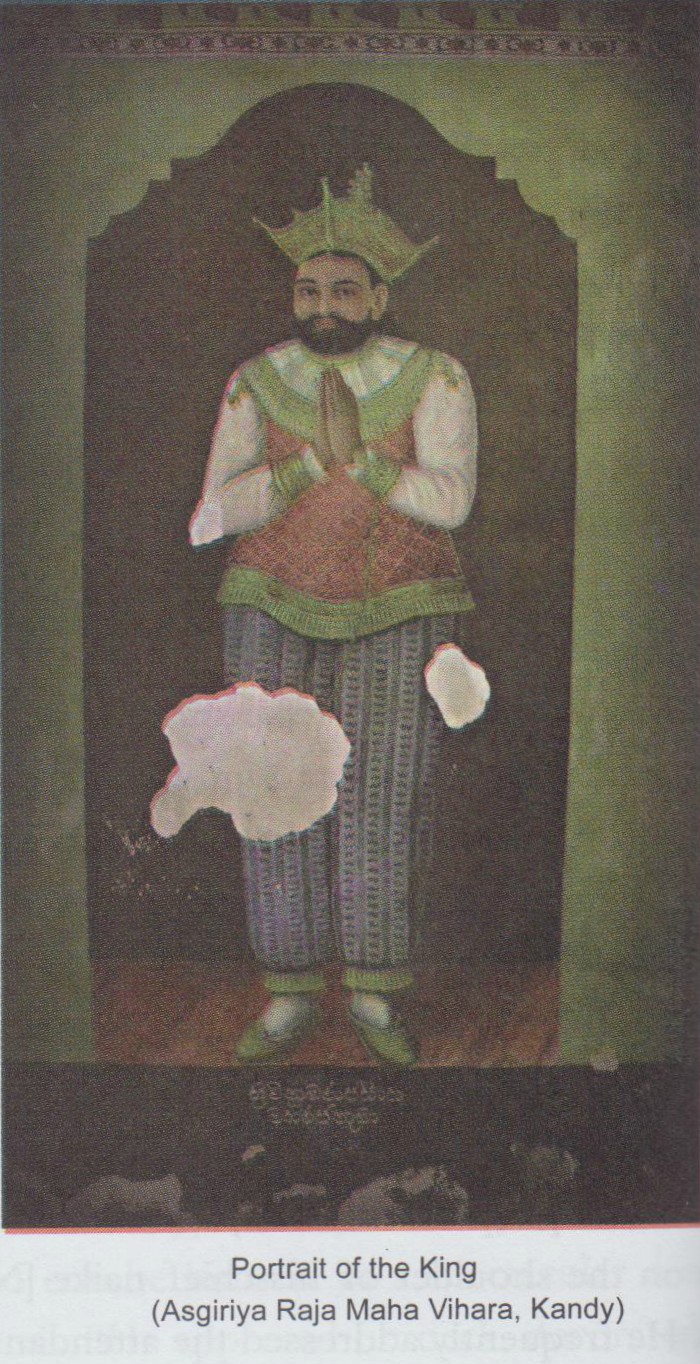
Sri Vikrama Rajasingha (SVR)My wife had already read our daughter’s copy with all footnotes. When I got my copy she wanted to re-read it and we literally fought for our turns and finished it in a day. Such is the gripping nature of Gananath’s narrative.
Gananath terms the deposing of SVR as the most momentous event in Lankan history because it marked the end of independence. Nayaka rule begins with the death of the childless Narendrasingha (1707-1739) who had appointed his Nayaka brother-in-law Sri Vijaya Rajasinha as Yuva Raja (sub-king). The Nayakas were warriors from Andhra Pradesh and Karnataka who had established their empire in Tamil country, especially Thanjavur and Madurai from where the Kandyan kings obtained their royal brides.
The Sinhalese saw the Nayakas as Tamil. SVR’s end is owed to the British demonizing him with a view to invading Kandy on the pretext of freeing the people from tyranny, and the Englishman John D’Oyly using numerous Buddhist monks as his spies to prepare for the invasion. To these Buddhists, the English King was preferred to this so-called Tamil king. The popular account from D’Oyly, “deliberate misinformation from [the traitor] Ahelepola’s Sabaragamuva loyalists,” is the stuff of school texts from my time.
 SVR is made villainous in the execution narrative of the wife and children of Ahelepola who was working with the British against SVR. He, his wife Kumarihami, children and his brother and wife were all sentenced to death. Ahelepola escaped. He could have saved his family by surrendering but failed them. The eldest, 11 years old, clung to his mother, terrified and crying. The second nine-year-old son, stepped forward showing his brother how to die. His head, severed by a sword was put in a rice mortar and the pestle given to the mother to pound it. The infant at the mother’s breast was decapitated. The milk he had drawn flowed mingled with blood. SVR is said to have watched all this with a crowd.
Gananath does not believe any of this, asking how it leaked out. He adds “surely not through the king’s executioner, very likely the only witness to the event.” The so called assembled crowd, Gananath puts down to John Davy the British surgeon’s inventiveness, “from British practices where crowds gathered at executions in a carnival-like atmosphere.” Having passed by an LTTE execution of a “traitor” husband and wife couple at Urumpirai where ice-cream and gram vendors were gathered and school children gleefully watched over these treats, I am not so certain the habit was not already introduced by the Dutch as seen from the gallows on the Jaffna Fort ramparts.
