

Privatization Of Education: Fight Should Not Only Be About SAITM

By Anushka Kahandagama –February 6, 2017

Anushka Kahandagama
SAITM has been an issue for a considerable time and was seen as the icon for privatizing education in Sri Lanka. The debates around this issue are varying. One of the arguments drawn was that, this is the end of free education and this might badly affect the quality of the country’s health care. Private hospitals and privately owned dispensaries are on the rise. It doesn’t matter whether public hospitals provide quality health care or not, most of the people prefer private health care. Most of these doctors who do private practice are attached to a Government hospital.
They use the off-time to serve for the people who come to get their service for money. Then, these doctors are no doubt burdened with overwork, which definitely affects the quality of the service they provide. Although not commissioned by this particular factor, past events suggest that, there were many medical negligence which led to loss of limbs of people and sometimes loss of life.
Another argument is that, while all the other disciplines have been privatized over these past years, it is ironic only to resist the privatization of medical education. Although this logic seems fair in abstraction, there should be a higher ideal for medicine as medical education directly deals with the lives of the people.
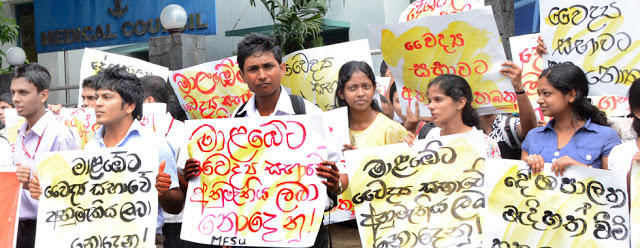
The argument against SAITM as an attempt to privatize Sri Lankan education is lacking in strength as the privatization did not start yesterday. Private tuition classes are the un-talked of yet mostly prevalent and obvious privatization of education in the country. The common understanding is that, the students who enter into the Government University System are a sole product of Government Schools, which is not true. Some of them are from international schools and some of them spend much time in private tuition classes rather than the schools. Furthermore, most of the teachers who are Government teachers do teach in private tuition classes. The problem of privatization intersects with many other socio-economic and political factors, which cannot be taken out of the context and analyses. However, when it comes to the point of private tuition classes, some of the students take many classes for one subject and get through their A/L and O/L. How can one ignore this fact completely and fight for the protection of the free education in Sri Lanka?
Sri Lanka provides free health care and education. Against this background, Sri Lanka managed to achieve a better position in the Human Development Index. Establishing SAITM is not only an attack on free education, but also an indirect influence on free health care system in the country as it might further encourage the privatization of health care.
Keeping health care and education free in a system where all the other sectors have succumbed to neo-liberal economic policies are pointless. All the other factors which are market driven and based on neo-liberal economic policies would certainly drive health care and education towards privatization. But, the only difference would be these forms of privatizations are subtle, hidden and sometimes beyond the boundaries of the nation state.
