

Democracy, Secularism & National Reconciliation

The fate of the programme of national reconciliation hangs on the capacity of the government to implement the resolution of the U. N. Human Rights Commission, of which Sri Lanka was a sponsor. A Charismatic and strong leadership endowed with maturity of wisdom and enriched with enlightenment is the need of the hour to usher in a new era of hope, co-existence, harmony and unity.
By S. Pathmanathan – Professor Emeritus in History at Peradeniya, Former UGC Vice Chairman, and Chancellor of University of Jaffna
Presented by: Prof. S. Ratnajeevan H. Hoole at the public meeting on the theme of Secularism titled “An Evening with Shri Navin B. Chawla on Mother Teresa, Now Saint Teresa of Calcutta”
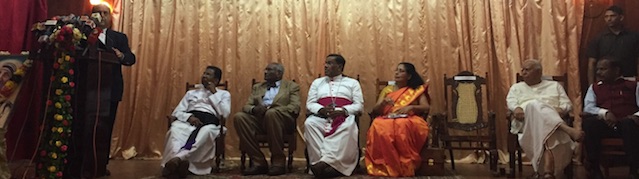
Photo -L to R; Shri Navin Chawla, The Ven. Sam Ponniah, Prof. S.R.H. Hoole, The Rt. Rev. J.B. Gnanapragasam, Dr. Dushyanthi Hoole, Hon. R. Sampanthan, HE A.Natarajan
Madame Chairman, Shri Navin Chawla, My Lord Bishop, The Honourable R. Sampanthan, Your Excellency A. Natarajan, Reverend Sirs, Sisters in Holy Orders, Distinguished Mesdames et Messieurs: Good afternoon.
I am deeply humbled that Prof. Pathmanathan has chosen me to read his talk. I am gratified not least because our thinking is very much aligned, and I am able to endorse everything he says here. Without further ado, let me turn to Professor Pathmanathan’s weighty thoughts of great relevance today as the role of religion in our proposed new constitution is debated.
Democracy and Secularism, as conceived presently in the South Asian context, have their origins in the colonial past, particularly under Pax Britannica. They are so interconnected that one cannot speak about either without reference to the other. The theory and practice of democracy have a long history. They had their origins in the ancient Greek civilization. At least once in a lifetime a free Greek citizen was expected to participate in the process of decision-making in the affairs of government. This was possible in the small Greek republics spread over the Mediterranean world.
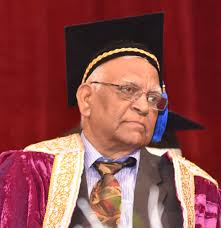
Chancellor S. Pathmanathan
The Greek conception of democracy has caught the imagination of political theorists and intellectuals in the medieval ages in Europe. It became the source of inspiration for the struggle against tyranny and despotism. Democracy had the promise of redemption from arbitrary exercise of power and authority and establishing a commonwealth of citizens in the form of a state with equality for all, and where the laws were supreme.
Political theory in relation to democracy was elaborated and refined with intellectual vigour by John Locke, Thomas Jefferson and Jean Jacqes Rousseau and a host of others. Rousseau made the people supreme and the state an instrument of their will. The Sri Lankan experience has to be examined against this background.
As in India and many other parts of the British empire, Democracy has been a transplant and sometimes without any consideration for the local environment. The scope of British democracy was also limited. They imposed a highly centralized system of administration and passed it over to the parliament of Sri Lanka in 1947. It had a great opportunity to foster and develop the traditions of harmony and co-existence among the principal communities, the Sinhalese and Tamils. However, the developments were in the reverse direction. The deficiency in the constitution and the political opportunism of those who sought to achieve power and retain it were among the combination of factors that led to this development.
