

Unexpected talks on Syria to take place this weekend, says Moscow
Switzerland meeting suggests US decision to abandon contact with Russia because of airstrikes on Aleppo has been reversed
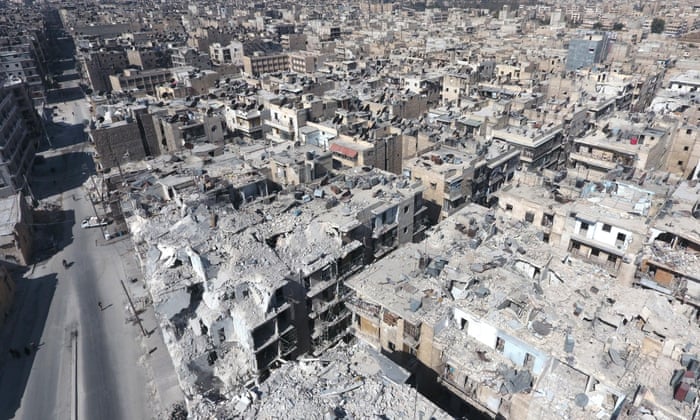
A US-Russia brokered ceasefire broke down after the bombing of a UN humanitarian convoy outside Aleppo. Photograph: Anadolu Agency/Getty Images

An unexpected round of multilateral talks on the future of Syria is to start on Saturday involving initially Russia, the US, Iran, Turkey and possibly Qatar, the Russian foreign minister, Sergei Lavrov, has said. The talks will be held in Lausanne, Switzerland.
Lavrov told CNN he hoped the weekend talks could help “launch a serious dialogue”.
The meeting means the US secretary of state, John Kerry, has reversed his decision to abandon contacts with Russia over Syria. Kerry only made that decision a few days ago in protest against Russian airstrikes on Aleppo and Moscow’s reluctance to rein in the Syrian president, Bashar al-Assad.
Kerry ended contacts after a US-Russia brokered ceasefire broke down in a welter of recrimination over whether the Russians had deliberately bombed a UN humanitarian convoy outside Aleppo. The attack has led to a UN inquiry, but the west has said all the available evidence points to Russian responsibility.
The US accused Russia of barbarism after the convoy attack. President Vladimir Putin countered by shelving a 2000 deal on the disposal of weapons-grade plutonium and cancelling a bilateral agreement on research cooperation between Russia and US nuclear sectors.
A subsequent French effort to secure a ceasefire agreement at the UN security council at the weekend was vetoed by Russia on the grounds there was no clear commitment that jihadi forces in eastern Aleppo would leave the city.
It was not clear whether any EU country will be invited to the Lausanne talks, a decision that would mark a break from previous diplomatic negotiations on Syria. The EU, including France Germany and the UK, has been part of the wider International Syria Support Group. The US State Department indicated that there would be a subsequent full meeting of the Friends of Syria Group, which comprises the US, EU countries and the Gulf states.
Analysts presume that Kerry – desperate for a durable ceasefire before the Obama administration comes to a close – has been given a fresh indication of Russian flexibility for him to decide to back down and attend the talks.
The presence of Turkey, Saudi Arabia, Iran and Qatar at the Lausanne meeting suggests there will be a focus on whether non-jihadi Syrian opposition fighters are willing to disentangle themselves from al-Nusra Front.
Although al-Nusra has changed its name to Jabhat Fateh al-Sham, both the US andRussia believe the group has retained its links to al-Qaida, and must therefore be regarded as a proscribed group.
But many opposition fighters backed by the west will not break with al-Nusra.
The UN has been trying to revive the ceasefire by proposing that 1,000 or so of the jihadi group’s fighters be escorted from Aleppo to a safe place in return for a commitment from Moscow that Russian and Syrian air forces will cease airstrike and allow the delivery of humanitarian aid to the 250,000 civilians in the city.
On Tuesday, Putin cancelled a trip to Paris, accusing the French of trying to set up a Russian veto on Syria at the UN security council last weekend. France claimed the Russian president was embarrassed to talk about Syria.
Western officials are increasingly convinced that Russia uses diplomatic negotiations as a cover to continue military activity in Syria and say that the west can no longer afford to believe Russia is seriously seeking a diplomatic solution instead of a military one.
Diplomats believe a wider ceasefire in Syria – let alone peace talks to end the conflict – will not be considered unless there is an end to to the impasse over Aleppo.
Separately there are German-led discussions under way on whether economic sanctions should be widened against Russia. Germany has previously been seen as one of the countries least eager to impose wider sanctions on Russia, but the issue is likely to be discussed at the next meeting of EU heads of state in Brussels on 20 October.
In response to that sanctions threat, the speaker of Russia’s upper house of parliament, Valentina Matvienko, said: “Only the United Nations is authorised to impose sanctions in case of grave rights violations. All other sanctions, including those against Russia, are illegitimate and unlawful.”
The leaders of Russia, Germany, France and Ukraine are due to meet in an attempt to find a peace settlement in eastern Ukraine, one of the issues that has damaged Russian relations with Europe. The meeting will only go ahead, probably next Wednesday, if there is a sign that it will reach an agreement on the next stage of de-escalation set out in the Minsk agreement.
