

The State Of Reconciliation

By S. I. Keethaponcalan –September 22, 2016

Dr. S. I. Keethaponcalan
Despite the intensity of the ethnic conflict, reconciliation always remained an attractive scheme or slogan for many civil society actors and political figures in Sri Lanka. With the end of the war in 2009, reconciliation transformed into an integral part of the political discourse. Many believed that the termination of the LTTE, bestowed an opportunity to bring the hitherto divided communities together through political means. The government headed by President Rajapaksa, who defeated the LTTE, was keen on bringing the land together rather than the people. Leaders of the former government chose to intensify security measures and the restrictions on the Tamil people to achieve the goal of territorial integration. The Rajapaksa government also ignored the international call for accountability as a means to reconciliation. This approach obviously dissatisfied the Tamil community, thus leading to further ethnic polarization.
Government and the Tamils
Consequently, the Tamil people collaborated with the predominantly Sinhala South, to bring the Rajapaksa government down in 2015. The main Tamil party, the Tamil National Alliance (TNA), extended unconditional support to the coalition that opposed Rajapaksa and facilitated the election of President Maithripala Sirisena. Despite being the main opposition party, the TNA tacitly works with the present government. Therefore, the government and President Sirisena are viewed as sympathetic to the Tamil issues and are expected to address Tamil political concerns.
The government also co-sponsored the United Nations Human Rights Council (UNHRC) resolution on Sri Lanka, adopting the international view that alleged human rights violations should be investigated with international assistance. During and after the presidential election, Sirisena promised constitutional reform as a means to promote good governance and reconciliation. In other words, constitutional reform was conceived partly as a reconciliation project. On the other hand, the government to date has not done anything to investigate the alleged human rights violations, as promised. The investigative mechanism the government promised has been stagnated at the point of discussion whether international assistance is needed for an investigative mechanism.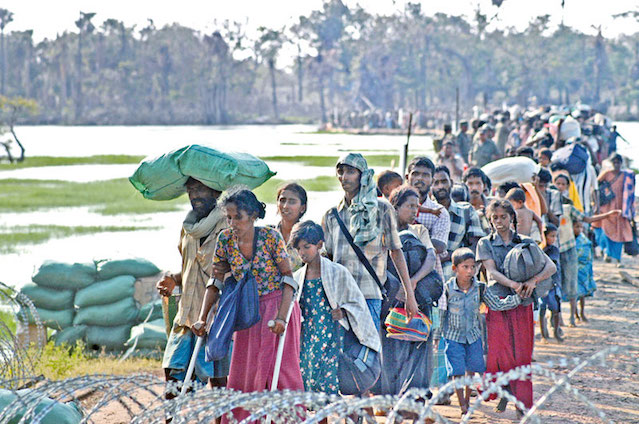
The government also co-sponsored the United Nations Human Rights Council (UNHRC) resolution on Sri Lanka, adopting the international view that alleged human rights violations should be investigated with international assistance. During and after the presidential election, Sirisena promised constitutional reform as a means to promote good governance and reconciliation. In other words, constitutional reform was conceived partly as a reconciliation project. On the other hand, the government to date has not done anything to investigate the alleged human rights violations, as promised. The investigative mechanism the government promised has been stagnated at the point of discussion whether international assistance is needed for an investigative mechanism.
Reconciliation through Reform
What is clear from the government attitude is that it believes more on constitutional reform to address minority concerns rather than the investigation. If this is true then there has been a philosophical similarity between the Rajapaksa government and the Sirisena government on this issue. Senior members of the Rajapaksa government, such as Gotabaya Rajapaksa, have constantly emphasized the importance of forgetting the past, i.e., the last phase of the war, and moving forward. They relied on national security to move forward and did not have a plan to structurally accommodate the minority communities. The former government promoted selective public amnesia as atrocities of the LTTE were remembered and the war victory was celebrated with the patronage of the state.
