


 Monday, 5 September 2016
 The promise to increase the expenditure on education and healthcare services
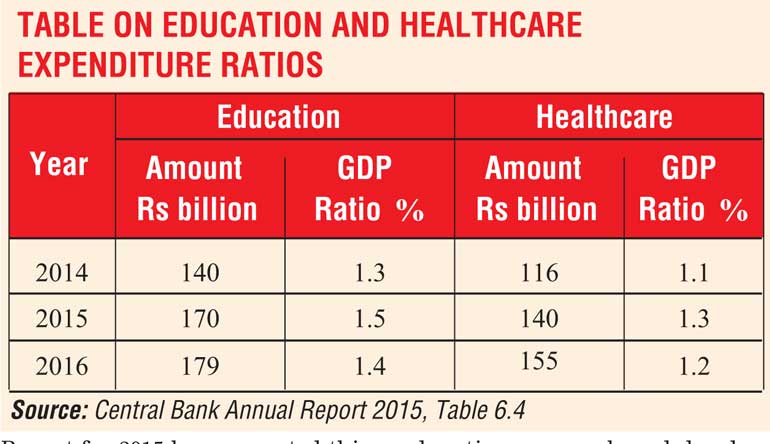
University academics had agitated from around 2012, coupling with their demand for a hike in salaries and other perks, for an increase in government expenditure on education to a level equal to 6% of GDP. There was a prolonged strike accompanied by a long march by them to pressurise the Government in power at that time for acceptance of their demand.
Yet, the response from the Government was poor. Seizing the opportunity, the United National Party in its election manifesto presented during Parliamentary elections in August 2015 made two promises to the electorate.
One was to progressively increase the expenditure on education to 6% of GDP. The other was to increase the expenditure on healthcare services to 3%. Later, Prime Minister Ranil Wickremesinghe, in his economic policy statement presented to Parliament in early November 2015, reassured the delivery of these two promises. Even Finance Minister Ravi Karunanayake, while refraining from mentioning any ratio, elaborated on the need for increasing these two items of expenditure in the Budget Speech he delivered in late November 2015.
Thus, the avowed goal of the new Good Governance Government has been to spend more on education and healthcare services for developing a healthy talent base, an essential component of the Government’s social market economy ideology based on both ‘knowledge’ and ‘competition’.
The need for using the money productively
The Government expenditure at 6% of GDP on education and 3% on healthcare is not a magic number. A Government can go up to these numbers but could still end up in disaster, if such expenditure is not productively utilised. As this writer has highlighted in previous articles, there are many ground conditions that are needed to be satisfied for a nation to get the best out of such expenditure programs (Available at: http://www.ft.lk/article/169481/Inconclusive-debate-over-Sri-Lanka-s-education--Education-may-deliver-garbage-but-remove-garbage-elsewhere-too and
http://www.ft.lk/article/484721/Part-6--Social-Market-Economy-%E2%80%93-Education-should-be-reformed-to-create-creative-capital-and-not-mere-human-capital).
Inventions should be followed by innovations
Education should develop scientists and they should have funds and facilities to conduct research. That research will bring about inventions that lead to technological advancements. Then, there should be entrepreneurs who are willing to take risks by adopting the new inventions made by scientists. Entrepreneurs should be supported by funds and protection so that they could put the inventions into commercial practices. Then, there should be mechanisms for both parties to come together and make available the products they produce to the ultimate users. The need for combining inventions with innovation was elaborated in a previous article in this series (available at: http://www.ft.lk/article/478857/Part-4--Social-Market-Economy--Universities--research-institutions-as-catalysts-of-an-innovation-economy).
To produce for the export market, access to science and technology is a must
The users of new products are both within Sri Lanka, called the domestic economy, and outside Sri Lanka, called the global economy. Since Sri Lanka’s domestic economy is small, it cannot gain a sufficient advantage by just producing only for the domestic economy. Its production outfits should necessarily have an eye on the global economy which the Prime Minister labelled in his economic policy statement as ‘producing for a market bigger than the market in Sri Lanka’.
But to produce for such a bigger market, Sri Lanka should have access to modern science and technology. Thus, it is a must that Sri Lanka should spend a higher proportion of its income on education, science and technology development that should be associated with proper marketing to generate innovations.
