

The re-nationalisation of SriLankan Airlines and the follies of State enterprise


A couple of weeks ago, Prime Minister Ranil Wickremesinghe announced that the debts of SriLankan Airlines, amounting to a mammoth US$ 3.2 billion, will have to borne by the taxpayer. He said the government is taking this action to defuse an economic ‘landmine’ and that his government is actively looking for an international partner to manage the airline.
When a three billion dollar bill is passed on to ordinary Sri Lankans, many of whom have never flown the airline, it’s worth examining what let do this disastrous situation. In examining the data, it’s clear that Srilankan Airlines provides an excellent example of the problems that arise from state-owned enterprises.
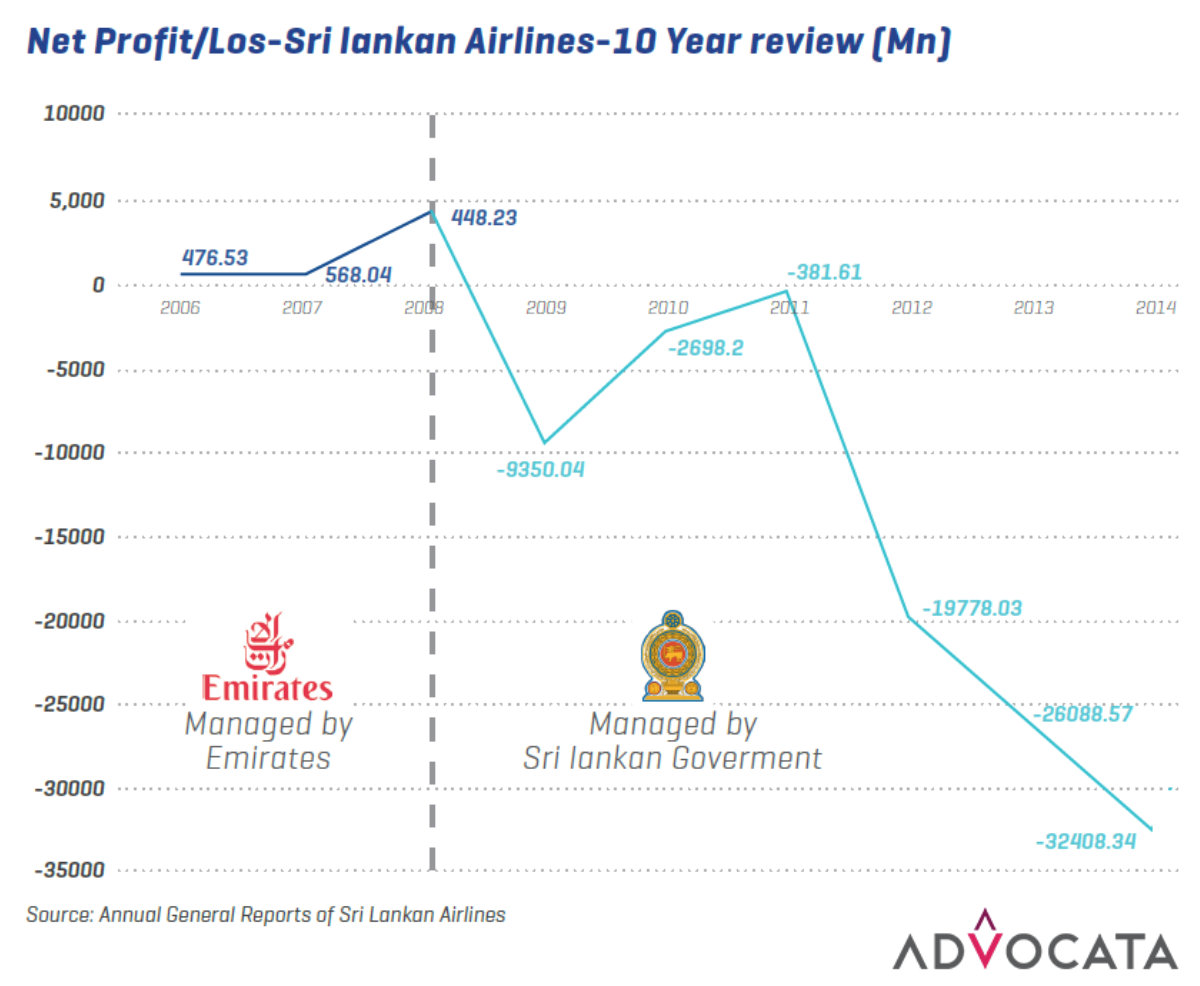
Air Lanka, the state-owned airline was privatised in April 1998. The government of Sri Lanka sold a 40% shareholding to Emirates Airlines, which was also contracted to manage the company for a period of 10 years. The government of Sri Lanka continued to retain the majority shareholding but management was relinquished to Emirates.
Emirates re-branded the airline as ‘SriLankan’, overhauled the airline’s infrastructure and adopted a new approach to its operations. Cost-effective strategies were introduced; new pro-active management teams were put in place; Information technology became the basis of everyday activities. The airline’s network was constantly reappraised and product enhancement became a part of the airline’s philosophy. The airline was completely re-fleeted with an all-Airbus fleet of A340, A330 and A320 aircraft replacing the ageing Lockheed Tristars.
Although the privatisation and restructuring attracted a lot of criticism at the time, the exercise was eventually deemed a success; indeed in many quarters it was hailed as model for other airlines.
At an international seminar on airline restructuring and privatisation, held a couple of years after the divestment; the President of the employees union of Srilankan spoke on how union rights were protected and the improvement of working conditions.
At the time of the privatisation all employees were gifted shares by the government based on the number of years of service. Although a voluntary retirement scheme was also implemented the President of the union stated that employees were given an excellent deal if they wanted to leave and no-one was made redundant. Collective Agreements signed by the airline with employee unions guaranteed increments to employees. New human resource development programmes were instituted after privatisation to upgrade employees’ skills and a new grade and pay structure put in place.
Union representatives from other state-owned airlines were also impressed by the manner in which the airline disclosed information to employees; “they had never seen such transparency from an airline’s management,” said K J L Perera president of the employees union. SriLankan published its quarterly financial results in its staff newsletter.
