

Philippines election: voters go to polls as frontrunner pledges to kill criminals
Rodrigo Duterte issues threat to ‘drug pushers, hold-up men and do-nothings’, after outgoing president Benigno Aquino compares him to Hitler
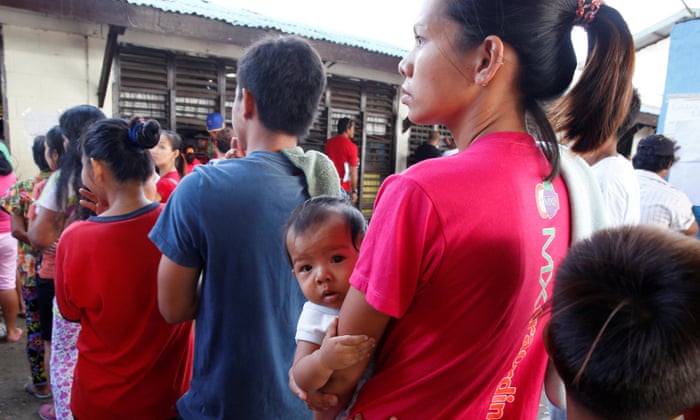
A woman queues to vote during elections in Davao city. The final stages of the campaign have been marked by threats and abuse. Photograph: Erik de Castro/Reuters

Voting has begun in the Philippines in a general election that opinion surveys suggest will see a tough-taking mayor, dubbed “the Punisher” for his lax attitude to extrajudicial killings, clinch the presidency.
Rodrigo Duterte, a 71-year-old ex-prosecutor, has run an obscenity-filled campaign in which he has boasted about Viagra-fuelled affairs and joked about raping a missionary.
Rights groups allege Duterte allowed death squads to kill more than 1,000 suspected criminals during his two decades as mayor of Davao city, an accusation he has at times denied and at other times bragged about.
The political establishment has warned that years of solid economic growth is threatened and foreign governments have looked on with trepidation as the country is a key regional player in the South China Sea dispute with Beijing.
The front-page headline of the Philippine Star newspaper on Monday summed up the anxiety: “It’s judgment day”.
In his last campaign speech on Saturday, Duterte, whose quick-fix plans to end crime and corruption have wooed voters, said there would be mass killings of criminals under his presidency.
“Forget the laws on human rights,” he said. “If I make it to the presidential palace, I will do just what I did as mayor. You drug pushers, hold-up men and do-nothings, you better go out. Because … I’d kill you.”
Duterte’s opponents are most fearful of his threats to abolish congress or create a revolutionary government. The Philippines, the first democracy in south-east Asia, prides itself on ousting late dictator Ferdinand Marcos in 1986.
In the five-way race with Duterte 10 poll points ahead, the outgoing president, Benigno Aquino, launched an 11th-hour attempt on Friday to unite the other candidates against him. Aquino had hoped they would rally their voters around his preferred successor, Manuel “Mar” Roxas, who is the grandson of a Filipino president.
But despite Aquino’s threats that Duterte is a dictator-to-be, the plan never materialised. Senator Grace Poe, former international criminal court judge Miriam Santiago and the current vice-president, Jejomar Binay all rejected the talks.
Recent preferential candidates surveys have given Duterte 33% in a system where contestants do not need a majority to win. Benigno Aquino won in 2010 with 42%.
Fifty-four million people are registered across the archipelago nation of more than 7,000 islands. Monday’s election is for 18,000 local and national representatives, including the president and vice-president, half of the senate, all governor posts, all mayors, and all city and municipal councils.
The election has seen violence, which is common in Philippine politics. On Saturday, a mayoral candidate was shot dead in the south by a gunman. And just hours before polls opened on Monday, seven people were shot dead when a convoy of vehicles was ambushed in Rosario, just south of the capital Manila.
Campaigning has ended, although in the capital over the weekend there were still supporters driving through the streets on motorbikes with their candidate’s names written across their backs and music blaring from speakers.
Voters are drawn to Duterte’s promise to tackle corruption in a country that has seen 6% economic growth on average while residents of slums still struggle to buy food. Many are frustrated with the political status quo in which a small clique governs the country.
Eufracia Taylor, Asia Analyst at risk consultancy Verisk Maplecroft, said the Philippines was in a strong position and it would take a lot to unravel the achievements of the Aquino administration, although she added Duterte was a “wild card”.
“The competition for the presidency has essentially become a battle between ‘status quo’ candidates and ‘sharp turn’ candidates. The public is split between supporters for a president seen as safe hands or one who will drive drastic, and potentially divisive, change.”
The campaign turned sour over the weekend with the outgoing president comparing Duterte’s rise to that of Hitler and the mayor responded that Aquino was a “son of a whore”.
Observers have linked Duterte’s demagogic rise with that of US Republican frontrunner Donald Trump. Although Duterte calls Trump a “bigot”, they were both dismissed by the political establishment before becoming serious contenders.
The anti-establishment mentality has also led to the rise of Marcos’s son, Ferdinand Marcos Jr, who looks likely to win the vice presidency.
The unity plan to block Duterte, which observers say came too late, illustrates the disbelief from the Philippines’ political dynasties.
When asked by reporters if she was open to talks, Grace Poe, the adopted daughter of a late movie star, replied “why not?” but she added: “At this point, what is there to talk about?”
The failed plea further divided the presidential hopefuls, with Roxas saying Poe had “rejected and ridiculed my offer”.
“Senator Poe said there’s nothing to talk about and I’m surprised. Isn’t the biggest threat to our democracy, the weakening of the peso, the risk of losing investments, an urgent matter?” Roxas said.
A campaign adviser for the vice-president, Jejomar Binay, who voted early on Monday, said his candidate would not be joining unity talks.
“We’re going to win. We don’t need to join anybody. If they want to join us they’re welcome,” former interior secretary Ronnie Puno told reporters in Manila.
Duterte’s campaign manager, Leoncio Evasco, responded to Aquino’s plan in a statement, saying: “Only a man on the verge of defeat can issue such frantic calls.”
AP and AFP contributed to this report
