

MR in Uganda Birds of a feather flock together...


 ast week, ex-President Mahinda Rajapaksa travelled to Uganda to grace the inauguration ceremony of President Yoweri Museveni, who was sworn-in for his fifth term. It could have been a bitter sweet moment for MR, who like his host, dreamt of being the President for life and amended the constitution to that effect, but, alas, then lost the election to his former health minister. MR was among an illustrious gathering of African leaders, including Chad, Ethiopia, Kenya, Somalia, South Africa, Tanzania, Zimbabwe and Sudan’s Omar al-Bashir, the last named is implicated by the International Criminal Court for crimes against humanity.
Some Western envoys at the event reportedly walked out in protest after the host made disparaging comments about the ICC. If the Ugandan President- who unlike our local politicos has not forgotten his old friend in his bad times -- is just another tin-pot dictator, that would not make much news. After all, Africa has bulk produced such individuals over the decades. On the contrary, Museveni was earlier feted as a new African statesman and a pioneer of a new generation of smart African leaders, who had a vision and a drive to bring stability and relative prosperity to a region ravaged by kleptocratic despots, warlords and cross-dressing cannibals.
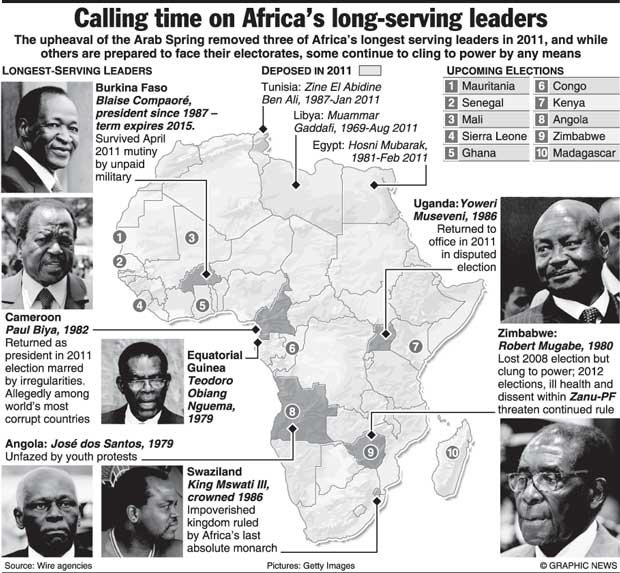
Under Museveni, who first came to power in 1986 ending a long running civil war and later elected to presidency in 1996, Uganda has recorded steady economic growth, investment has flown in (So did some Ugandan Indians who were early kicked out by Idi Amin) and the country has introduced free primary education. However, over the time, Museveni, like his Sri Lankan counterpart succumbed to the temptation of power, amended the Constitution to remove presidential term limits, and now rules the country for his fifth term. Vigour and drive that defined his earlier decades have now withered away and a gradual political decay has set in. However, this temptation for presidency for life is not exclusive to Messrs Rajapaksa and Museveni, a whole bunch of African leaders have either removed presidential term limits or are considering to do so. They include another African leader, Paul Kagame of Rwanda who envisions to turn his genocide-ravaged country into a Singapore and some other less salubrious and less competent individuals such as the presidents of the Democratic Republic of Congo Josep Kabia. Another, the president of Burundi who ran and won a third term against public protests has brought the country to the brink of a civil war.
Our own ex-President holds both similarities and differences to those African strongmen who succumbed to the perpetuation of power. Like Museveni or Kagame, MR was a competent leader, who was called into serve the nation at some decisive juncture of the nation’s history. Also the different social political culture he came from, limited his room for manoeuvring even after he accumulated near absolute power and finally he lost the election.
- See more at: http://www.dailymirror.lk/109529/MR-in-Uganda-Birds-of-a-feather-flock-together-#sthash.a79Q5lNN.dpuf
2016-05-15
ast week, ex-President Mahinda Rajapaksa travelled to Uganda to grace the inauguration ceremony of President Yoweri Museveni, who was sworn-in for his fifth term. It could have been a bitter sweet moment for MR, who like his host, dreamt of being the President for life and amended the constitution to that effect, but, alas, then lost the election to his former health minister. MR was among an illustrious gathering of African leaders, including Chad, Ethiopia, Kenya, Somalia, South Africa, Tanzania, Zimbabwe and Sudan’s Omar al-Bashir, the last named is implicated by the International Criminal Court for crimes against humanity. Some Western envoys at the event reportedly walked out in protest after the host made disparaging comments about the ICC. If the Ugandan President- who unlike our local politicos has not forgotten his old friend in his bad times -- is just another tin-pot dictator, that would not make much news. After all, Africa has bulk produced such individuals over the decades. On the contrary, Museveni was earlier feted as a new African statesman and a pioneer of a new generation of smart African leaders, who had a vision and a drive to bring stability and relative prosperity to a region ravaged by kleptocratic despots, warlords and cross-dressing cannibals.
Under Museveni, who first came to power in 1986 ending a long running civil war and later elected to presidency in 1996, Uganda has recorded steady economic growth, investment has flown in (So did some Ugandan Indians who were early kicked out by Idi Amin) and the country has introduced free primary education. However, over the time, Museveni, like his Sri Lankan counterpart succumbed to the temptation of power, amended the Constitution to remove presidential term limits, and now rules the country for his fifth term. Vigour and drive that defined his earlier decades have now withered away and a gradual political decay has set in. However, this temptation for presidency for life is not exclusive to Messrs Rajapaksa and Museveni, a whole bunch of African leaders have either removed presidential term limits or are considering to do so. They include another African leader, Paul Kagame of Rwanda who envisions to turn his genocide-ravaged country into a Singapore and some other less salubrious and less competent individuals such as the presidents of the Democratic Republic of Congo Josep Kabia. Another, the president of Burundi who ran and won a third term against public protests has brought the country to the brink of a civil war.
Our own ex-President holds both similarities and differences to those African strongmen who succumbed to the perpetuation of power. Like Museveni or Kagame, MR was a competent leader, who was called into serve the nation at some decisive juncture of the nation’s history. Also the different social political culture he came from, limited his room for manoeuvring even after he accumulated near absolute power and finally he lost the election.
