

ETCA or any other policy is destined to fail if
not properly managed
 The best economic policy doesn’t guarantee its success
Monday, 14 March 2016
 A country may have the best economists who could come up with a set of best economic policies. Simply because a ‘policy is the best’ does not mean that it would be a success. That is because policies are implemented in the field among people of diverse interests, tastes and ambitions. The list of such people is long. But the key characters, loosely called ‘stakeholders’, include the people at large, critics, Parliamentarians, bureaucrats and foreigners. A policy becomes successful only when it is managed properly among its stakeholders.
Getting support of the people for policies without tears and pains
Economic policies in the past, specifically those intending to introduce market reforms, budgetary discipline, stability in the domestic prices and the exchange rate, have been failures mainly because of the bad policy management. These policies become necessary when a country has ‘lived beyond its means’ creating vast holes within the economy which cannot be filled with available resources. The inevitable corollary is the ballooning of the country’s indebtedness to its own citizens in the case of domestic debt and to foreigners in the case of foreign debt. This, however, worsens the country’s ailments because, now, more and more resources have to be utilised to service the creditors.
The reversal of the trend calls upon people to sacrifice the wellbeing which they have been enjoying unabashedly. But when the situation becomes chronic and acute, as was the case with Greece in the recent past, there is no alternative except getting people to tighten their belts. But, how to get the people to tighten the belts without ‘tears’ and ‘pains’ is the challenge before governments that are required to introduce such painful economic reforms.
Critical economic crisis faced by Sri Lanka
Sri Lanka today is exactly in such an economic mess. Its debt levels have grown beyond its ability to service them without tightening the belts of the Government. In the recent past, the money spent by the Government for repaying debt and paying interest has been more than the Government revenue. Hence, without funds for maintaining the normal services, the Government had to incur more debt not only to repay the principal but also to pay interest on the past borrowings.
This is a critically vulnerable situation for Sri Lanka. Despite the growth in the economy, the Government revenue had fallen as a ratio of the country’s total output, known as the Gross Domestic Product or GDP. Since there was no corresponding cut in the expenditure, the deficit in the budget remained stubbornly high. An artificial reduction in the budget deficit as a ratio of GDP was attained not by cutting the Government’s consumption expenditure, but by curtailing its capital expenditure. The result was the slow growth of the country’s capital stock stunting its future growth potential.
not properly managed
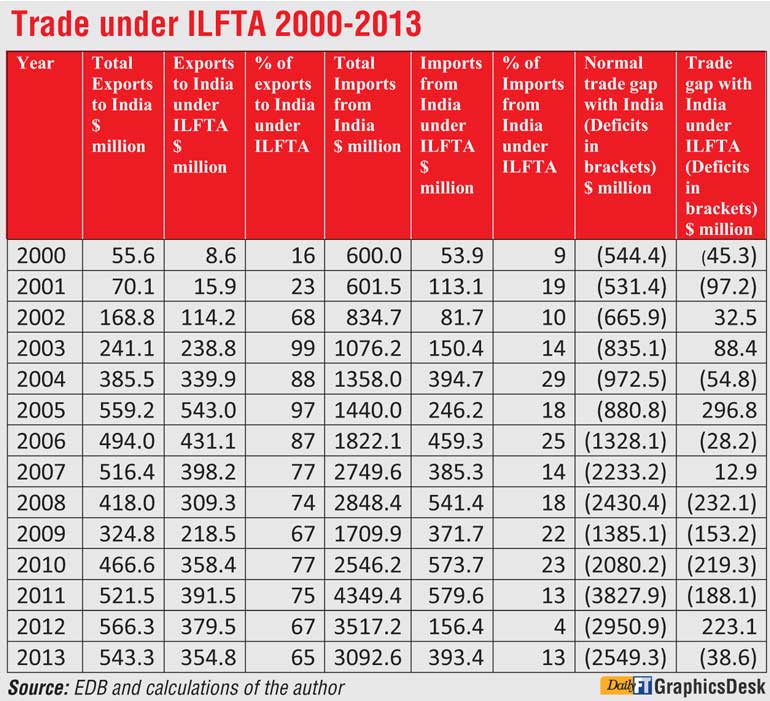
Critics say that ILFTA has favoured India and not Sri Lanka. This is a misconception and a conclusion arrived at by glancing at the information available on the surface
The best economic policy doesn’t guarantee its successMonday, 14 March 2016
A country may have the best economists who could come up with a set of best economic policies. Simply because a ‘policy is the best’ does not mean that it would be a success. That is because policies are implemented in the field among people of diverse interests, tastes and ambitions. The list of such people is long. But the key characters, loosely called ‘stakeholders’, include the people at large, critics, Parliamentarians, bureaucrats and foreigners. A policy becomes successful only when it is managed properly among its stakeholders.Getting support of the people for policies without tears and pains
Economic policies in the past, specifically those intending to introduce market reforms, budgetary discipline, stability in the domestic prices and the exchange rate, have been failures mainly because of the bad policy management. These policies become necessary when a country has ‘lived beyond its means’ creating vast holes within the economy which cannot be filled with available resources. The inevitable corollary is the ballooning of the country’s indebtedness to its own citizens in the case of domestic debt and to foreigners in the case of foreign debt. This, however, worsens the country’s ailments because, now, more and more resources have to be utilised to service the creditors.
The reversal of the trend calls upon people to sacrifice the wellbeing which they have been enjoying unabashedly. But when the situation becomes chronic and acute, as was the case with Greece in the recent past, there is no alternative except getting people to tighten their belts. But, how to get the people to tighten the belts without ‘tears’ and ‘pains’ is the challenge before governments that are required to introduce such painful economic reforms.
Critical economic crisis faced by Sri Lanka
Sri Lanka today is exactly in such an economic mess. Its debt levels have grown beyond its ability to service them without tightening the belts of the Government. In the recent past, the money spent by the Government for repaying debt and paying interest has been more than the Government revenue. Hence, without funds for maintaining the normal services, the Government had to incur more debt not only to repay the principal but also to pay interest on the past borrowings.
This is a critically vulnerable situation for Sri Lanka. Despite the growth in the economy, the Government revenue had fallen as a ratio of the country’s total output, known as the Gross Domestic Product or GDP. Since there was no corresponding cut in the expenditure, the deficit in the budget remained stubbornly high. An artificial reduction in the budget deficit as a ratio of GDP was attained not by cutting the Government’s consumption expenditure, but by curtailing its capital expenditure. The result was the slow growth of the country’s capital stock stunting its future growth potential.
