

The Need To Address The Root Of Conflict With Public Participation
By Jehan Perera –February 22, 2016

Jehan Perera

February 22 marks the anniversary of the signing of the Ceasefire Agreement in 2002 between the government and LTTE with Norwegian facilitation. This was an unexpected development that brought hope to the country that the war would come to an end and a peaceful solution to the ethnic conflict would be possible. Faced with the prospect of economic collapse, and a protracted war, the government of that time headed by Prime Minister Ranil Wickremesinghe sought to break the stalemate with a bold initiative. The sudden cessation of armed conflict came as a relief to the general population and almost immediately the wounds of war began to heal with people traveling for business and tourism from the north to the south and to the east. The benefits to the people of the peace process made it seem that it had become irreversible. But what was not seen so well at that time was that the ceasefire was only the start of the process, not its end. There needed to be a sustainable political solution that addressed the roots of the conflict.
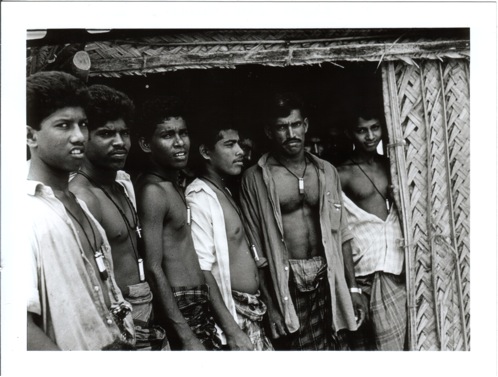
TIGER FIGHTERS WITH CYANIDE CAPSULES
IN CAMP, c. 1989
Photo by SHYAM TEKWANI, an Indian journalist
embedded within LTTE during war against IPKF.
IN CAMP, c. 1989
Photo by SHYAM TEKWANI, an Indian journalist
embedded within LTTE during war against IPKF.
The ceasefire agreement brought the country respite for four years from a war that had sapped its strength, and led the economy to shrink rather than to expand. If it had succeeded it would have saved tens of thousands of lives and obtained enormous economic resources for the country with the active support of the international community. After the ceasefire broke down in early 2006 the Ceasefire Agreement became seen as a political liability to the government that had signed it. The fact that neither the opposition nor the LTTE assisted the government to come up with a political solution was lost sight of. The ceasefire agreement became a subject of vilification for giving in to the international community and to the LTTE. The only ones who explained what it meant to the country were those who opposed it tooth and nail, and they gave it a one-sided interpretation. The ceasefire agreement of 2002 continues to be criticized for this even to this day by the nationalists and opposition politicians.
