

Maduluwawe Sobitha, From Nationalist To Democratic Activist

Prof. H.L. Seneviratne

Walpola Rahula’s Bhiksuvage Urumaya (The Heritage of the Bhikkhu), published in 1946 envisaged a new kind of monk, cultured in both Buddhism and modernity, and socially and politically activist. The public discussion and the social effect that ensued had the positive result of empowering the monk, but unfortunately that empowered monk had also imbibed a narrow conception of society and polity, that of Sinhala Buddhist hegemony, a conception that eventually placed the country on the path of ruin. The defining political flowering of which the empowerment of the monk was part was the general election of 1956, in which the monks also played a significant role.
A striking fact of this context was that the monks were unprepared and unqualified to play the role they were empowered to by Rahula’s classic. It liberated the monks from obligations of ritual duty, but these monks had neither the knowledge nor the training nor the ethical commitment to use that freedom in the service of the general good. With the opening of the Pirivena universities, a large number of young monks received an education of sorts, but it was not an education that equipped them with the necessary wherewithal to perform the needed national task. This lack of fit between empowerment and preparedness led these monks in two different but not always mutually exclusive directions: (1) engaging in financially and/or politically profitable activity and (2) embracing Sinhala Buddhist chauvinism. Thus, it was to the decline rather than enrichment of the society that this young, educated, and empowered generation of monks contributed.
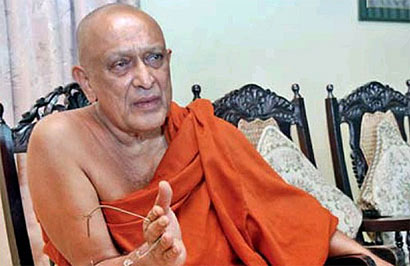 In this dismal scene, there were a handful of monks who were commendable in their selfless commitment to social amelioration. The brightest star among these dedicated, responsible monks was the Venerable Madoluvave Sobhita. When I, as a student of contemporary Buddhism, first met the Venerable Sobhita in the late 1970s, he was still in a mood of mild elation at the nationalist victory of 1956. It is however to his lasting credit, both as a social observer and activist, that he had the truly Buddhist understanding and compassion to gradually notice the damage that 1956 brought to the country, a damage reflected in the chain reaction starting with Sinhala Only and leading to anti Tamil pogroms, the massacres by and of the youth of both the north and the south, the rise of private armies and the related collapse law and order, the rise of a violent and fraudulent political culture, and in general, the pervasive malaise epitomized by the Rajapaksa rule. The Venerable Sobhita had both the intellect and the moral courage to move away from the Cintana Parisad, the ideological core of the ultra Sinhala right wing Jatika Cintanaya.