

87 people killed as crane crashes in Mecca's Grand Mosque
Saudi Arabia’s civil defence authority says almost 200 injured in preparations for annual Haj pilgrimage
Ambulances arrive at the Grand Mosque where a crane collapsed killing at least 87 people
 Kevin Rawlinson, Martin Chulov and agencies-Friday 11 September 2015
At least 87 people were killed and as many as 184 more were injured when a crane collapsed at the Grand Mosque in the Muslim holy city of Mecca on Friday, the Saudi Arabian government has said.
The country’s civil defence authority said on its Twitter account that rescue teams had been sent to the scene. The tweet said that the authority’s director general Suleiman al-Amr attended.
ارتفاع عدد الإصابات إلى ١٥٤ إصابة.

مباشرة مدير عام الدفاع المدني الفريق سليمان العمرو لحادث سقوط رافعة في الحرم المكي بـ #العاصمة_المقدسة. pic.twitter.com/aeVrlSi547

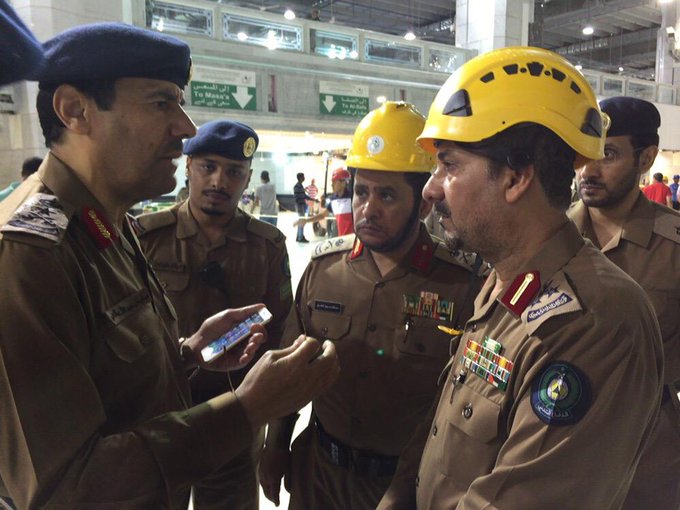

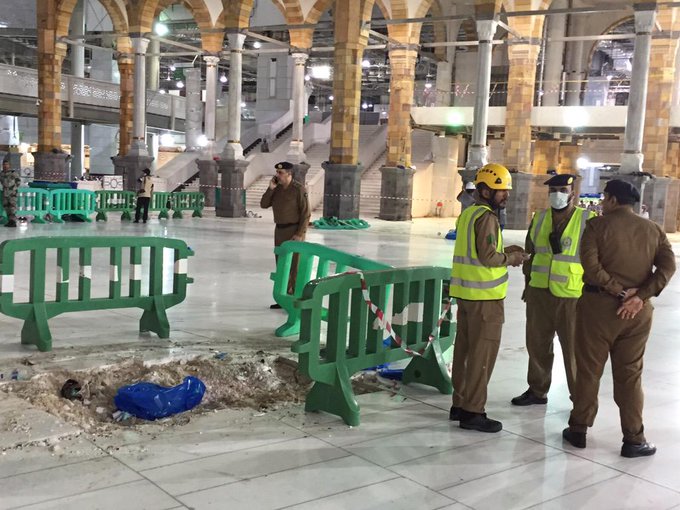
Muslims make their annual hajj pilgrimage later this month and Saudi authorities go to great lengths to be prepared for the millions of people who converge on Mecca.
Pictures circulating on social media, which the Guardian could not independently verify and which were too graphic to reproduce, showed what appeared to be numerous bodies on the ground - as well as bloodied, injured people being helped the scene.
Mobile phone footage captures the moment a crane collapses onto the Grand Mosque in Mecca on Friday
They showed a large group of people lying on marble-like flooring, most of them near to a wall and surrounded by rubble and other debris. One man appears to be being wheeled out of the building on a wheelchair.
Other images posted on the same account appeared to show parts of a crane that crashed through the roof of a building.
Al-Arabiya television earlier said the crane had fallen because of strong storms. Western Saudi Arabia has been hit by strong sand storms in the past few days.
Saudi authorities have taken a series of safety measures over the past decade aimed at preventing crowd crushes after tragedies such as the stampede in 2006, which resulted in 350 deaths, a building collapse in the same year which killed 76 and a stampede that killed more than 200 people in 2004.

Officials limited numbers attending the hajj after a peak in 2013, in which more than 3.1 million pilgrims arrived. Bottlenecks in which crushes occurred along the pilgrimage route were widened and religious authorities decreed that it was not mandatory for pilgrims to touch sacred spots.
