

The Search For Justice: Will Sri Lanka Match Up To The Task?

By Usha S Sri-Skanda-Rajah -April 17, 2015

Usha S Sri-Skanda-Rajah
In the article: “Genocide In Sri Lanka: It’s A Question That Certainly Needs To Be Litigated“,[1] I identified two related issues currently of critical consequence to Tamils:
- The deferment of the release of the OISL report (the OHCHR Investigation on Sri Lanka report) initially fixed for March 25, 2015
- and the question of whether or not it was Genocide and the Dire need for it to be litigated.
On the subject of deferment, recent pronouncements coming from the new Sri Lankan regime beg the question that in the search for justice for the Tamil people..will Sri Lanka match up to the task?
Shocking Admission
Sirisena Regime would have nothing to offer to strengthen OISL Report in September
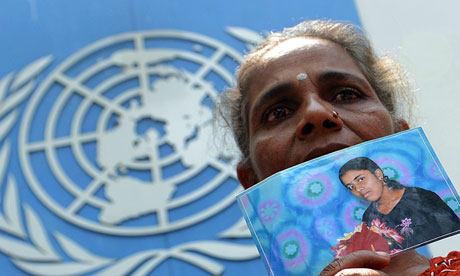 The announcement by Ajith P Perera, Sri Lanka’s new Deputy Minister of External Affairs of a postponement of a domestic inquiry, in other words that, “there would be no immediate domestic probe as the government will only submit a report to the UN Human Rights Council (UNHRC) in September on the modalities,”[2] does not come as a surprise to the Tamil people.
It’s as expected, Sri Lanka has managed to con the High Commissioner for Human Rights, Zeid Ra’ad Al Hussein into agreeing to a deferral of the release of the findings of the OISL report until September 2015 – undoubtedly on a false pretext.
Adding insult to injury, Mangala Samaraweera’s deputy still boasts of “the diplomatic victory” the new regime achieved by the deferral. Talking to Ceylon Today, he seems to be boldly theorising, that “when Sri Lanka is ready to conduct an impartial inquiry the issue is a domestic problem and there will be no room for any international intervention.” There wasn’t the slightest show of regret for the delay in any form by the Minister.
It’s without question the deferral is final and the only one that the High Commissioner was prepared to give and has said so in no uncertain terms. It’s also without question the deferral was obtained in the now mistaken belief that Sri Lanka would conduct its internal investigation with all the modalities in place, making available new information to strengthen the OISL report, [3] get on with the business of hearing witnesses, just as the High Commissioner stated in his opening statement to the UNHRC, whilst delivering his annual report. Given the allotted time of six months, he was expecting the, “authorities to consult deeply with the people, particularly victims, in order to design mechanisms that will work and not repeat the failures of the past.” [4]
