

Germany rejects Greek request for loan extension
Shock announcement from Berlin came after Greece filed formal request to eurozone partners
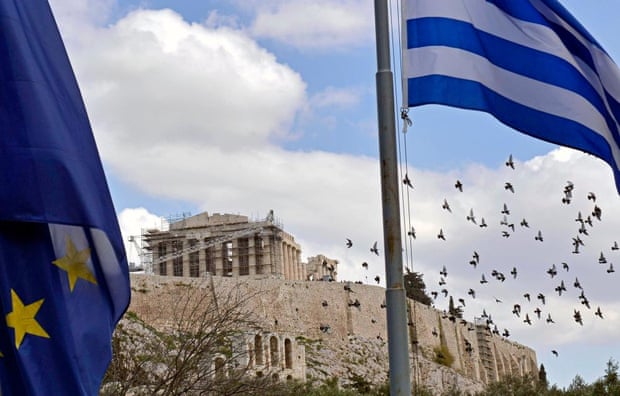
The Acropolis in Athens. Germany has rejected Greek plans for not going far enough. Photograph: Louisa Gouliamaki/AFP/Getty Images

Jennifer Rankin in Brussels and Helena Smith in Athens-Thursday 19 February 2015
Germany has rejected Greece’s proposal for an extension of its loans, saying that it fell short of the conditions expected by the rest of the eurozone.
The shock announcement from Berlin came just hours after Greece filed a formal request to its eurozone partners to extend its loan agreement, in the hope of averting a cash crisis.
Eurozone ministers are due to meet on Friday in an attempt to hammer out a deal. It will be their third attempt in 10 days to resolve a standoff that has sent jitters across the continent at the prospect of a messy Greek exit from the single currency.
The European commission had described the Greek proposal – widely seen as a climbdown on some of Greece’s key demands – as a positive sign that could pave the way for compromise.
But Germany said the Greek plan failed to meet eurozone ministers’ demands that Greece stick to its bailout programme – a set of demands laid out on Monday at an acrimonious meeting in Brussels that failed to end the deadlock.
“The letter from Athens is not a proposal that leads to a substantial solution,” finance ministry spokesman Martin Jaeger said in a statement.
“In truth it goes in the direction of a bridge financing, without fulfilling the demands of the programme. The letter does not meet the criteria agreed by the Eurogroup on Monday.”
A Greek government official said its latest proposal included measures to deal with the country’s “humanitarian crisis” and kickstart the economy. The request for a six-month loan extension would give Greece room to negotiate a new deal for growth with its eurozone partners, the official said.
But the request was seen as a climbdown by the Greek government to the demands of its eurozone creditors.
In a letter to Jeroen Dijsselbloem, president of the eurozone finance ministers’ group, obtained by Reuters, Greece’s finance minister, Yanis Varoufakis, conceded that the Greek authorities would “refrain from unilateral action that would undermine the fiscal targets, economic recovery and financial stability”.
Crucially, he said Greece would remain under the supervision of the European commission, the European Central Bank and International Monetary Fund – the unpopular troika that the Syriza-led government had insisted it would throw off.
Aides to the Greek prime minister, Alexis Tsipras, insisted that the loan request respected the popular will of the Greek people.
Calling it an “interim agreement,” well-placed insiders said the request was significant in two important domains: it raised the issue of debt restructuring and included a pledge from the new government to keep to a balanced budget.
“It’s not very often that you get left-leaning governments making those sort of commitments,” said one Greek official.
“They’ve clearly sought to strike a very fine balance between tackling the humanitarian disaster and promising to be a government that will not only tackle corruption and tax evasion, the malfunctions of Greek society, but take on all the invested interests that plague political and business life.”
The request from Greece for an extension of its loan agreement with the eurozone – known as the “master financial assistance facility agreement” – was widely expected. Questions remain, however, about whether Greece can convince the rest of the eurozone that it should get further loans without signing up to more austerity.
Eurozone officials are meeting in Brussels on Thursday to assess the latest Greek proposal.
Raoul Ruparel, the head of economic research at Open Europe, thinks the Greek government has little chance of getting the rest of the eurozone to back its plans on labour market reforms, pensions or privatisation.
However, in a briefing paper, he wrotethat the eurozone could give way on another one of Greece’s key demands, to allow the government to run a smaller budget surplus, so freeing up money for social spending. “The Greek election represented a tipping point, meaning that the rest of the eurozone will have to consider some tradeoffs,” he wrote.
A spokesperson for the European commission president, Jean-Claude Juncker, said the letter was a positive sign that could pave the way for a reasonable compromise.
Hopes of ending Greece’s standoff with the eurozone pushed Greece’s stock market up by nearly 3% on Thursday. The mood of investors was also boosted bythe decision of the European Central Bank to allow Greece a further €3.3bn in emergency liquidity, bringing the total ECB help to Greek banks to €68.3bn.
