

The Need For Media Reform

By H.L. Seneviratne -January 21, 2015

H.L. Seneviratne
It is no secret that the state media were used in the most blatantly partisan manner by the Rajapaksa government during the recent election campaign. Since state media are the property of the people, their partisan use is unacceptable, and the programme of reform contemplated by the new government should significantly include reform of the state media. A sound media culture and organization would be an indispensable tool in any methodical programme of social and political reform.
Media constitute a powerful means of public education in the modern world. This is particularly so with regard to radio and television, but the socially and educationally persuasive power of even the traditional media is considerable. In any rational attempt to build a happy and prosperous society, the state media should be used positively to propagate modern ideas and knowledge.
 Far from engaging in any such, the state media, in addition to being politically partisan, have propagated conservatism, parochialism and other forms of medieval thinking, as well as superstitions and ritualism, hailing these as “national culture”. Religion should be respected as a personal matter to be observed privately, but find no place in the state media. This is particularly so in a multi-religious society where the majority religion ends up dominating the media space allocated to religion. Instead, in a progressive society, media should be used to propagate modern social and scientific ideas and help the society rid itself of magic and other forms of superstition. Former president Rajapaksa’s reliance on astrology should sober our thoughts about that branch of ignorance.
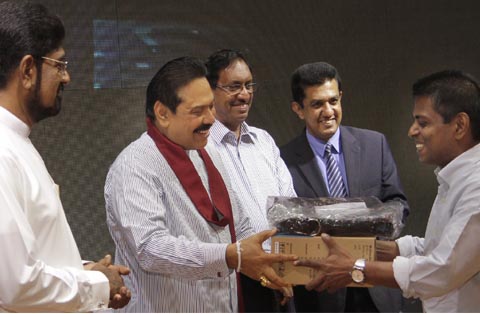
*Free Laptops from President to Journalists | File photo
In a diverse society like ours, the media could be a powerful tool for promoting mutual understanding among ethnic, religious and otherwise different communities, and in the present context, national reconciliation. Not the least, an enlightened media policy can also elevate the standards of literary and aesthetic taste in the society as a whole. Such enrichment could supplement the improvement in the quality of life that a people-friendly programme of economic development can bring about.
In view of these incontrovertible facts, it would make sense for the new government to establish an independent authority to ensure the organization, quality, professionalism and impartiality of the state media. When we have such an exemplary state media system, the private media will have no choice but to improve their own quality if they are to stay competitive and profitable for their owners.
Spokespersons for the government just voted out of office, conspicuously including its leader Mr Rajapaksa, have made the irresponsible and divisive claim that the new government was elected by the Tamils and the Muslims, and they got the vote of the Sinhala Buddhists. If they did, the reason is the relentless racist and supremacist propaganda carried out by the illegal and immoral use of state funded newspapers, radio and television for their partisan benefit. Had the people been given the opportunity to hear and judge the case made by each of the two contending parties, it is clear as daylight that they would have overwhelmingly voted for the common opposition candidate.
