

Siamese Twins: India And Sri Lanka


Priyakala Manoharan
The current diplomatic moves of the new regime of Sri Lanka, after deposingMahinda Rajapaksha from his decade-long throne, imply that Sri Lanka has once again adopted India as its prime foreign policy ally. Even the Indian media is very positive about this unprecedented democratic upsurge. Does this climate augur good yields for India? This is too early to infer but more about this sooner or later.
Following the groundbreaking victory of Excellency President Maithripala Sirisenawho defeated the invincible personality of his predecessor, Indian Prime Minister Narendrn Modi, was the first one to extend his wishes to the President and promptly invited him to pay a visit to India. In return, the new President stated that his first foreign visit next month would be to India and his foreign policy would give India a prominent place.
In another event that affirms India’s continuous solidarity, India’s envoy in Colombo Y.K. Sinha in person showered his well-wishes on the President. In contrast, Wu Jianghao, China’s ambassador could meet the president rather very late after his victory.
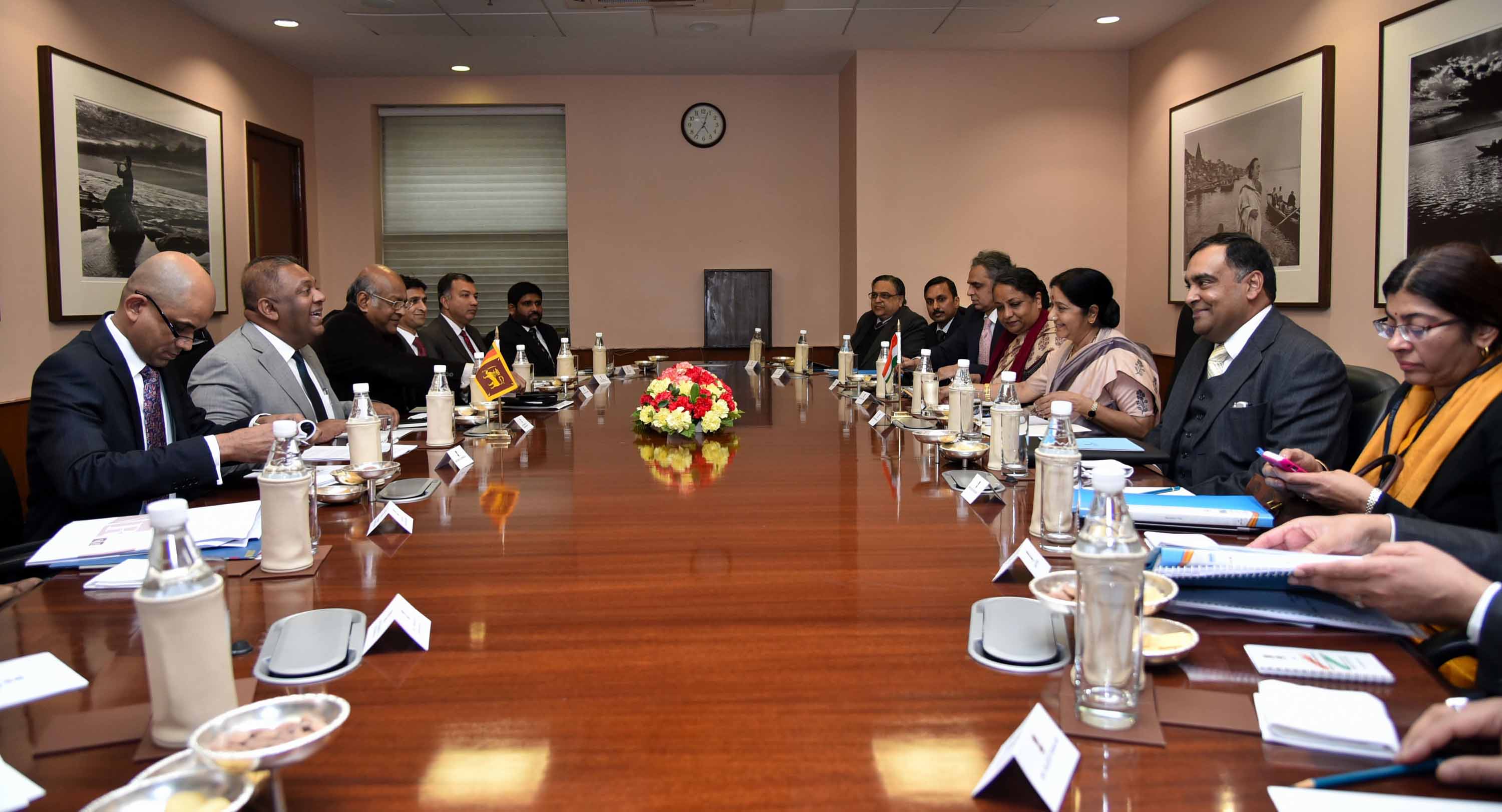 The first foreign visit of Mangala Samaraweera to India, after assuming as the External Affairs Minister marks the age-old rich significance and cooperation reserved in the agenda of Sri Lanka. What the new government’s approach towards India showcases is the resurrection of the traditional bond shared between them and the withdrawal from the policies of former President Mahinda Rajapaksha whose reign maintained strained ties with India owing to its continuous display of pro-China tilt.
Ranil Wickremesinghe, the Prime Minister has in an interview to NDTV said “The strategy of the former president Rajapaksa to play India against China and vice versa came a cropper”, and the new government would review the feasibility of all heavy investment-laden foreign contracts, especially the Colombo Port City project where land for this mega project will be reclaimed from the sea. This mega project is anticipated to be a milestone in China’s conceived Maritime Silk Road.
Like India, China will be closely looking at the unfolding events owing to its deep-rooted interest in the geopolitical location of the Island in the Indian Ocean which is what takes no change no matter whatever miracles take place. Indian policy makers will make a blunder if they think that a change of regime, which still leaves ripples of shockwaves in the country, makes both Sri Lanka and India freer because new development eclipses the exposure of China in the Sri Lankan soil and leaves a greater say to India.
What culminated the voters’ power is not necessarily marked by their resentment over China rather their long-whispered allegations of nepotism, opacity and corruption the previous government wallowed in. China’s role in terms of infrastructure development and investments is engraved through out Sri Lanka. Its money and muscle power and lust for power in the Indian Ocean through its String of Pearls Strategy keeps its motive revived in the Island and entices the high-rise ambitions of the Sri Lankan economy. India alone can not compete with China as she herself receives monetary benefits from China.
Looking at the footprints of China, its leverage would only fatten in the Island. Thereby, India, keeping the newly developed harbinger in its mind, should efficiently deal with the Island to regain its alienated status without having to place its domestic politics in jeopardy.
