

WHO warns 10,000 new cases of Ebola a week are possible
UN agency says fatality rate at 70% and that ‘a lot more people will die’ unless world steps up its response to crisis
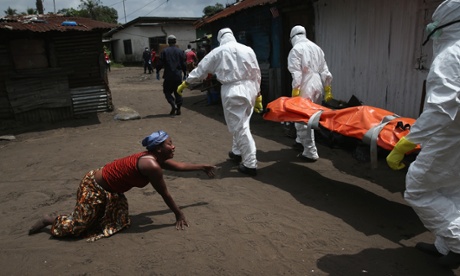

There could be up to 10,000 new cases a week of Ebola within two months, the World Health Organisation warned on Tuesday, as the death toll from the virus reached 4,447 people, nearly all of them in West Africa.
WHO assistant director-general, Dr Bruce Aylward, told a news conference in Geneva that the number of new cases was likely to be between 5,000 and 10,000 a week and added that the death rate for the outbreak is at 70%.
WHO’s regular updates show figures for deaths that are roughly half the number of reported cases – 4,447 from 8,914 cases – but, Aylward said, any assumption that the death rate is 50% would be wrong. Many are not reported or recorded officially. Where detailed investigations have been carried out, it has been clear only 30% of people are surviving.
Aylward said: “It is almost exactly the same number across all three countries. This is a high mortality disease in any circumstances but particularly in these places.”
The UN Mission for Ebola Emergency Response, newly set up to coordinate the fight against the disease, has set targets to isolate 70% of suspected Ebola cases and safely bury 70% of the dead within the next 60 days – described as the 70-70-60 plan.
It is a tough target, said Aylward, but if it takes 90 days rather than 60, “a lot more people will die who shouldn’t and we will need that much more capacity on the ground to manage the caseload”. As the numbers continue to escalate, there will be an increased need for beds and for health personnel to treat the sick. There is a serious shortage of trained and experienced people to lead the effort, he said. Good training programmes are being put in place, particularly by the UK and the US, “but there is still the challenge of getting internationals on the ground who have expertise - in Ebola ideally.”
For the last four weeks, there have been about 1,000 new cases per week, including suspected, confirmed and probable cases.
Aylward said the WHO was concerned about the continued spread of Ebola, especially in the capital cities of Sierra Leone, Guinea and Liberia – Freetown, Conakry and Monrovia. “The virus is still moving geographically and escalating in the capitals,” he said.
Large treatment centres are taking a long time to build and staff and those that exist are full. A new strategy which the UK is supporting in Sierra Leone is to set up a lot of community care units with a handful of beds, where people can stay and get basic care rather than endangering their families at home, while waiting for a treatment centre bed. The units will also help people arriving with fever because they have malaria, who at the moment are not being treated or are afraid to go to hospital.
In Berlin, a UN medical worker infected with Ebola in Liberia died despite “intensive medical procedures”. The St Georg hospital in Leipzig said on Tuesday that the 56-year-old man, whose name has not been released, died overnight of the infection.
The man tested positive for Ebola on 6 October, prompting Liberia’s UN peacekeeping mission to place 41 other staff members under “close medical observation”.
He arrived in Leipzig for treatment on 9 October. The hospital’s chief executive, Dr Iris Minde, said at the time there was no risk of infection for other people, since he was kept in a secure isolation ward specially equipped with negative pressure rooms that are hermetically sealed.
He was the third Ebola patient to be flown to Germany for treatment. The first man recovered and returned home to Senegal. A Uganda aid worker is still being treated in Frankfurt.
