

Inflation Administratively Deflated?

By Muttukrishna Sarvananthan -August 4, 2014

Dr. Muttukrishna Saravananthan
The annual average rate of price change (annual average rate of inflation) in terms of the Colombo Consumer Price Index (CCPI based on 2006-2007 = 100) has been in single digits for over five years now. In 2008 the annual average rate of inflation (based on CCPI 2002=100) was 22.6%, the second highest in the post-independence period after 26.1% in 1980 (based on CCPI 1952=100). Since 2008 inflation has dramatically declined to single digit (see table) because of the revision of the methodology including the change in the base year.
The base year and the measure of the CCPI have been revised and updated in November 2007 (base year 2002=100) and in June 2011 (base year 2006-2007=100). The revision of CCPI in 2007, which was long overdue, included (i) expansion of the geographical coverage of markets where prices are regularly collected, (ii) changes in the weights assigned to different categories of consumption goods based on changing consumption patterns as reflected in the Household Income and Expenditure Survey (HIES), and (iii) dropping alcohol and tobacco from the basket of goods taken into account in the compilation of CCPI on moral grounds, purportedly.
While the expansion of the geographical coverage of the markets is objective because of wider representation of prices, dropping of alcohol and tobacco from the basket of goods is subjective because historically in Sri Lanka as well as almost all other countries of the world relatively higher proportion of the income of the lower income groups is spent on alcohol and tobacco. Therefore, the non-inclusion of alcohol and tobacco in the basket of goods underestimates the Consumer Price Index and thereby the rate of inflation.
Moreover, although the update of the base year was long overdue, in the base year 2002 the inflation was relatively low at 9.6% and in the base year 2006-2007 the inflation was relatively high at 10.0% and 15.8% respectively. Therefore, the annual average rate of inflation measured currently is in terms of a higher base (2006-2007) which partly (only partly) explains the relatively lower rates of inflation since 2009.
Furthermore, anecdotal evidence suggests that the ordinary citizens, including this author, feel the declining rate of inflation in 2013 and 2014 to be unbelievable and unrealistic. Therefore, we checked the national product data presented in the Annual Report of the Central Bank of Sri Lanka in order to investigate the plausible cause/s of the discrepancy between the official statistics on the cost of living and the real-life cost of living.
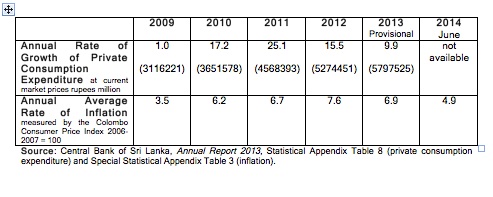 The national output/product is computed by income method, expenditure method, and value added method. Basic economic theory underpinned by real-life experiences suggests that a rise in prices (or inflation) should reduce private consumption expenditure and a drop in prices (or inflation) should increase private consumption expenditure. That is, there is an inverse relationship between inflation and private consumption expenditure. Public consumption expenditure could, of course, increase or decrease irrespective of the rate of inflation. Read More