

Syrian opposition threatens to pull out of peace talks after Iran invitation
UN secretary-general Ban Ki-moon's invitation to Iran to attend touches off fresh round of uncertainty over fragile talks
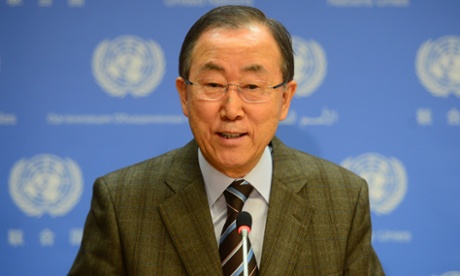

Syria's political opposition said on Monday it would withdraw its attendance at international peace talks scheduled this week unless United Nations secretary-general Ban Ki-moon retracted an invitation to Iran, President Bashar al-Assad's main backer.
Ban said earlier he had invited Iran to attend the first day of talks on 22 January in Montreux, Switzerland, and that Tehran had pledged to play a "positive and constructive role" if it was asked to participate.
Less than 48 hours after Syria's main political opposition group in exile, the National Coalition, agreed to attend the talks, dubbed "Geneva II", it threatened to withdraw.
"The Syrian Coalition announces that they will withdraw their attendance in Geneva II unless Ban Ki-moon retracts Iran's invitation," it said in a Twitter post, quoting National Coalition spokesman Louay Safi.
Another senior Coalition member, Anas al-Abdah, told al-Jazeera TV by phone that the body was "surprised" by the invitation to Iran. "It is illogical and we cannot in any way accept it."
The United States said on Sunday the invitation to Iran should be withdrawn unless Tehran publicly stated its support for a 2012 agreement designed to establish a transition government in Syria.
"If Iran does not fully and publicly accept the Geneva communique, the invitation must be rescinded," State Department spokeswoman Jen Psaki said in a statement.
The United States has long said that Iran should not be allowed to attend the talks until it states its support for the 2012 agreement.
Ban said he had spoken at length to Iran's foreign minister, Mohammad Javad Zarif, in recent days and that he believed Tehran supported the 2012 plan.
Ban said he had spoken at length to Iran's foreign minister, Mohammad Javad Zarif, in recent days and that he believed Tehran supported the 2012 plan.
"He has assured me that like all the other countries invited to the opening day discussions in Montreux, Iran understands that the basis of the talks is the full implementation of the 30 June, 2012, Geneva communique," he said.
"Foreign minister Zarif and I agreed that the goal of the negotiations is to establish by mutual consent a transitional governing body with a full executive powers," Ban said. "It was on that basis that foreign minister Zarif pledged that Iran would play a positive and constructive role in Montreux."
"Therefore as convener and host of the conference I have decided to issue an invitation to Iran to participate," Ban said. "Iran needs to participate as one of the important neighbouring countries."
Ban said he expected Iran would issue a statement soon in response to his invitation.
Earlier this year the United States said Iran might play a role on the sidelines of the peace conference. Tehran dismissed that ideas as beneath its dignity.
Ban said he had invited nine other countries on Sunday to attend the talks – the Vatican, Australia, Bahrain, Belgium, Greece, Luxembourg, Mexico, the Netherlands and South Korea. Speaking to reporters at UN headquarters, Ban made clear that the full negotiations between the government and opposition would begin in earnest on 24 January in Geneva.
