

Nelson Mandela 1918-2013: To honour Mandela Is To Learn From His Example
Rajan Philips
One of the most inspiring
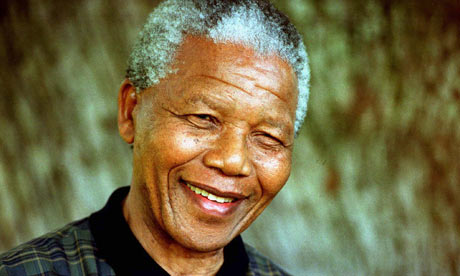
 moments in our life time was watching Nelson Mandelawalk out of prison on 11 February, 1990. He looked tall and determined, defiant yet kind. He looked taller than his 6’1” height, even though the twenty seven years in harsh prison conditions had shrunken his massive 200+ lb frame that he took to the prison. On Thursday, 5 December 2013, Nelson Mandela passed away quietly in his Johannesburg home after keeping an anxious nation awake for several months. The world that watched him walk out of prison 23 years ago is now ready to watch his last journey through the land that he liberated from apartheid. “What would be his legacy?” – his longtime friend, anti-apartheid activist and Nobel laureate for literature, Nadine Gordimer, was once asked. “It depends on what we make of it”, was her response. The world could make a lot of it. Even Sri Lankan leaders could benefit hugely from Mandela’s legacy.
moments in our life time was watching Nelson Mandelawalk out of prison on 11 February, 1990. He looked tall and determined, defiant yet kind. He looked taller than his 6’1” height, even though the twenty seven years in harsh prison conditions had shrunken his massive 200+ lb frame that he took to the prison. On Thursday, 5 December 2013, Nelson Mandela passed away quietly in his Johannesburg home after keeping an anxious nation awake for several months. The world that watched him walk out of prison 23 years ago is now ready to watch his last journey through the land that he liberated from apartheid. “What would be his legacy?” – his longtime friend, anti-apartheid activist and Nobel laureate for literature, Nadine Gordimer, was once asked. “It depends on what we make of it”, was her response. The world could make a lot of it. Even Sri Lankan leaders could benefit hugely from Mandela’s legacy.
As a prisoner, Mandela became the icon in the world’s final fight against political racism. In South Africa, the site of that struggle, Mandela mediated the transition from apartheid to freedom. Today, he is revered by everyone and everywhere. But for the greater part of his political life as a leading member of the African National Congress, he was reviled by powerful forces in and out of South Africa. Never before, or after, has the international community – governments as well as civil societies – become so involved as it did in the 1980s movement to free Mandela from prison and apartheid in South Africa. The modern NGOs emerged and made their mark on the world stage through the anti-apartheid struggle.
The Commonwealth led the sanctions against apartheid, with Canadian Prime Minister Brian Mulroney leading the way and breaking ranks with his powerful friendMargaret Thatcher. Thatcher despised the African National Congress and applauded the South African government for its economic prowess. She was ideologically blinkered from seeing apartheid as inhuman racial exploitation that underpinned South Africa’s economic success. Her ideological soul mate, President Ronald Reagan declared Nelson Mandela a terrorist and put him on the US list of terrorists. By oversight and mistake, the Mandela name remained on the US terrorist list until 2008, when Hillary Clinton under President Obama formally took the name off the list. The definition of terrorism and heroism vary across time and space. A terrorist in the west or north could be a hero in the east or south, and a terrorist now could be a hero later.
Following In The Footsteps Of Mandela Is What We Need Sri Lanka Today
 I join my Colleague, the Hon. Nimal Siripala de Silva, in expressing the condolence of our House and of this country on the passing away of Nelson Mandela. The prisoner from Robben Island became a beacon of hope to the whole world. As my Colleague pointed out, it was the imposition of the apartheid state which led to Nelson Mandela getting involved in the struggle to regain full rights of the African people and thereafter, to take leadership of the movement. But, Mandela together with other colleagues, all had to suffer imprisonment. Nelson Mandela represented the ANC whose objectives were not limited to non-violent struggle. They also had to launch a liberation struggle in which they wanted the rights of the majority. They had to suffer many hardships. Nelson Mandela, at once, remarked that his was the least. He was kept in a prison and beaten up. He had to suffer much more than the others had to suffer. As we listened to the Truth and Reconciliation Commission, it certainly shows the extent to which the apartheid system worked to try and hold its power. That is a characteristic of many authoritarian States which seeks to control thinking, which seeks to control the media – that is one sign, which seeks to control the judiciary and put those who are very favour to them, which seeks to control civil society and which seeks, in fact, to keep an eye on anyone who they think is a dissident and then take action against him legally or indirectly. So, it is not kept only to countries which go on white supremacy. It is an unfortunately sign that we see in many parts of the world.
What I see in Nelson Mandela is that once he took over, he dismantled that apparatus. He kept the states structure very much like Shri Jawaharlal Nehru and the Right Hon. D.S. Senanayake did in India and Sri Lanka. But, he dismantled that apparatus. Finally, we have to remember that the victory of Africans in South Africa was due, firstly because the struggle launched by the African National Congress, and secondly the international pressure that came in. Without that international pressure which finally forced even the USA to agree, it would not have been possible. They made it difficult for the apartheid regime inside and the others; the international pressure made it difficult them from outside. Read More
