

From Mutur To Geneva
“Do we really have to pass through every sort of horror before we can open our eyes?” - Tim Parks (Hell and
Back: Selected Essays)
 The
Permanent Peoples Tribunal (PPT) is the successor to the Russell
Tribunal which investigated American war crimes in Vietnam. Set up in
1979[i], its aim is to “make up for the moral and political shortcomings of states as instruments for the achievement of justice”[ii].
The
Permanent Peoples Tribunal (PPT) is the successor to the Russell
Tribunal which investigated American war crimes in Vietnam. Set up in
1979[i], its aim is to “make up for the moral and political shortcomings of states as instruments for the achievement of justice”[ii].
Last week, at the end of its second session on the Lankan war, the PPT
concluded that Colombo is guilty of ‘crimes of genocide’ against the
Tamils and that ‘both the United States of America and United Kingdom
were complicit in the genocide while the involvement of India warranted
further investigation’[iii].
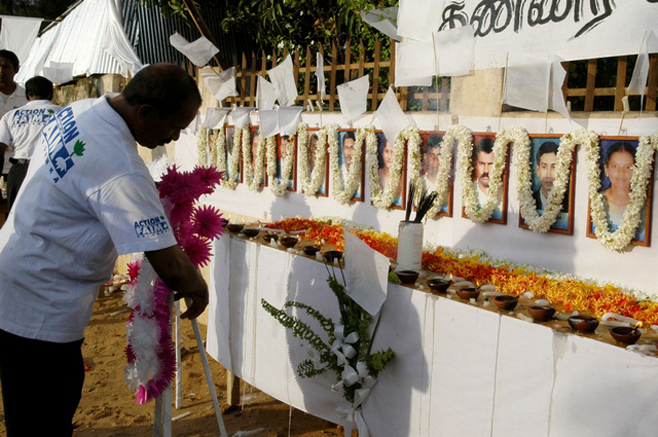
A member of the French aid group Action Contre La Faim places a wreath
in front of the photographs of his 17 slain colleagues at their memorial
in Batticaloa, Sri Lanka on August 11, 2006
According to the Rajapaksa version, the Fourth Eelam War was fought –
and won – as an autarkic enterprise, with some help from a handful of
non-Western allies. In reality, the Rajapaksa regime defeated the LTTE
thanks partly to an enabling international environment created by the
LTTE.
In the early, heady months of the Third Peace Process, most of the world
was the Tiger’s oyster. The LTTE was welcomed and treated as an
unofficial government in many of the world’s capitals. Had Vellupillai
Pirapaharan been a little less maximalist, and a little more
intelligent, he could have won a federal or even a confederal deal for
the Tamils.
But moderation was viscerally alien to Mr. Pirapaharan. He wanted his
own state and he wanted to win it on the battlefield. Consequently, the
Tiger did not really change its ways and act in accordance with
internationally accepted norms during the peace process; it only
pretended to do so. Behind a façade of moderation, the LTTE continued to
prepare for the next war, conscripting children, murdering political
opponents and extorting money (even in Western capitals).
For a long time, despite concerted
efforts by national and international human rights organisations (the
UTHR, the Amnesty International and the Human Rights Watch) to expose
Tiger crimes, the West opted to give the LTTE the benefit of the doubt[iv].
And the Tigers believed – wrongly – that denials, promises and
pretences would suffice to satisfy the world.
Read More
