

De Facto Chief Justice Clears Way For De Facto Denial Of Parliament Control Over Public Finances
 November 24, 2013
The De Facto Chief Justice Mohan Pieris (with two other judges K. Sripavan and S. Hettige not dissenting) have officially cleared the way for the Executive under the Rajapaksa regime to be able to plunder public finances by avoiding effective control by Parliament. Several commentators have pointed out that Parliament is now reduced to a mere rubber stamp, with the powerful Rajapaksa regime doing as it wants with public monies.
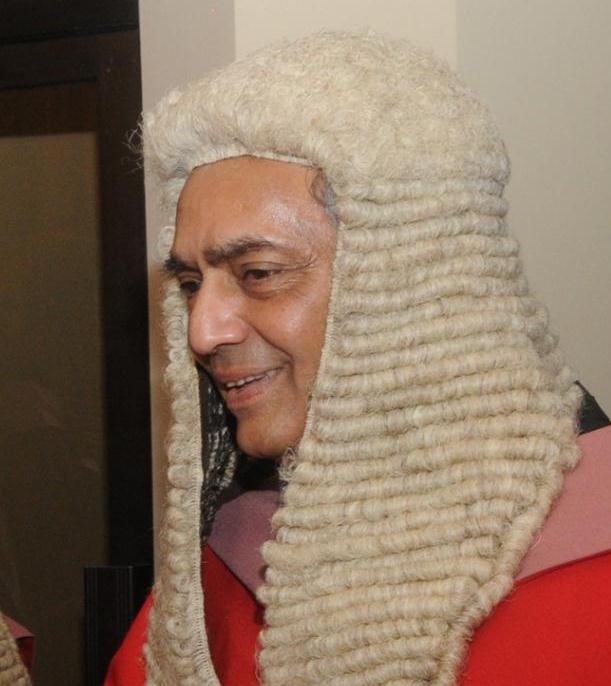
De facto Chief Justice Mohan Pieris
Pieris has made the ruling in the challenge to the Appropriation Bill 2013 by the Centre for Policy Alternatives (CPA) and Dr. Paikiasothy Saravanamuttu, its Executive Director where the Supreme Court was asked to rule that some provisions which removed and weakened Parliament’s supervision and control of public finances was inconsistent with the Constitution. This was on the basis of the Constitution providing for Parliamentary control of Public Finances, to be able the legislature to act as a check and a balance against possible wastage or plunder by the Executive.
Earlier, when 2012 Appropriation Bill was challenged by the CPA, a Supreme Court bench headed by Justice Shiranee Thilakawardene had held that Parliamentary control of public finances was important and upheld the principle.
This is said to have upset the Rajapaksa regime. President Mahinda Rajapaksa then quietly referred to De Facto Chief Justice Mohan Pieris, the question whether such controls by Parliament were required. This ‘reference’ (using the power given to an Executive President to refer a question to the Supreme Court for its determination) was taken up by Pieris in a controversial way. He had taken it up in court, clearing out all parties and lawyers except for the officers of the Attorney General sent to make submissions so that there was secrecy. Pieris sat with five judges picked by him. This set the stage for overruling the ruling by Justice Thilakawardene. The opinion of the five judges was communicated to the President Rajapaksa and total silence was maintained on the matter until the 2013 Appropriation Bill was challenged.
After the case challenging the 2013 Appropriation Bill was filed, the ‘opinion’ of Pieris and four others picked by him was suddenly brought into circulation. Our correspondents confirm that Pieris himself kept citing from it during the submissions made on the 2013 Appropriation Bill, which was fixed before himself and two other judges only. Pieris could not have failed to realize that if the five-judge opinion was to be brought into play (as he himself tried to do), at least five judges should have heard the case. But that risk was not taken.
The Colombo Telegraph contacted several legal experts, all of whom asked not to be named. However most of them (a few refused to comment at all) confirmed that according to their professional opinion the ruling by Pieris is clearly wrong, undermines controls and checks on spending of Public Finances and only paves the way for the Executive (Rajapaksa regime) to do as it pleases without controls. One expert said even joked that though it is of very poor quality reasoning, it seems like an attempt to at least sound like Chris Nonis (UK High Commissioner, who used big words in a recent CNN interview). But his smile vanished, as he added that “The implications of the ruling for greater abuse, wastage and squandering of public finances is terrible”.
The determination by Pieris on the 2013 Appropriation Bill is now published in the Parliament Hansard of November 21, 2013 which we publish for the benefit of our readers.
