

Behind The Numbers: A Closer Look At Voting Trends In Jaffna

Wigneswaran
 Introduction
A recent article[1] has questioned our analysis[2] of the Northern Provincial Council (NPC) election results. While thoughtful, the piece – published onColombo Telegraph – is misguided and reflects a lack of understanding of both the current political context in the north and Tamil people’s ideological mindset.
The thrust of the argument presented is that the real story behind TNA’s victory has little to do with past UPFA performance. Rather, it’s principally a product of a significant increase in voter turnout since the conclusion of war. It’s true that voter turnout has increased since Jaffna Municipal Council elections were held in 2009. But does that argument hold up under further scrutiny? Is that the main reason why TNA won last month? Or is there more nuance to this narrative than meets the eye?
Behind the Numbers
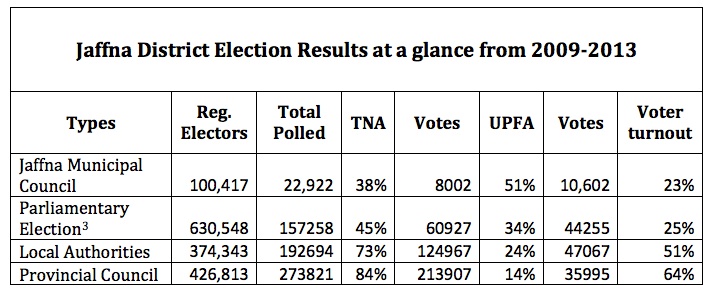
In the Jaffna Municipal Council election in 2009, 22,280 actually voted,[3] but there were only 100,417 registered voters. In the 2013 NPC election, the number of registered voters for Jaffna polling division has been listed as 28,610.[4] It is important to note here that the Jaffna Municipal Council boundary is larger than Jaffna polling division, which includes an extra nine polling sub-areas from Nallur polling division. If we do the math right, the figure for those nine polling areas can be calculated as approximately 20,454 people. [This figure is deduced by subtracting the Nallur Pradeshiya Sabha registered voters (20,012[5] people) from the registered voters of the provincial council Nallur polling division (42,466[6] people)]. This means that a more realistic number of registered voters for the Jaffna Municipal Council election would have been around 49,000. (That figure includes registered voters from Jaffna polling division (28,610), plus the approximate number of voters from nine Nallur polling stations, which amounted to 20,454 people, in 2009). This produces a much smaller pool of registered voters than official statistics suggested in 2009 – bringing the approximate voter turnout for that 2009 election to 47%. (The boundary lines for polling divisions for provincial council and local authorities elections are not exactly the same; this needs to be taken into consideration). Read More
