

Northern Provincial Council Elections In Sri Lanka
Prof
S. Ratnajeevan H. Hoole
 The provincial council system was set up in
response to Tamil demands for separation in the face of brazen discrimination by
the Sri Lankan state from the very time of independence. It was a compromise
mediated by India in 1987 under the Indo-Lanka Accord to give Tamils a say in
their own affairs while preserving the state without any breakup. It was for the
Tamils. However, although every province would receive the same regional
autonomy without making it seem a Tamil thing, the Northern and Eastern
provinces were merged into one North-East Province through the Accord because
the Tamil numbers in the Eastern Province were vitiated through systematic
colonization using poor Sinhalese and prisoners, and through ethnic cleansing
using massacres by the state’s dreaded Special Task Force. For the Eastern
Province was not expected to survive on its own.
The provincial council system was set up in
response to Tamil demands for separation in the face of brazen discrimination by
the Sri Lankan state from the very time of independence. It was a compromise
mediated by India in 1987 under the Indo-Lanka Accord to give Tamils a say in
their own affairs while preserving the state without any breakup. It was for the
Tamils. However, although every province would receive the same regional
autonomy without making it seem a Tamil thing, the Northern and Eastern
provinces were merged into one North-East Province through the Accord because
the Tamil numbers in the Eastern Province were vitiated through systematic
colonization using poor Sinhalese and prisoners, and through ethnic cleansing
using massacres by the state’s dreaded Special Task Force. For the Eastern
Province was not expected to survive on its own.
Ironically
the Provincial Council system functions well in the Sinhalese provinces, but not
for the Tamils for whom it was originally intended. By a Supreme Court order on
16 Oct. 2006 the North-East Province was broken up and, with internecine Tamil
murders and Tamil massacres of Muslims, the government has been able to muster
enough support to form a subservient local government in the Eastern Province as
the Accord envisaged.
The
Northern Province with Jaffna as its cultural capital is now being subject to
ethnic cleansing after the government brought the civil war to a brutal close in
2009 through the criminal use of force on civilian targets and the subjection of
the Tamil population to terror. Yet, the Tamil dominance of the Northern
Province is still undiminished and will remain so until the government’s ongoing
efforts at colonization and ethnic cleansing take root.
First Tamil Government
Given
the government’s deep unpopularity among Tamils, if elections to the Northern
Province are held today, they will lead to the first Tamil government since the
weak North-East government of Chief Minister Varadarajaperumal. His government,
established in 1988 after the Accord was signed with India, collapsed in 1990
under LTTE assault and the lack of funds from the centre which prevented any
meaningful development, let alone a seat and desk for the Chief Minister.

Sri
Lanka’s Northern Province
When
the LTTE fell in 2009, Varadarajaperumal said that the “major Hindrance to
Democratic Movement among the Sri Lankan Tamils has been Removed.” At that time,
he did not realize how deeply hateful the Sri Lankan government is towards
Tamils and that the government could not countenance Tamils having a say in our
own affairs.
Token
Tamil in Government
In
fact, the government has been keen to have a Tamil in the cabinet as a show of
Tamil support, and therefore has cultivated the paramilitary leader Douglas
Devananda, who is the lone Tamil politician from the North who stands with
President Mahinda Rajapaksa. Devananda broke off from the Eelam People’s
Liberation Front over internal rivalries and formed the EPDP – the Eelam
People’s Democratic Party. The EPDP lacked funds, so it is widely believed that
Devananda resorted to the kidnapping of and extortion from Sri Lankan Tamils
living in Madras. With various criminal cases pending against him in Madras over
allegations of brigandry and murder, Devananda jumped bail in 1990 and, in the
face of LTTE assassination attempts, took shelter with government forces in
1990, becoming a paramilitary ally of whichever Sinhalese government was in
power. He was given control of the islands off Jaffna where the LTTE had no
presence, and the navy, which protected him, was dominant. Although the EPDP
continued in brigandry, he was deemed plucky by many Tamils who did not favor
the LTTE and had themselves suffered at its hands
Devananda
in a way hit the jackpot when, with an LTTE enforced boycott, he entered
electoral politics in the 1994 elections, winning 9 seats in parliament with
10,744 or 0.14% of the vote, nearly all of it from the islands. He was made a
minister, and so, the Sinhalese could claim that they had a Tamil in government,
making it national in character.
Thus
began the mutually dependent symbiotic relationship between Devananda and the
Sri Lankan state. In the 2000 parliamentary elections he obtained 4 seats. Since
then, with no LTTE boycott of elections, Devananda has managed to come to
parliament with under 1% of the vote, most of it from the islands where the main
Tamil party, the Tamil National Alliance (TNA) forged by the LTTE, cannot
campaign because of physical threats from the EPDP. His one seat from the
islands vote has been enough to keep him on as MP, allowing him to join the
cabinet, continuing the appearance of the government’s national character.
Lost Opportunities of 2009
The
end of the war in May 2009 saw many civilian deaths – at least 40,000 or 70,000
depending on which UN report one reads, and as many as 140,000 according to The
Rt. Rev. Rayappu Joseph, the much respected Roman Catholic Bishop of the Diocese
of Mannar. But that period also exposed the Jaffna population, with its
peninsular mindset, to an understanding of what the LTTE was capable of. Until
then most Jaffna Tamils (who also predominate the expatriate Tamil groups) had
adulated the LTTE as heroes who sacrificed much for the welfare of the Tamil
people – remaining happily oblivious and deliberately blind to LTTE atrocities
against civilians, especially in the Vanni (the mainland below the peninsula)
where child conscription was rampant. All this was denied by peninsular Tamils,
and these stories were suppressed as being sourced by Tamil traitors. But as the
war was ending, even as there was clear evidence of genocide (as I described
in The Hartford Courant), stories also emerged of LTTE atrocities
against civilians (as I expressed in The New Indian
Expressand The Island); of civilians being used as human
shields and being shot to death upon trying to escape; and of LTTE leaders
fleeing with their families and looted gold hoarded by the LTTE, while forcing
children to fight the brutal army. These new stories came from ardent LTTE
supporters who had gone to serve them, and from respected civilians who had been
forced to retreat as human shields with the LTTE as the fearful army advanced.
An engineering student whom I know well enthusiastically went to serve behind
LTTE lines upon graduation, but with his eyes newly opened during the 2009
climax, testified to atrocities by both the army and the LTTE to international
evidence gatherers who deposed his evidence. To many of the LTTE faithful this
was all news and an eye-opener, although their view of the army as brutish
needed no recalibration.

Douglas
Devananda (Left) with President Rajapaksa
As
a result, when elections were held for the Jaffna Municipal Council on 8 Aug.
2009 immediately after the defeat of the LTTE, it was a chance to see what
effect the removal of the LTTE had had on Tamil minds. The government (i.e.,
Devananda’s EPDP) secured 50.67% of the vote while the TNA got merely 38.28% of
the vote. It was a magnificent improvement for the EPDP which had previously
struggled to hit the 1% mark.
The
government now only had to treat Tamils well and it would have had us
constructively cooperating on reconstruction and reconciliation. But the
government’s undoing was its intrinsic anti-Tamil ethos amounting to
Tamil-phobia. The North was flooded with troops who regularly rape and rob.
Bishop Rayappu Joesph recently testified to a visiting Indian parliamentary
delegation of how when a young girl was raped by a soldier, the army offered her
marriage to the rapist who was already married – underlying the impunity for
Sinhalese criminals preying on Tamils and the government’s lack of commitment to
law and order, including the simple laws on bigamy.
Everything
is watched. Even a meeting (which I attended) of
the organization Noolaham, which is devoted to preserving old Tamil books, was
disrupted and held up till the army could bring in an intelligence official who
could understand Tamil to sit through; all our names and identity cards were
then recorded as we left. It was enough to make even those few of us interested
in our culture to never attend a Noolaham meeting again.
Thus
when the Local government elections were held on June 23, 2011, the government
preceded the ballot with a lot of election manipulation, road building and other
development work, jobs, free shoes for children etc. Despite these illegal
efforts (for reporting which I had an arrest
order issued against me), when the elections results came, they were
telling: the government was roundly defeated. Even in the LTTE leader
Prabhakaran’s Valvettithurai, a hotbed of Tamil militancy, it got 2 seats to the
TNA’s 7. Although better than the less than 1% before the war, it was a clear,
major reversal of the Jaffna municipal election results. The government had
dissipated all goodwill it had earned.
Some
dismiss the municipal elections as a Jaffna town syndrome where the popular
mayor Alfred Duraiyappah used to get elected off and on as Mayor and MP; but
that explanation is too simplistic. Duraiyappah used to get elected with the
help of a significant Muslim population in Jaffna; the 50.67% showing by the
government in 2009 was thus truly a sea change without the Muslims (Jaffna
having been cleansed of them by the LTTE in October 1990). Any goodwill the
government had in 2009 had now been dissipated.
Northern Provincial Council
The
government had lost significant ground. So the Provincial Council continues to
be run by the government, this time under a military man appointed governor
without elections. If elections were held, we Tamils would have our first
government after 1990, with an official Tamil voice far more powerful and
convincing than that of one minister in government becoming an MP in an
electorate where others cannot campaign, and those who do have their hands
chopped off as done by Napoleon,
an EPDP paramilitary member. As if in anticipation of a humiliating rout of
a government which claims to have saved the Tamils from the LTTE, State Minister
Susil Premajayantha announced on March 4, 2011 that there would be “some months’
delay” as “land mines are excavated in the North and resettlements are done in
the proper manner, before the northern provincial election will be held.”
However,
under intense Indian pressure it was announced that elections would be held in
September this year. The unexpected announcement was seen as one more common lie
to India to buy time. Such promises have been amply documented with one
statement to India and another to local constituencies, finally resulting in
breaking word to India. The elections in September were widely seen as another
false promise to buy time with India and the then impending action at the
UNHRC.
However,
the US resolution effectively made the election a promise to the world by
incorporating in the UNHRC resolution the line “Welcoming the announcement by
the Government of Sri Lanka to hold elections to the Provincial Council in the
Northern Province in September 2013, [etc.].”
Backing
off now is very difficult and would lead to severe repercussion the next time
Sri Lanka is before the UNHRC – which would be soon. As a result the government
seems to be going ahead. The latest date for the elections announced by the
elections commission is August.
Why No Show for the International Community?
One
would expect a clever, sensible government, particularly one without any
principles, to put on a show of compliance with the UNHRC resolution for the
international community. The government has an excellent record of holding long
inquiries that go nowhere as under the Disappearances Commission (see Kishali
Pinto Jayawardena’s Report
for the International Commission of Jurists); and of lower level soldiers
being found guilty while senior persons responsible get away scot free. Two good
examples are the 1996 case of Krishanthi Kumaraswamy (the 17-year-old Tamil
schoolgirl who was raped and murdered, with her mother, brother and friend who
went looking for her also killed), and the 25 Sinhalese schoolchildren of
Embilipitiya forcibly disappeared in 1989 by soldiers. In these two examples,
according to the International Commission of Jurists, “junior officers were
convicted while their superiors were left untouched, despite evidence
(particularly in the Embilipitiya case) that responsibility for these grave
crimes lay higher in the chain of command.”
A
third example is the Bindunuwewa
Massacre where LTTE-ers who had surrendered and were in rehabilitation were
murdered with the connivance of the police and the army. But after conviction by
a Presidential Commission, the Supreme Court let the convicts off on appeal,
making the adverse unsympathetic comment that a murdered 12 year old conscripted
child was a terrorist.
So
why is the government rejecting the UNHRC resolution and digging its own grave
instead of deploying its usual tactics of show trials? I believe it is because
war crimes culpability goes very high up the Sri Lankan chain of command. In The
Sunday Leader (Dec. 13, 2009), General Sarath Fonseka charged that he
had “learnt that Basil [Rajapaksa] had conveyed this information [about the
proposed surrender of the LTTE’s senior leadership] to the Defense Secretary
Gothabaya Rajapaksa – who in turn spoke with Brigadier Shavendra Silva,
Commander of the Army’s 58th Division, giving orders not to accommodate any LTTE
leaders attempting surrender and that ‘they must all be killed’.”
But
the government unexpectedly took The Sunday Leader story by Frderica
Jansz head-on instead of denying it as expected. It accused Fonseka of treason.
Fonseka and his handler Mangala Samaraweera with others held a press conference
on the following day, Monday, where they seemed to deny the truth of the Jansz
report. They would have got away with it making Jansz seem unethical, except
that the then US Ambassador Patricia
Butenis’ cable of Dec. 14, 2009 to Washington on her lunch-meeting with
Sarath Fonseka and Karu Jayasooriya (of the UNP) recounts her discussions on
Fonseka’s accusations of orders to shoot surrendering LTTTE-ers. The cable
confirmed that Fonseka did indeed make the accusations as reported by Jansz.
Fonseka comes out as wooly headed for having admitted it to the US ambassador at
lunch, not knowing that he would, as The Hindu’s B. Muralidhar Reddy
put it, do a volte
face at the same afternoon’s press conference.
Any
credible inquiry into war-crimes allegations, seeking genuine accountability
will hit and raise questions about the Rajapaksas, damaging them irreparably.
If Basil and Gothabaya Rajapaksa are implicated as seems likely from what we
know, no one would believe that Mahinda Rajapaksa is guilt-free and was kept out
of command responsibility by his brothers.
That
is why they cannot afford the presence of a legitimate Tamil government in the
North holding the powers and possessing the credibility to call witnesses and
document their accounts of the dastardly deeds culminating in May 2009.
Saviours of the Sinhalese Race: the Matale
Graves
The
Rajapaksas have effectively used the defeat of the LTTE to pose as “Saviours of
the Sinhalese Race.” It has certainly helped them at elections.
Mass
Grave At Matale
But
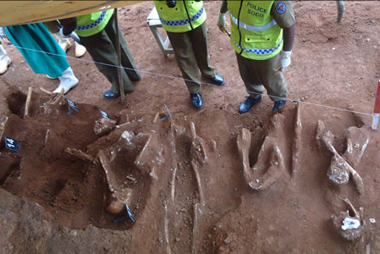
a major setback for the Rajapaksas is the discovery of theMatale
graves where 154 skeletal remains were buried when the second JVP
insurrection was crushed by the army. Gothabaya Rajapaksa was the commanding
officer at the time, posted to Matale as the district coordinating officer
tasked with bringing the JVP under control. Among his Company Commanders were
Lieutenants Shavendra Silva, Jagath Dias, and Sumedha Perera, who are now the
principal suspects in the war crimes against Tamils. Due to these graves
Sinhalese too are demanding investigations. The Rajapaksas’ previous claims
about having saved the “Sinhalese Race” ring hollow.
Any
possible connection between Gothabaya Rajapaksa and the Matale murders would
raise this question: How can those who murdered Sinhalese children so brutally
and in such large numbers, credibly claim to be saviours of the “Sinhalese
race”?
War
crimes inquiries are therefore absolutely anathema to the Rajapaksas even if
done for show. No Tamil government that can aid in evidence gathering would be
tolerated.
Spreading Terror in Preparation of Elections
Now
that the announced date for the northern elections is drawing near, the
government is in a dither. It really seems too late to call them off after the
welcoming statement from UNHRC.
So
their Kayts
tactics are in full play. The government is unleashing the same election
rigging tactics it deploys in Kayts at every election. The 2003
Annual Report of Reporters without Borders describes EPDP cadres led by one
Napolean murdering TNA members coming to Kayts for election campaigning. The
Vavuniya High court dutifully released the man without confiscating his
passport, despite the murder charge pending. Napolean was thus permitted to jump
the nominal bail set at his EPDP lawyer’s request.

Uthayan
Editor Gnanasundaram Kuhanathan in Intensive Care (July 2011).
The
same report also describes journalist Uvindu Kurukulasuriya’s experience when
the police attacked and insulted him when he took note of the licence number of
a police vehicle in which persons were being beaten by policemen. When he went
to the Maharagama police station to file a complaint, he was arrested for being
drunk on the public highway and obstructing the police. His experience bears
marked similarity to my own when I wrote of police vehicles without number
plates in Kayts and ended up with charges. Similarly the BBC
Reporter Nimalrajan was murdered by EPDP paramilitary men with full
impunity.
We
have just seen the beginnings of the same terror tactics being deployed against
the TNA with the full force of the army, police, and the EPDP paramilitary
cadre. Ceylon
Today reported with eye-witness testimony that when the TNA office in
Kilinochchi was attacked this month, law enforcement authorities arrived late
and that when the assailants who were caught were given into their custody, the
assailants were released. The BBC reported that the widely read Tamil language
newspaper Uthayan, which reports much of the government’s underhanded
dealings against Tamils, was torched and that
newspapermen continue to be attacked in various parts of the North.
The
army flooding the North is said to have 1 soldier for every 6 Tamils. Now
permanent bases are being constructed with facilities for their families. It is
expected that these soldiers with their families will be voting. That by itself
will tilt the electoral result.
Reports
from Jaffna this week state that 18,000 Sinhalese families are being resettled
as persons chased off by the LTTE during its massacres of Jaffna Sinhalese in
October 1987. It is absolutely doubtful that there were 18,000 families then and
even if there were, that they could be traced after 25 years, and that, even if
traced, they would want to return, disrupting their now settled lives. I believe
that these are simply militant Sinhalese being planted in anticipation of the
elections to vote and to terrorize.
Will
these tactics be enough to scare the Tamil people from going to vote, thereby
allowing the government to win the Provincial Council? Or will we Tamils have a
Tamil government after more than two decades, even if it be with few powers but
the legitimacy to speak up for our rights and needs as the voice of the
people?
