



The original document from the first Geneva Convention in 1864 provided for care to wounded soldiers.
The First Geneva Convention (1864)

The true civilization is where every man gives to every other man every right he claims for himself.

 - Robert G. Ingersoll
We hold these truths to be self-evident, that all men are created equal, that they are endowed by their Creator with certain unalienable Rights, that among these are Life, Liberty and the pursuit of Happiness.
—United States Declaration of Independence, 1776
The ideal of free human beings enjoying civil and political freedom and freedom from fear and want can only be achieved if conditions are created whereby everyone may enjoy his civil and political rights, as well as his social, economic and cultural rights.
—International Covenant on Civil and Political Rights and the International Covenant on Economic Social and Cultural Rights, 1966
All human rights are universal, indivisible and interdependent and related. The international community must treat human rights globally in a fair and equal manner, on the same footing, and with the same emphasis.
Whereas it is essential, if man is not to be compelled to have recourse, as a last resort, to rebellion against tyranny and oppression, that human rights should be protected by the rule of law.
—Preamble to the Universal Declaration of Human Rights, 1948
Human rights belong to every member of the human family regardless of sex, race, nationality, socio-economic group, political opinion, sexual orientation or any other status.
Human rights are universal. They apply to all people simply on the basis of being human.
Human rights are inalienable. They cannot be taken away simply because we do not like the person seeking to exercise their rights. They can only be limited in certain tightly defined circumstances, and some rights, such as the prohibition on torture and slavery, can never be limited.
Human rights are indivisible. You cannot pick and choose which rights you want to honour. Many rights depend on each other to be meaningful – so, for example, the right to fair trial would be meaningless without the prohibition on discrimination, and the right to free speech must go hand in hand with the right to assemble peacefully.
Human rights are owed by the State to the people – this means public bodies must respect your human rights and the Government must ensure there are laws in place so that other people respect your human rights too. For example, the right to life requires not only that the actions of those working on behalf of the State do not lead to your death, but that laws are also in place to protect you from the actions of others that might want to do you harm.
Human rights were first recognised internationally by the Universal Declaration on Human Rights in 1948. This was quickly followed by the adoption two years later of the European Convention on Human Rights. In 1998 the Human Rights Act was passed making the human rights in the European Convention on Human Rights directly enforceable in the UK. It entered into force on 2 October 2000.
The UK is also a party to a number of other international instruments that seek to protect and promote other human rights.
What are human rights?
Human rights are rights inherent to all human beings, whatever our nationality, place of residence, sex, national or ethnic origin, colour, religion, language, or any other status. We are all equally entitled to our human rights without discrimination. These rights are all interrelated, interdependent and indivisible.
Universal human rights are often expressed and guaranteed by law, in the forms of treaties, customary international law , general principles and other sources of international law. International human rights law lays down obligations of Governments to act in certain ways or to refrain from certain acts, in order to promote and protect human rights and fundamental freedoms of individuals or groups.
Universal and inalienable
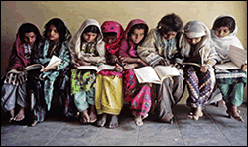 The principle of universality of human rights is the cornerstone of international human rights law. This principle, as first emphasized in the Universal Declaration on Human Rights in 1948, has been reiterated in numerous international human rights conventions, declarations, and resolutions. The 1993 Vienna World Conference on Human Rights, for example, noted that it is the duty of States to promote and protect all human rights and fundamental freedoms, regardless of their political, economic and cultural systems.
All States have ratified at least one, and 80% of States have ratified four or more, of the core human rights treaties, reflecting consent of States which creates legal obligations for them and giving concrete expression to universality. Some fundamental human rights norms enjoy universal protection by customary international law across all boundaries and civilizations.
Human rights are inalienable. They should not be taken away, except in specific situations and according to due process. For example, the right to liberty may be restricted if a person is found guilty of a crime by a court of law.
Interdependent and indivisible
All human rights are indivisible, whether they are civil and political rights, such as the right to life, equality before the law and freedom of expression; economic, social and cultural rights, such as the rights to work, social security and education , or collective rights, such as the rights to development and self-determination, are indivisible, interrelated and interdependent. The improvement of one right facilitates advancement of the others. Likewise, the deprivation of one right adversely affects the others.
Equal and non-discriminatory
 Non-discrimination is a cross-cutting principle in international human rights law. The principle is present in all the major human rights treaties and provides the central theme of some of international human rights conventions such as the International Convention on the Elimination of All Forms of Racial Discrimination and the Convention on the Elimination of All Forms of Discrimination against Women.
The principle applies to everyone in relation to all human rights and freedoms and it prohibits discrimination on the basis of a list of non-exhaustive categories such as sex, race, colour and so on. The principle of non-discrimination is complemented by the principle of equality, as stated in Article 1 of the Universal Declaration of Human Rights: “All human beings are born free and equal in dignity and rights.”
