

If resolution is not implemented, US may push for punitive action

Geneva drama shakes Indian government also; it tried to toughen the draft to please the DMK, but failed
Pakistan works hard to win the support of Islamic countries for government, but our own EAM still indulging in DPL harakiri
 By Our Political Editor-Sunday, March 24, 2013
Perhaps never before has a resolution at the UN Human Rights Council in Geneva brought a government to the brink of collapse or allowed a country facing accusations to relax whilst others did diplomacy for it.
That in essence is the action-packed saga of the second US-backed resolution approved by the Council on Thursday. Twenty-five countries voted in favour, thirteen against, eight abstained and there was one absentee from the 47 member Council. The table on this page shows how the countries fared during a General Assembly session of the HRC. It was watched live by Sri Lankans through a UN webcast also downlinked by a local TV channel.
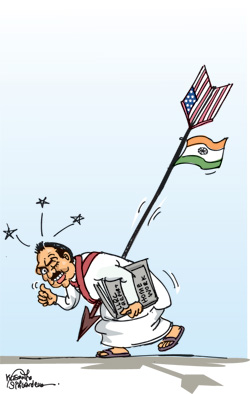
Some 48 hours ahead of Thursday, changes in the final US draft saw an ostensible moderation. A few foreign diplomats in Geneva described it as only a chocolate coating over the tough and bitter clauses. It was the result of behind-the-scenes diplomacy between a world power, the United States, and a regional power, India. Diplomats of the two countries were locked in close dialogue. For India, the need for re-phrasing and even exclusion of provisions that seemed “intrusive” was important in its own national interest. It did not want such provisions to become instruments to be used against it someday. The seemingly beneficial fallout was for Sri Lanka.
Seizing on that action which appeared to him as a “watered down” resolution was the Dravida Munnetra Kazhakam (DMK) of Muthuvel Karunanidhi. Angered by it, he decided that 26 DMK MPs in the United Progressive Alliance (UPA) government of Prime Minister Manmohan Singh, including cabinet ministers should withdraw. They quit on Tuesday. This was notwithstanding three cabinet ministers – A.K. Anthony (Defence), P. Chidambaram (Finance) and Ghulam Nabi Azad (Health) – rushing on a flight from New Delhi to Chennai to plead. The DMK leader who accused the Congress Government of “watering down” the resolution refused to change his mind. He wanted a reference made to investigating “genocide,” clearly a transparent political ploy. With that action, Karunanidhi appears to have not only outsmarted his Tamil Nadu political archival Jeyaram Jeyalalithaa. Above all, he has also placed the government of the world’s largest democracy, India, a lame duck administration.
In marked contrast, Pakistan’s Foreign Minister, Hina Rabbani Khar set in motion a diplomatic campaign for Sri Lanka. On her directions, Zamir Akram, Pakistan’s Ambassador to the UN in Geneva, arranged for meetings in the Swiss city of diplomats from the Organisation for Islamic Cooperation (OIC) and what are described as “like-minded” groups. During at least three different sessions, Akram lobbied for Sri Lanka. Consequently, OIC countries Kuwait, Mauritania, Qatar and United Arab Emirates (UAE) voted against the resolution.
In marked contrast, Pakistan’s Foreign Minister, Hina Rabbani Khar set in motion a diplomatic campaign for Sri Lanka. On her directions, Zamir Akram, Pakistan’s Ambassador to the UN in Geneva, arranged for meetings in the Swiss city of diplomats from the Organisation for Islamic Cooperation (OIC) and what are described as “like-minded” groups. During at least three different sessions, Akram lobbied for Sri Lanka. Consequently, OIC countries Kuwait, Mauritania, Qatar and United Arab Emirates (UAE) voted against the resolution.
This was besides Pakistan. Another member, Burkina Faso abstained. Libya and Sierra Leone were the only two OIC members to support the US move. If not for the seven Islamic countries, vote in favour of Sri Lanka would have been only six. Their support was despite lobbying by US diplomats about the issues Muslims were facing from the Bodhu Bala Sena (BBS) and a line in the resolution which expressed concern, among other matters, on “discrimination on the basis of religion or belief.”
That seemed the scene setter for two days of talks between Sri Lanka and Pakistan on April 4. Pakistan’s Foreign Secretary Jalil Abbas will be in Colombo for the event with External Affairs Ministry Secretary Karunatilleke Amunugama. A gamut of bilateral and regional issues is expected to figure in the talks, an EAM official said. Abbas will also call on External Affairs Minister G.L. Peiris and President Mahinda Rajapaksa.
As for Sri Lanka itself, Minister Mahinda Samarasinghe, President’s Special Envoy on Human Rights, was picked with less than three days to go for the Human Rights Council sessions. The earlier plan was to leave matters in the hands of Ravinatha Aryasinha, Sri Lanka’s Ambassador to the UN in Geneva. Rajapaksa, though in favour, later changed his mind and was not happy leaving it in Aryasinha’s hands alone. If Samarasinghe had little time to work on strategy, it was spelt out to him by President Rajapaksa only on Monday, March 11, just a week before the voting, as revealed in these columns last week. Contrary to wild speculation, Samarasinghe did not have a trump card up his sleeve from Rajapaksa to play in Geneva. Parachuted into the diplomatic battlefield, the ground for an assortment of more than fifty Sri Lankan delegates last year, he had to hold the reins with Ambassador Aryasinha. Yet, there are volumes of lessons to be learned from the aftermath in Geneva. This is at a time when all and sundry are being blamed for the outcome. Nothing is being said about the conduct of Sri Lanka’s foreign policy if indeed there is one.
In the light of confusion over how the different draft resolutions evolved, an explanation is necessary before one takes a look at other issues. From late January, the US began consulting its allies on a draft resolution and won Indian support for the move. One of the early drafts to circulate was dated February 16. The salient provisions in this draft appeared exclusively in the front-page lead story of the Sunday Times of February 17. As it continued to evolve during consultations by US with different countries, various drafts emerged. They were revealed in the Sunday Times (Political Commentary) of February 24, March 10 and March 17. At 2 p.m. on March 8, the US handed in to the UNHRC Secretariat in Geneva a draft resolution (A/HRC/22/L1) dated 12 March notwithstanding the discrepancy in the dates. Thereafter, a revised text (A/HRC/22/L.1/Rev.1) was handed over to the Secretariat at 6 p.m. on March 18. This text dated March 19, endorsed by 41 co-sponsors, both HRC members and non-members, was approved by the Council on Thursday. It reads: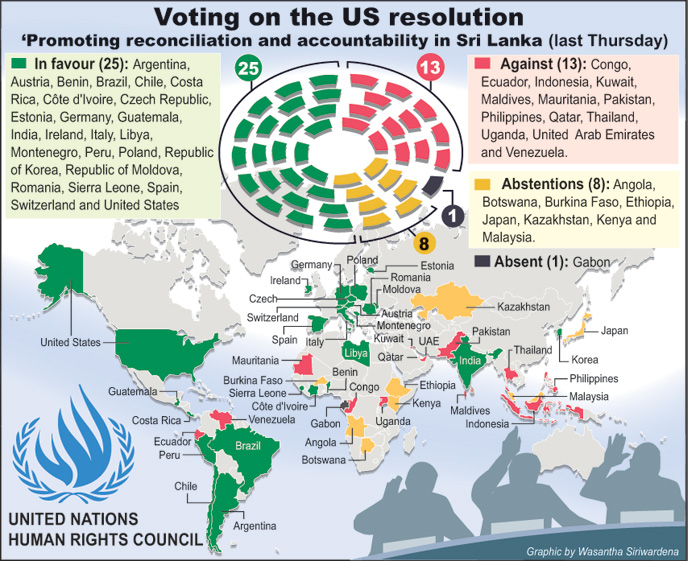
Promoting reconciliation and accountability in Sri Lanka Read More
