

Human
Rights Council Resolution on Sri Lanka Crimes
Ron Ridenour Salem-News.com-Mar-21-2013
Ron Ridenour Salem-News.com-Mar-21-2013
More
of the same nonsense causes huge protests.
 |
(GENEVA)
- United Nation’s Human Rights Council’s passed a resolution on March 21, the
third in four years, concerning Sri Lanka’s conduct towards Tamils. The vote was
25 for, 13 against with eight abstentions. Those opposed rejected any criticism
of Sri Lanka as “foreign meddling”. (1)
The
US-led resolution A/HRC/22/L.1 "Promoting Reconciliation and Accountability in
Sri Lanka" “noted” that the National Action Plan put forward by Sri Lanka to
implement the recommendations made in its own Lessons Learnt and Reconciliation
Commission (LLRC) “does not adequately address serious violations of
international humanitarian law.”
Sri
Lanka’s government is then called upon to conduct an "independent and credible"
investigation into allegations of human rights violations.
One
paragraph goes a bit further than the previous US-led resolution last year. It
expresses “concern at the continuing reports of violations of human rights in
Sri Lanka, including enforced disappearances, extra-judicial killings, torture
and violations of the rights of expression, association and peaceful assembly,
as well as intimidation of and reprisals against human rights defenders, members
of civil society and journalists, threats to judicial independence and the rule
of law, and discrimination on the basis of religion and belief.” (2)
 |
While
the US resolution also stated that Sri Lanka’s government (GoSL) has failed to
devolve political authority to Tamils, it expressed thanks for having
facilitated “the visit of a technical mission from the Office of the United
Nations High Commissioner for Human Rights.” It “notes” the High Commissioner’s
“call for an independent and credible international investigation into alleged
violations of international human rights law and international humanitarian
law,” without suggesting such itself. No remedies are demanded. The resolution
simply concludes by suggesting further reports “monitoring progress”.
No more white-wash
A
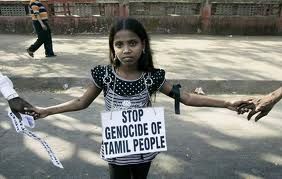
day before the vote, the greatest pro-Tamil protest in years took place with
upwards of one million people in India’s state Tamil Nadu. They denounced the
US-led resolution as “ineffectual” for calling upon the Sri Lanka government to
investigate itself. Protestors demanded that the GoSL be investigated by an
independent international body for its war crimes and genocide against the Tamil
people.
Varieties of
colorful actions, including civil disobedience, occurred in several Tamil Nadu
cities and schools. People denounced the “empty resolution further diluted by
New Delhi.” They called for a UN plebiscite for Tamils in the north of Sri
Lanka. (3)
For the first time
since the end of the civil war, significant numbers of Tamils have publicly
protested the US for meaningless “slaps on the wrist”. Thousands of Tamils in
many countries in the Diaspora demonstrated against the resolution, burning it
before the US embassy in several cities. Protestors now view the US as actually
“facilitating the agenda of the genocidal state”.
Critics assert that
the US and Europe are not seriously advancing the rights of Tamils nor actually
sanctioning GoSL for its brutal war crimes, and certainly not its 65 year-long
genocide against the minority Tamils. They point out that the US, its side-kick
Israel and NATO countries, always aided the Sri Lankan government.
The Western powers
provided Sri Lanka’s military with weaponry, money, counter-intelligence, and
training to win the long war against Tamil nationhood. Then, since their mutual
victory, the Western axis criticizes the Asian government for having committed
excesses. This “human rights” approach is the best of all possible worlds for
Western dictates: world domination for the cause of humanity is what they say if
you read between the lips of communicators for globalization. (4)
 |
China, Russia, Iran,
India and Pakistan also militarily and economically assisted Sri Lankan
governments in avoiding federalism for the two peoples—majority Sinhalese and
minority Tamils—yet they did so without the hyperbole of “protecting human
rights”. Unfortunately, Cuba and its seven associates in the Latin
American-nation Bolivarian Alliance of the peoples of the Americas (ALBA) got
caught up in the geo-political game and supported Sri Lanka.
The two ALBA
countries on the Council, Ecuador and Venezuela, voted for Sri Lanka’s stance,
while six other Latin American countries voted to criticize it. The Africa and
Asian governments were divided in three ways. There was no obvious “first
world,” “third world” juxtaposition. (1)
The conciliatory
role India’s Congress party-led government plays to placate Sri Lanka with
massive economic aid, and by diluting the original draft of the both 2012 and
2013 resolutions, led the Tamil Nadu DMK (Dravida Munnetra Kazhagan) party to
withdraw its participation in the coalition UPA (United Progressive Alliance)
government. By losing 18 seats in the government, including the minority party’s
five ministers, Congress President Sonia Gandhi felt compelled to state that,
“We are fully committed to the cause of Lankan Tamils and an impartial inquiry
should happen into the allegations of atrocities against them.”
Apparently, at the
last minute, the weakened UPA government leadership tried to amend the final
draft with stronger words, according to the newspaper “The Hindu”.
However, DMK Chief
Muthuvel Karunanidhi said, “There were no strong words of censure against Sri
Lanka in that resolution, which indicated that there was no scope at all to
incorporate amendments suggested by the DMK like including the word
‘genocide’.”
 |
Karunanidhi said, on
March 19, this justified the decision to pull out of the government, which
forces the Congress party to rely even more so on opposition parties, in order
to continue to rule.
The new resolution
has not ceded to demands of human rights bodies and almost all Tamil political
parties and grass roots organizations for an independent international
investigation, which UN High Commissioner for Human Rights Navaneetham Pillay
also asserts is necessary.
She has consistently
upheld the findings of the “Report of the Secretary-General’s Panel of Experts
on Accountability in Sri Lanka” delivered to Secretary-General Ban Ki-moon on
March 31, 2011.
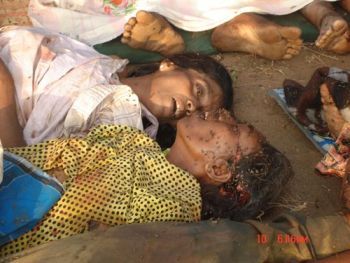
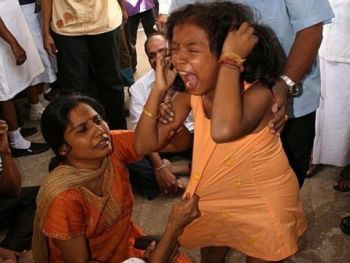
“The Panel found
credible allegations associated with the final stages of the war. Between
September 2008 and 19 May 2009, the Sri Lanka Army advanced its military
campaign into the Vanni using large-scale and widespread shelling causing large
numbers of civilian deaths. This campaign constituted persecution of the
population of the Vanni. Around 330,000 civilians were trapped into an ever
decreasing area, fleeing the shelling but kept hostage by the LTTE [Liberation
Tigers of Tamil Eelam]. The Government sought to intimidate and silence the
media and other critics of the war through a variety of threats and actions,
including the use of white vans to abduct and to make people disappear.
 |
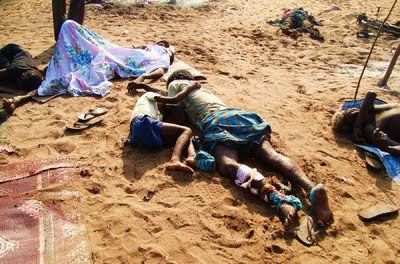
“The Government
shelled on a large scale in three consecutive No Fire Zones, where it had
encouraged the civilian population to concentrate, even after indicating that it
would cease the use of heavy weapons. It shelled the United Nations hub, food
distribution lines and near the International Committee of the Red Cross (ICRC)
ships that were coming to pick up the wounded and their relatives from the
beaches. It shelled in spite of its knowledge of the impact, provided by its own
intelligence systems and through notification by the United Nations, the ICRC
and others. Most civilian casualties in the final phases of the war were caused
by Government shelling.”
The new resolution
is virtually the same as the one put forth by the US last March when the HRC
made a shift from the pro-Sri Lanka resolution of May 2009. In March 2012, a
majority (24 for, 15 against and 8 abstentions) voted to criticize the Sri
Lankan government for “not adequately address[ing] serious allegations of
violations of international law” when conducting its final phases of war against
the liberation guerrilla army LTTE (Liberation Tigers for Tamil Eelam).
Nevertheless, the statement simply asked the government to investigate itself.
(5)
Despite the UN panel
of experts’ 214-page report and recommendations, and those of the High
Commissioner, no session of the Human Rights Council has discussed those
recommendations.
While US-NATO
conducts war crimes against several countries in the Middle East and Africa,
progressive governments in Latin America, along with Russia-China-Iran-Pakistan,
view the US role in Sri Lanka as hypocrisy. This motivates those governments to
back Sri Lanka as a “victim” of US-European meddling. In so doing, they are
silent about the crimes against the Tamil people.
Venezuela, a new
member on the HRC replacing Cuba, voted against the slap wrist resolution.
Parting from journalistic style, I would suggest that Venezuela, in the spirit
of its recently deceased leader, Hugo Chávez, would take the bull by the horns.
Take the moral, solidarity path and admit war crimes wherever they are committed
and oppose them. That goes for Sri Lanka, and it goes more so for the US-UK-NATO
axis. Publicly chastise Sri Lanka for its brutality, and then introduce a new
HRC resolution indicting the Western axis for the untold amount of human blood
and planet destruction it causes with its aggressive profit-grabbing wars.
 |
Future Actions
There is a shift in
the wind. Tamils are righteously upset with the US-UK axis. The multitude of
Tamil groups especially some international ones in the Diaspora, have relied
upon the axis to come to their aid. After four years of getting nowhere, great
numbers of Tamils are awakened.
Some pro-Tamils
groups are calling upon the Commonwealth Ministerial Action Group (CMAG) to
prevent Sri Lanka being rewarded as planned by hosting the Commonwealth’s grand
summit this November.
The moderate Sri
Lanka Campaign for Peace and Justice wrote: “If the Commonwealth continues as
usual then the Government of Sri Lanka will be able to use this to whitewash
their crimes, and derail the process of reconciliation. The cycle of violence
will continue.”
The group initiated
a petition to sign pressuring Commonwealth countries to follow “the Canadian
Prime Minister's example and announcing that if the summit happens then they
will not go.” (6)
The
group initiated a petition to sign pressuring Commonwealth countries to follow
“the Canadian Prime Minister's example and announcing that if the summit happens
then they will not go.” (6)
A more activist
movement is expected to grow now!
