

Nudge for Sri Lanka on independent judges

Updated

The Commonwealth Secretary-General opened talks with Sri Lanka on Sunday by pushing for judicial independence on the island, as Canada renewed calls to boycott the bloc's summit in Colombo later this year.
Secretary-General Kamalesh Sharma is holding talks with Sri Lankan leaders in Colombo on the rule of law and the separation of powers after the island defied international appeals and sacked its chief justice in January, the bloc said.
Mr Sharma's four-day visit to Sri Lanka came as Ottawa urged others in the 54-member grouping to stay away from the November Commonwealth Heads of Government Meeting (CHOGM) hosted by Colombo.
Canada had reported Sri Lanka to the Commonwealth over the alleged violation of the organisation's democratic values by ignoring two court rulings and sacking Chief Justice Shirani Bandaranayake last month.
She had given rulings which were thought unfavourable to President Mahinda Rajapakse's regime which is also accused of failing to probe war crimes allegations against Sri Lankan troops which defeated Tamil rebels in 2009.
"Sharma is expected to discuss, among other issues, options for advancing Commonwealth values and principles, including the independence of the judiciary and the separation of powers," the Commonwealth said in a statement.
The statement said the Secretary-General was also discussing arrangements for the November summit which is going ahead despite Canadian objections.
Canadian Prime Minister Stephen Harper has warned that he may refuse to attend the summit unless Sri Lanka addresses allegations of atrocities during the closing battles of the war against separatist Tamil rebels in 2009.
Mr Sharma in September asked the two countries to resolve their differences and ensure the smooth conduct of the summit.
Sri Lanka has denied allegations from international rights groups that government troops killed up to 40,000 civilians during the civil war.-AFP
DR Congo: War Crimes by M23, Congolese Army Response to Crisis in East Should Emphasize Justice
Jennifer Fierberg-Feb-10-2013
“The M23 said they were going to free us, but instead they came to kill us. What kind of liberation is that?”
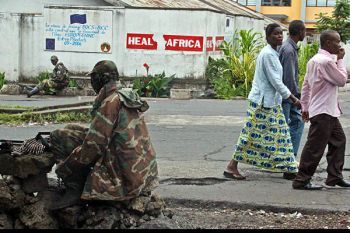
Courtesy: csmonitor.com
|
 (Washington, D.C.) - (Goma, February 5, 2013) – M23 rebels and Congolese army soldiers raped scores of women and committed other war crimes during the rebels’ occupation of Goma in eastern Democratic Republic of Congo, http://www.hrw.org/drc in late 2012, Human Rights Watch said today.
Ongoing talks among parties to the conflict, countries in the region, and the United Nations should ensure that any agreements include holding those responsible for war crimes to account and that rebel commanders with abusive records do not serve in the Congolese army, Human Rights Watch said.
“The killings and rape by M23 and government forces around Goma were fueled by an environment in which horrific abuses are rarely punished,” said Daniel Bekele (http://www.hrw.org/bios/daniel-bekele), Africa director at Human Rights Watch. “The UN and others involved in talks should send a strong message to rebel leaders and Congolese army commanders that they will not be rewarded for their atrocities.”
In the two months since the M23 occupied Goma in late November, Human Rights Watch interviewed more than 180 victims and witnesses of abuses, family members of victims, health workers, civil society leaders, and others who provided detailed information on alleged war crimes committed by M23 fighters and Congolese army soldiers.
The M23 rebel group, named after a March 23, 2009 peace agreement, took control of Goma on November 20. After entering the city, their leaders publicly declared that their movement was disciplined. Yet beyond the center of town, the M23 spread terror through deliberate attacks on civilians and threats against those who spoke out against them.
After the M23 occupied Goma, soldiers from several Congolese army units based nearby retreated to Minova, a town 50 kilometers away. Over the next 10 days, they went on a raping and looting rampage in Minova and neighboring communities.
The M23 officially withdrew from Goma on December 1, after the Congolese government agreed to negotiate with them. Talks began in Kampala, Uganda, http://www.hrw.org/africa/uganda, on December 9, but have made little progress.
African countries and the UN are holding parallel discussions about the conflict. These include a proposal to deploy an African-led “intervention brigade” to operate within the UN peacekeeping force in Congo, MONUSCO. The brigade’s mandate would be to robustly enforce peace, prevent the expansion of armed groups, neutralize the threat posed by these groups, and disarm them.
The intervention brigade should have a clear mandate to arrest people wanted on international warrants for war crimes and crimes against humanity, and assist Congolese authorities in the enforcement of national arrest warrants, to bring them to justice, Human Rights Watch said.
