

 Columns
By Our Political Editor
= Spotlight shifts to Geneva again, while cold war with judiciary aggravates
= Gotabaya goes to New Delhi as govt. partners move to repeal 13th Amendment
= Gotabaya goes to New Delhi as govt. partners move to repeal 13th Amendment
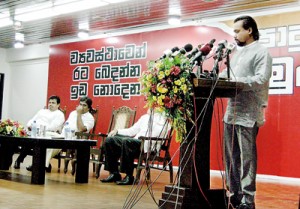
Minister Wimal Weerawansa calling for the abolition of the 13th Amendment at a public meeting last week.Pic by Athula Devappriya
World attention will be on Sri Lanka again on Thursday November 1. The United Nations Human Rights Council (UNHRC) in Geneva will review the country’s record during a three and half hour session beginning 2.30 p.m.
Like for all other 193 member countries of the UN, the event is routine. Every four or five years, the human rights record of members is reviewed under the Universal Periodic Review (UPR), a mechanism which the UN believes improves the situation on the ground. However, for Sri Lanka the event is significant for many other reasons.
Three months after this event, in March next year, the UNHRC is set to review matters related to the US-backed resolution on Sri Lanka. This was adopted in March this year at the 19th sessions. Issues there extended from alleged human rights violations to probing “extrajudicial killings”. How the government responded to them is due to come up for scrutiny in March next year. In the light of this, several western nations are watching the UPR sessions closely. Their interest has been heightened by what they believe are newer developments in Sri Lanka including ‘alleged state interference in the judiciary,’ ‘no forward movement’ in the government’s reconciliation efforts and media freedom issues among other matters.
It comes as the cold war between the Executive and the Judiciary showed clear signs of heating up. This was after Pradeepa Gamini Suraj Kariyawasam of 170 Lake Drive, Colombo 8, was indicted before the Colombo Magistrate’s Court for causing a loss of more than Rs. 391 million to the government and for alleged corruption. The former chairman of the National Savings Bank (NSB) is the husband of Chief Justice Shirani Bandaranayake. He had earlier served as chairman of the Insurance Corporation of Sri Lanka.
The UPR itself has also sent ripples in government circles. These are over questions on the possible role of India, which is heading a troika that will prepare the report of the Working Group once the discussion on Thursday is over. It may be recalled that India voted for the US-backed resolution in March this year.
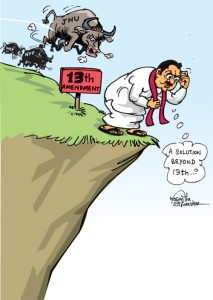
As revealed in the political commentary last week, relations between Colombo and New Delhi have hit a new low, largely due to that vote. The measures government leaders contemplated in the past weeks including the repeal of the 13th Amendment to the Constitution caused serious concerns in India. Under such circumstances, New Delhi’s role at UNHRC’s 22nd sessions in March next year is cause for study by the government. Though belatedly, some measures to rectify the situation have got under way as tensions continue to remain.
The current sessions of the UNHRC began on October 22 and will continue till November 5. Until last Thursday, the human rights records of eight countries have been reviewed. They were the Czech Republic, Argentina, Gabon, Ghana, Ukraine, Guatemala, Benin and the Republic of Korea.
Tomorrow (Monday) the case of Switzerland will come up followed by Pakistan and Zambia. Japan will follow on Wednesday. Besides Sri Lanka, the case of Peru will also be taken up on Thursday. Of significant interest during the current sessions is the fact that the largest number of speakers, 99 of them, want to address the Council on Sri Lanka’s case.
As a result, each speaker has been allotted only a minute and 22 seconds. This is the lowest among the time limits allotted. In the case of Peru where 55 speakers have registered so far with the Palais des Nationes, two minutes are allowed per speaker. Among the four countries on which NGOs, including those based in Colombo, are conducting meetings in Geneva on the sidelines of the UPR process, is Sri Lanka. Others are Guatemala, Japan and Pakistan.
A total of 42 UN member countries are reviewed each year during three Working Group sessions dedicated to 14 countries each. Already presented to the UNHRC is Sri Lanka’s national report which recalls the assurances given by the government during sessions in 2008, the action taken so far and the newer developments. India which heads a troika together with Spain and Benin will prepare the report of the Working Group.
