

The Z-score imbroglio: Towards a fair and simple solution
Image courtesy Tharunaya-Nishan de Mel-10 Sep, 2012

Groundviews
I will assume in this article the general acceptance of two principles of fairness with regard to university admission. Fairness principle 1: That, apart from any affirmative action criteria used, admission should be based on merit rankings. Fairness principle 2: That affirmative action criteria and the merit ranking scheme should not be arbitrary, but must follow fixed transparent principles or past precedence.
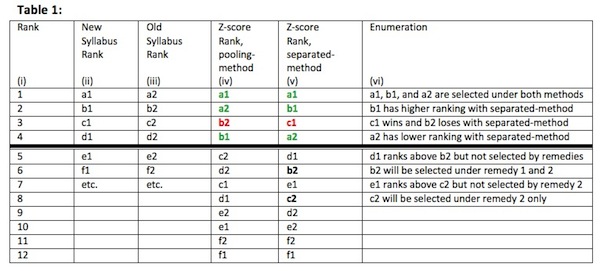 It is possible to show that the current solutions being debated to the Z-score imbroglio fails to meet these principles. An explanation and solution is given in the twenty numbered paragraphs below.
1. The G.C.E A’level exams: in 2011 were administered under two syllabi. One set of students sat papers set according to the new syllabus; another set (presumed to be repeaters) according to the old syllabus.
2. Admission to university: is based on a national merit ranking of all students who sit the exams, and a long standing affirmative action criterion which creates quotas for each district. The Z-score is a statistical method of expressing the performance rank of an individual within a group.
3. Precedence: In the past, when two syllabus’ were used, the Z-scores were calculated separately within the syllabus group (in statistics jargon – treating each group as a separate population) and the resulting Z-score was used to compare all the students and create a single national ranking.
